
James Supple looks at how the Cronulla riots were the result of the racism pushed by John Howard’s government and the media, and the lessons as we face a rising far right today
The Cronulla riots were the shocking result of years of racist poison pumped out by governments and the mainstream media.
On 11 December 2005 more than 5000 people descended on Cronulla beach after text messages began circulating urging them to, “Come to Cronulla this weekend to take revenge. This Sunday every Aussie in the Shire get down to North Cronulla to support the Leb and wog bashing day.”
This followed bubbling racist hostility in the overwhelmingly white suburb directed at Lebanese-Australians for daring to visit the beach. The week before there had been a fight between off-duty surf lifesavers and young Lebanese men.
Shock-jock Alan Jones stirred up a racist panic through the week on his radio program, reading out the message and saying it was a call for, “A rally, a street march, call it what you will. A community show of force.”
Murdoch’s tabloid The Daily Telegraph joined in, demanding a crackdown on anyone who assaulted a lifeguard.
The NSW Labor government at the time backed them. “Premier Morris Iemma proposed a ludicrous 25 year maximum jail sentence for assaults on lifesavers,” academic Scott Poynting recounted.
The crowd of thousands set out to hunt down and attack anyone who looked Arab or Middle Eastern.
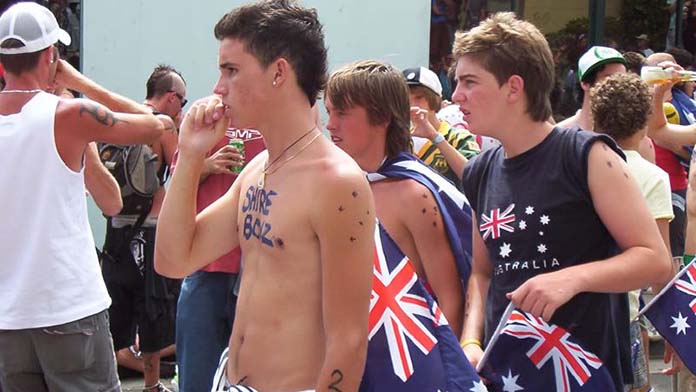
Groups of men draped in Australian flags ran around screaming “fuck off Lebs” sporting racist slogans written across chests and t-shirts including “Ethnic cleansing unit”, “We grew here, you flew here” and “Save Nulla, F*ck Allah”.
Nazi groups including the Australia First Party, its youth wing the Patriotic Youth League and Blood and Honour handed out leaflets and attempted to direct the crowd.
One man was chased into a local pub. A large crowd gathered, hurling bottles at him before he was dragged out and attacked.
A rumour spread that dozens of Lebanese men were on trains heading to Cronulla station. When the crowd got there all they found were two men sitting on a train waiting for it to depart.
After the first group ran onto the train and started attacking them, “Within seconds the carriage was full of people throwing punches and bottles at these two guys,” photographer Craig Greenhill explained.
Pushed from the top
The right-wing media storm may have provided the spark. But it was years of racism pushed by John Howard’s Liberal government that fuelled the fire.
Ever since his election in 1996, Howard had stirred up racism, first against Indigenous people, then against refugees and the Muslim community.
First he attacked Indigenous Native Title and the results of the High Court decisions in Mabo and Wik, refused to apologise to the Stolen Generations and cut funding to the Aboriginal and Torres Strait Islander Commission, which he later abolished.
In the lead up to the 2001 election he sent the SAS onto the Tampa to stop hundreds of asylum-seekers making it to Australia, vilifying refugees in an effort to demonise them.
After the 9/11 attacks in 2001, there was a wave of Islamophobia as political leaders blamed “Islamic terrorism”. Islam was presented as a “backward” and savage religion that encouraged violence.
The US responsibility for devastating the Middle East through decades of interventions to prop up pliant dictatorships was never mentioned.
Instead the racism against Muslims and Arabs became the justification for further wars, as the Howard government supported the US invasions of Afghanistan and Iraq.
Muslims in Australia were presented as an enemy within and a threat to the community.
Howard accused the Muslim community in Australia of failing to “integrate” and claimed that “extremism” among Muslims was “not a problem that we have ever faced with other immigrant communities”. The Liberals claimed refugees arriving by boat, mostly from the Middle East, could be terrorists.
In 2005 the London bombings led to a panic about “home grown terrorism”.
In November 2005 there were dramatic anti-terror raids in Sydney and Melbourne, with police declaring they had foiled an imminent terrorist attack. More than 400 police were sent to arrest 18 men, with video footage fed to the media to help dramatise the event.
The result was a surge in racist attacks against Muslims. In 2004 two-thirds of Muslims said they had experienced violence or abuse in public.
The rise in racism in the community was also dramatically demonstrated in opinion polls.
More than half of Victorian Year 10 and 11 students surveyed in late 2005 said they viewed Muslims as terrorists, over 50 per cent thought they “behave strangely” and 40 per cent agreed that Muslims “are unclean”. A 2006 Gallup poll found four out of ten Australians believed Islam is “a threat to our way of life”.
This was combined with a panic about “ethnic crime” and so called “Lebanese gangs” in Sydney that was promoted by the police, media and Bob Carr’s NSW Labor government from the late 1990s.
Between 2000 and 2002 the media and the state government racialised a number of sexual assaults by Lebanese males.
All those involved were second-generation migrants born and socialised in Australia. But the assaults were presented as a result of their cultural background.
Alan Jones was also implicated in promoting this racist campaign, saying they were “the first signs of an Islamic hatred towards the community that welcomed them”.
But when wealthy, white students from Trinity Grammar School in Sydney were implicated in another set of sexual assaults in 2000, they were treated very differently. The offenders received relatively light sentences and there was no attempt to link the crimes to their racial background or religion.
Response
There was a real danger after Cronulla of a new racist movement emerging that would allow fascist and far right groups to grow—just as there is today with thousands joining the racist anti-immigration March for Australia protests.
Howard’s response to the violence at Cronulla was to claim there was no “underlying racism” in Australia.
But it was clear there was widespread disgust and opposition to what had happened. A poll in the Sydney Morning Herald found 75 per cent of people rejected Howard’s claim.
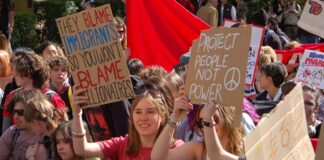
Many rightly blamed the government for the racism that caused the Cronulla riots. The following weekend more than 10,000 people rallied against racism in central Sydney, with several hundred Lebanese-Australians joining the protest.
This was the consequence of consistent anti-racist campaigning all through the Liberals’ time in power.
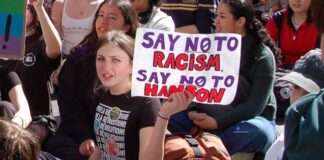
When Pauline Hanson’s One Nation emerged in 1998, anti-racist marches and protests outside her meetings helped to discredit her racist attacks on migrants and Indigenous people and made it impossible for her to build a mass membership party based on racism.
As the Liberals’ attacks on refugees escalated from 1999, the left began organising to counter the myths that refugees were “queue jumpers”, “illegal” and a threat to working class people.
The grassroots Refugee Action Collectives held regular protests and focused particularly on taking anti-racist arguments into the trade union movement and the working class.
The Labor Party Opposition shamefully backed Howard over the Tampa crisis in 2001.
But several important union leaders supported the refugee rights campaign, including former Unions NSW Secretary John Robertson, recognising the way Howard was trying to use racism to win support within the working class.
The refugee movement was able to significantly shift public opinion over time, with Newspoll showing that the number of people who thought some or all asylum boats should be able to land went from 47 per cent to 61 per cent between 2001 and 2004.
After 9/11, a mass movement against the wars in Afghanistan and Iraq helped undermine the Islamophobia used to justify the wars. At the height of the movement in 2003 more than 750,000 people joined a weekend of protests against the Iraq war nationwide.
In the years following, the anti-war movement worked with the Muslim community to oppose new anti-terror laws and the Liberals’ campaign of racism and fear.
Socialists argued that Howard was trying to use Islamophobia and terrorism scares to distract attention from his attacks on trade unions and workers, such as the WorkChoices laws passed in 2005.
Today racism in the mainstream from the Labor and Liberal parties and the media is again producing a climate where far right groups can grow.
In late 2024 the Albanese government cut international student numbers is response to a racist campaign blaming them for the housing crisis. Albanese has responded to the racist marches against immigration by repeatedly declaring that “we are getting the numbers down” by cutting immigration.
Liberal leader Sussan Ley is also moving to campaign more aggressively against immigration levels.
This follows Liberal MP Andrew Hastie’s labelling of immigration as “unsustainable” and “the real reason you can’t afford a home” along with dog-whistling to nostalgia for a White Australia by saying, “We’re starting to feel like strangers in our own home.”
All this has legitimised the lies that immigration is to blame for housing prices and the cost of living.
As a result 63 per cent of people say they want fewer immigrants allowed in, according to a Newspoll in November.
We need to rally against the anti-immigration marches to make sure there is a clear voice against their racism. Nazis should never be allowed to take to the streets unchallenged.
But we also need to campaign against the racism that feeds them. The left’s response to the racism of the Howard government helped ensure there was no repeat of the Cronulla riots.
Grassroots campaigning against racism can help stop the far right and their racist marches again today.