

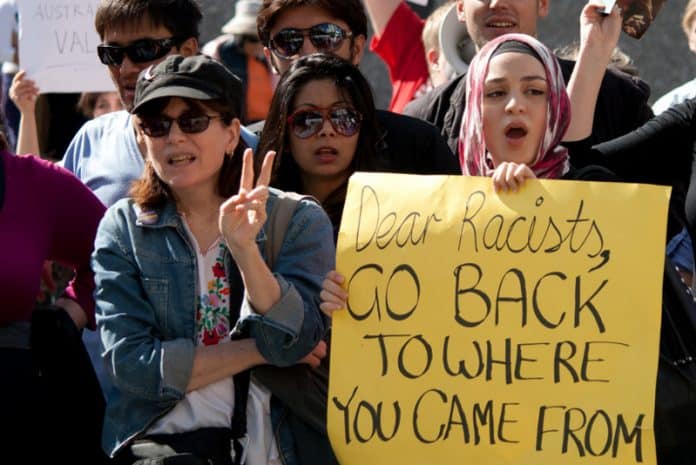
David Glanz looks at the origins of racism and how it continues to be pushed from the top of society in the interests of our rulers
Australia is riddled with racism. It does real damage to its victims and divides working class people.
So where does racism come from and why, more than 50 years since the formal abolition of the White Australia policy, does it continue to fester?
Racism is widespread. The Australian Reconciliation Barometer reports that racism experienced by Aboriginal and Torres Strait Islander people increased over 10 years from 39 per cent to 54 per cent in 2024.
New research by Victoria University finds that 76 per cent of people in ethnic and religious minority groups have experienced racism.
Racism causes deep harm. A Victorian government report states, “Racism has serious effects on people’s mental health and wellbeing … The suicide rate among First Peoples nationally is twice the rate of the non-First Peoples population …
“For young people, racial discrimination is linked to higher rates of anxiety, depression and psychological distress.”
Racism is not just a matter of individual hateful acts. Systemic racism means all Indigenous people, migrants and refugees are at risk.
This can be seen in the disgracefully high level of Indigenous incarceration—36 per cent of all prisoners, though Indigenous people are only 3 per cent of the population. Or the refusal to grant permanent protection to thousands of refugees.
Competition
To fight racism we need to understand its origins.
There’s a widely held belief that racism is the outcome of ignorance and a lack of education, leading to the finger being pointed at blue-collar workers and their families.
Some explain the rising racism behind the spate of March for Australia and similar racist rallies as a product of working-class anger over the housing and cost-of-living crises.
There is an element of truth about this. Workers, including union members, have joined the MFA rallies.
Capitalism brings workers together in factories, universities, hospitals and warehouses and lays the basis for unions and collective resistance. But it also creates competition between workers, for jobs and access to housing and services.
The ruling class play on those divisions—blaming migrants for the job losses or housing crisis that the capitalists themselves have created. They pit workers against each other through outsourcing jobs or encouraging tensions based on skills or wages.
But that doesn’t explain where the racist ideas that workers are encouraged to adopt come from.
Imperialism
Racism was imported into this continent with British invasion in 1788. By this time, Britain was the leading slave-trading nation. Profits from slavery made up about a third of new investment made by British capitalists in the years around 1770.
Racist ideas of white superiority were generated by the wealthy to excuse getting rich from such barbarism. Those ideas arrived with the First Fleet and were applied to Indigenous people to justify land theft and genocide.
The new ruling class saw Aboriginal people and society as inferior and stealing an entire continent and imposing capitalism as historically progressive. Australia’s rulers believed they had a right to dominate the region because they represented a superior European civilisation.
Today, Australia’s position as an outpost of western imperialism in Asia continues to contribute to intense racism. In recent years we’ve seen Islamophobia to justify US-led wars in the Middle East and anti-Palestinian racism to obscure the reality of the genocide.
The emerging Australian ruling class also found racism useful to divide the new working class between Europeans and the large numbers of people from southern China attracted by gold mining. By encouraging racism among workers, Australia’s rulers hoped to defuse class struggle and bind white workers to the system.
That early ruling class agenda of driving racism into society to divide the working class has continued—from the White Australia policy, to giving a platform to the racism of One Nation, refusing to act over Indigenous deaths in custody, and the tough-on-borders policy shared by Labor and the Coalition.
The “debate” on cutting immigration is not driven by the Nazi NSN or the MFA. It is fuelled by Labor and the Coalition, competing on who can be more vicious.
The politicians and billionaires fomenting these ideas are for the most part highly educated. But racism suits their class interests.
Fighting racism
We desperately need a working class fightback over the cost-of-living crisis. But that alone won’t automatically destroy racist ideas.
France has seen titanic workers’ struggles over pensions and against austerity. Yet opinion polls show the presidential candidate for the fascist National Rally still on about one third of the vote.
So racism needs to be challenged in its own right. We cannot rely on governments to lead the way.
The Victorian government, for example, has an official anti-racism strategy. Its “key areas for action” include supporting community-driven anti-racism initiatives and reducing racism and discrimination in policing.
That strategy meant nothing when, in April, police announced a “strong show of force” in the Melbourne suburb of Footscray. Less than a week later, cops there shot and killed Abdifatah Ahmed, a homeless Somali Australian man.
Police clashed with some of those who joined a community rally to mourn his death.
The Victorian government recently agreed a Treaty with Aboriginal representatives. But within days, it announced it would change the law so children as young as 14 can be brought to court as adults and face possible life sentences—a measure that will disproportionately affect Indigenous kids.
Instead we need to build a movement against racism from below that can take the message of unity into workplaces, campuses and communities. The rally against racism in September called by Melbourne’s Refugee Action Collective shows the potential—endorsed by 60 organisations including ten unions and bringing together activists from ethnic communities, Greens and Labor.
The ruling class fosters racism. Our slogan must be, don’t let the bosses divide us.