

Venezuela is under fire from US imperialism and Trump’s attempts to reassert US hegemony over Latin America.
The US has undertaken the biggest military build-up in the region since its invasion of Panama in 1989.
More than a dozen warships, 15,000 troops, a nuclear-powered submarine, F-35 jets and B-52 bombers—capable of carrying nuclear weapons—have been circling Venezuela. This includes the world’s largest aircraft carrier that can house over 5000 military personnel.
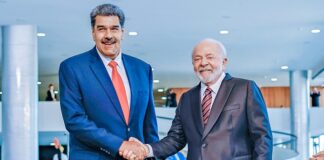
A $70 million bounty has been placed on President Nicolas Maduro’s head and Trump publicly announced he had authorised covert CIA operations in Venezuela, something not typically broadcast by US presidents.
On Trump’s orders the US has blown up at least 21 alleged drug boats since September in the Caribbean and Pacific. Over 80 people have been killed.
The airstrikes are extra-judicial killings designed to destabilise Venezuela’s government and provide a pretext for further US intervention. Just as the US lied about Saddam Hussein harbouring “weapons of mass destruction” to justify its invasion of Iraq, it is lying about Maduro being responsible for cocaine and fentanyl being smuggled into the US.
The US Drug Enforcement agency’s annual report on cocaine in 2024 named Colombia as the main source of cocaine smuggled into the US. It did not mention Venezuela at all. Nearly all the fentanyl smuggled into the US comes from Mexico. Venezuela plays little to no role.
Trump has never released any evidence that the people killed were smuggling drugs bound for the US. The families of those killed have provided evidence that their loved ones were fishermen, not drug smugglers.
In late November the US began a new phase of “Venezuela-related operations”, beginning with an increase in covert operations, a series of US officials told Reuters.
Trump wants to bring down Maduro’s government although he has denied he is considering airstrikes on Venezuela.
Trump wants a government in Venezuela that’s more pliable to accepting US policy and is less friendly to the US’s main rival, China.
Method to the madness
Trump is intervening in Venezuela to try to strengthen US influence in the region so it is better positioned to take on China. The US has always seen Latin America as its own backyard.
But as the Latin America editor of the Financial Times writes, “Almost every US president since Clinton has neglected Latin America, with serious economic and military consequences.”
China is now South America’s largest trading partner, amassing nearly $800 billion of trade in 2024.
China has invested billions into lithium extraction in Latin America, a critical component of batteries for electric vehicles and military uses. It holds multiple trade agreements targeting strategic sectors, such as electricity distribution agreements with Chile.
Venezuela sells around 90 per cent of its oil to China and has the largest proven oil reserves in the world. Venezuela has over $90 billion in loans to China and is the largest buyer of Chinese armaments.
The US wants China out of “its backyard” and sees Venezuela as a key link in the chain to reassert its control over Latin America.
Trump promised Ecuador billions of dollars if the plebiscite vote on whether the US could re-open a military base in the country came back with a yes. The people of Ecuador voted no, in a blow to Trump’s ambitions.
Trump helped erratic right-wing president Javier Milei win a surprise victory in Argentina’s midterm elections by promising billions of US dollars to Argentina if Milei triumphed.
And Trump has targeted Brazil’s left-wing government with tariffs after Brazil’s former authoritarian leader Jair Bolsonaro was convicted for plotting a coup to overthrow the government.
But Trump’s attempts to reshape the region in the interests of the US are far from guaranteed.
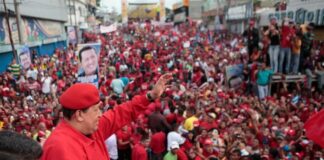
Under President Hugo Chavez, Venezuela became a beacon for the international left in the 2000s. Chavez defied US imperialism and fought off a coup attempt thanks to the active support of the poor in the capital Caracas.
But even before his death in 2013 a corrupt bureaucratic regime was taking shape around his successor and current president, Maduro.
Solidarity signed an international declaration on Venezuela initiated by the Workers Party in Argentina. It says, “We oppose imperialist intervention and militaristic aggression aimed at regime change, but we do not give political support to Maduro and his corrupt, repressive circles against the working people.”
Workers and the poor in Venezuela and Latin America need to fight against both US imperialism and their own corrupt rulers. Here in Australia we must break the support Albanese gives Trump as he rains terror on workers and the poor from Venezuela to Gaza.
By Luke Ottavi