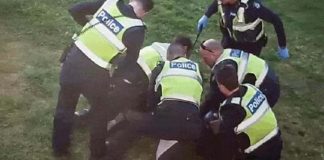

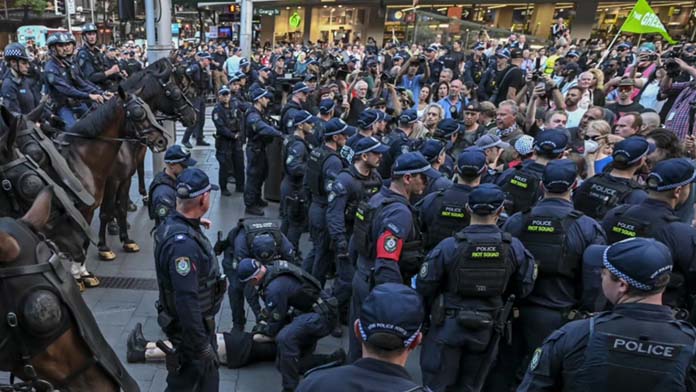
The scale of the police violence in Sydney at the protest against Isaac Herzog’s visit has rightly drawn outrage.
But this is far from the first time protests have faced violence from police. The two port blockades against ZIM shipping in Sydney in 2023 and 2024 saw 42 protesters arrested, with people punched, kicked and tackled by police.
In December a court awarded $54,000 in damages against Victoria police for grossly excessive use of force against demonstrators outside the International Mining And Resources Conference in 2019. Last year police in Melbourne used capsicum spray, flash bang grenades and pepperball projectiles against anti-racist demonstrators.
Violence against protests is not the result of rogue officers. It is part of the basic role of the police. Their central function is to defend a deeply unjust social order, protecting property and wealth in a capitalist system based on extreme inequality.
The police are part of the armed core of the state, alongside repressive institutions like the courts, prisons and the police, that exist to defend the interests of billionaires and the ruling class. They exist not just to deal with crime but to suppress threats to the social order.
The state first emerged with the development of classes only a few thousand years ago. The exploiters needed some organisation to apparently “stand above” and hold together a society based on divisions between rich and poor, while in reality helping the ruling class to maintain its power through force.
When capitalism emerged, the economically dominant class, the one that owns and controls the factories, banks and major corporations, became the politically dominant class. It took over and reshaped the state in its own interests.
Karl Marx therefore described the state as “a committee for managing the common affairs of the whole bourgeoisie”, the capitalist class.
The state creates “order”, an order that enshrines the right of the rich and powerful to exploit the vast majority of society, of the government to launch imperialist wars against the wishes of the majority, and of the courts to imprison people who steal to feed themselves or refuse to be evicted from their homes.
In extreme situations the state has been prepared to physically eliminate elected governments when the interests of capitalism are threatened—such as when the military overthrew Salvador Allende’s government in Chile in 1973.
The state is much more permanent than any government. Parliamentary majorities change. But the state machine goes on regardless of the views of voters.
Police and protests
Modern policing was born in Britain during the industrial revolution to force compliance amongst the newly formed working class.
From 1838 they were used against the Chartists, the first mass working class movement. They attacked workers’ demonstrations and broke up picket lines—and still do so today.
Police have been used countless times since then to attack protests. During the Vietnam War police in Chicago famously beat up protesters outside the Democratic National Convention in 1968. The same year police in Melbourne used batons and horse charges against anti-war protesters outside the US embassy.
In 1978 the first Mardi Gras was driven from the streets by police, with protesters severely beaten and 53 people arrested.
The way to answer this is to mobilise people in large numbers—since the bigger the crowd the higher the political cost is to police for unleashing repression.
In Australia, the police were first created to discipline convicts and other lower classes. They also helped carry out the massacres of Aboriginal people, driving them off the land to make way for pastoral capitalism. Police have been central to upholding Aboriginal oppression ever since, enforcing racist Protection laws, confining people on reserves and forcibly removing children.
Even today they still spend much of their time harassing and locking up Indigenous people. Aboriginal people make up 37 per cent of the prison population nationally despite being only 3.8 per cent of the total population. There have been 623 Aboriginal deaths in custody since the Royal Commission into the issue in 1991.
Police focus on patrolling and monitoring Indigenous people because they often live in situations of economic marginalisation and oppression. As a result, deeply racist attitudes are ingrained within the police.
The police spend most of their time dealing with the homeless, people suffering mental illness or living in poverty.
Their role enforcing social order means they are not simply “workers in uniform”. Instead they come to dehumanise the people marginalised under capitalism and develop a brutal authoritarian and reactionary mindset.
Police should be held accountable. But the police cannot be reformed. They are a product of class society and defend the interests of capitalism. The police should be abolished–but achieving this requires a socialist revolution that gets rid of the capitalist system altogether.
By James Supple