
Mike Grewcock reviews a new book that looks at how workers played a key role in bringing down regimes in Iran, Poland and South Africa, but then lost out to other forces
As I read this book in January, mass protests were erupting across Iran. Censorship by the regime and the delusional focus by much of the Western media on the possible return of the Shah’s son, Reza Pahlavi, made it difficult to assess exactly what was happening.
But it was clear the protests included widespread strikes and that the regime was losing popular support.
However, the Israeli-US invasion physically threatens a genuinely democratic popular uprising and gives the regime an excuse for further repression in the name of national unity. This raises urgent strategic questions about how to push the mass movement forward, while opposing the bloody carnage wrought by US imperialism.
The starting point is to look back to the revolution of 1979.
That revolution provides one of the four case studies in this important book. In each case—Iran in 1979, Poland in 1980-81, South Africa and Brazil in the late 1980s—“independent workers’ movements played a decisive role in removing tyrannies” only to lose the political initiative and the possibilities of workers carrying “forward the political struggle in their own interests”.
All of them were mass upheavals that demonstrated the power of working class action to paralyse key sections of society through mass strikes, as well as the potential to overthrow capitalism itself. But in each case, potential revolutions were thwarted.
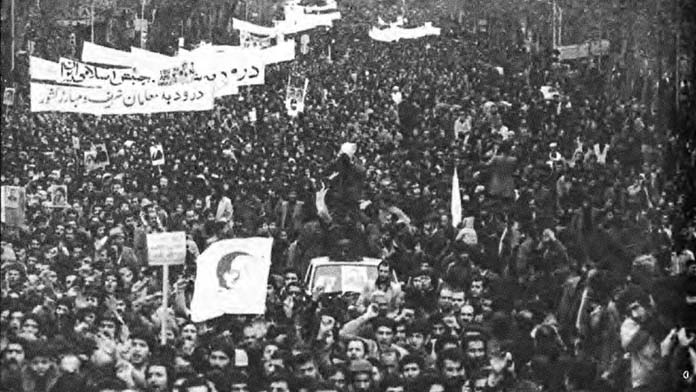
In Iran, that potential rested in the massive strike wave, especially in the oil industry, that helped bring the Shah’s brutal pro-Western regime to its knees between 1977 and 1979.
“By late October 1978, oil workers strikes were closing down oil production [and] raising openly political demands: end martial law, release political prisoners, Iranianise the oil industry, dissolve SAVAK [the secret police], end discrimination against women employees.”
Most of these demands were met but more importantly, the strike movement gave rise to independent democratically elected workers’ councils, the shoras. Rose recounts how:
“The councils by their nature were democratic, grass roots organs. Their executive committees were directly elected and were subject to recall, at any time, by the members … Almost all workers in a unit would attend meetings in which heated debates would take place on issues concerning the running of the workplace
“The day-to-day activities of the shoras … had a dramatic effect on the way the workers conceptualised society, authority and their social position in the society at large … the workers were involved in a learning process.”
Rose highlights the potential of the shoras to provide a political challenge to Khomeini and the Islamists, who had widespread support especially among small business owners and the majority of workers still in small enterprises.
Tragically, this potential was never realised.
From the mid-1960s, the persecution of Khomeini and the Islamists by the Shah enabled them to promote Islam as an ideology of the oppressed:
“Islam belongs to the oppressed … not to the oppressors
Islam represents the slum dwellers … not the palace dwellers
Islam is not the opiate of the masses
The oppressed … of the world, unite
Neither East nor West, but Islam
We are for Islam, not for capitalism and feudalism
Islam will eliminate class differences
In Islam there will be no landless peasant.”
By the time Khomeini returned to Iran from 15 years of exile in February 1979, his popularity was so great, he was able to call on the support of the army. A ruthless, Western-installed monarchy disintegrated in days, opening up a struggle for political power and enormous opportunities and challenges for the Left.
But the radical appeal of Islam meant the Left—mainly the Fedayeen and the pro-Moscow Tudeh Party—needed to build an independent revolutionary socialist movement within the working class that could challenge the developing theocratic state.
Crucially, this meant working to extend the influence of the shoras, which were exclusively workplace based, unable to relate to the majority of workers and urban poor often organised in mosque-based neighbourhood committees and heavily influenced by Islamist politics.
It also meant trying to ally the shoras movement with vital political struggles to defend women’s rights and the rights of national minorities, such as the Kurds.
Rose discusses in detail how the Left, to its own cost, failed or was unable to do this in a consistent and principled way. The Fedayeen’s focus on urban guerilla campaigns at the expense of building a base in the working class meant its cadre were in a much weaker position than the Islamists as the revolution unfolded.
This was exacerbated when a majority of the Fedayeen split to ally with the “anti-imperialist wing” of the regime. Similarly, the Tudeh Party, following the Soviet Union’s desire to normalise relations with the new government, sought alliances with the Islamists, even collaborating in the repression of the opposition.
Khomeini consolidated his rule through reforms that brought significant material benefits to working class families and the Islamisation of state and public institutions.
He mounted a systemic ideological campaign against secular politics, won overwhelming support to replace rule by monarchy with an Islamic constitution, positioned himself as anti-imperialist through confiscation of US assets and supported the occupation of the US embassy in Tehran from November 1979 to January 1981.
He achieved this while winding down the shoras and engaging in bloody repression of the Left and other political opponents, which accelerated during the 1980-1988 war with Iraq. This hardened the core of Khomeini’s supporters and severed any lingering ties between the religious populists and secular radicals.
The regime that has developed since continues both to present itself as anti-imperialist and crush internal dissent. It is also thoroughly capitalist and unable to provide solutions to a deepening economic crisis, exacerbated by sanctions and now, military invasion.
The recent protests were a response to this crisis and seriously challenged the government. However, the Iranian Left is fragmented and there were few signs of shoras re-emerging or that their potential provides a strategic focus.
Soviets
This reflects a fundamental problem Rose raises at the beginning of his book: the general dismissal of the significance and potential of the 1917 Russian revolution.
That revolution rested on the power of the soviets, the network of democratically elected workers’ committees and councils. Like the shoras, they were based on workplaces and the power of the organised working class. But, unlike the shoras, they were also able to lead the mass of the peasantry and rank-and-file soldiers through a successful alliance.
As a result, the soviets played an important role in the wider community through, for example, “the creation of cultural enlightenment commissions”.
“The Putilov works committee encouraged evening classes with an appeal to gain scientific knowledge … At the Baltic works, the education commission sponsored theatre, arranged for women workers to be given some teaching by women students, gave financial help to the apprentices’ club and for a school to soldiers and sailors. At the Sestroretsk works the commission gave the house and garden of the former director to local children as a kindergarten.”
Rose’s detailed descriptions of the soviets give a real sense of what workers’ power might look like and how a socialist society could be built.
But he emphasises that the fight for political power also required a revolutionary party, the Bolsheviks, which over many years before 1917 brought together a cadre of the most militant and politically committed worker activists able to carry forward the arguments for socialist politics and ultimately the case for revolution, in their workplaces and wider community.
The isolation and defeat of the Russian revolution led to a “brutal caricature of real communism”, a system of bureaucratic state capitalism, in which the working class had no active role, emerging as the everyday understanding of Marxism.
This badly distorted the politics of Communist parties and much of the Left. Instead of communism resting on workers’ power, organised from below, it was associated with an authoritarian state-run economy, put in place primarily by military struggle or invasion.
The collapse of the Soviet Union further challenged the viability of any regime describing itself as communist and “easily flowed over into a demoralising sense that the original socialist revolution in … 1917 was itself flawed”.
In his case studies, Rose examines how this absence of vision and influential revolutionary organisations like the Bolsheviks were an enormous obstacle to challenging capitalism when workers’ councils or other forms of organisation emerged at the heart of opposition movements.
And failure to recognise or develop the potential power of workers’ organisations not only halted the prospects of genuinely radical change but opened the way to repression and the consolidation of neoliberalism.
This is a complex book that draws on interviews with dozens of activists from the struggles Rose describes. It applies Marx’s concepts of revolution to the late 20th century and combines hard-headed political analysis with a sense of the courage, ingenuity, excitement and optimism of radical political movements.
“Demands for workers’ control of production surfaced in all four cases … Workers’ leaders, potential worker-intellectuals, with deep roots in the mass movements, emerged, perfectly capable of becoming political leaders. One of 1968’s greatest slogans, ‘self-management’, resounded across four continents. Alas, they were ideologically and organisationally disarmed and blocked at critical moments when circumstances created openings that might have thrust them forward.”
The common thread across the four very different case studies is that the working class has the power to challenge capitalism, and the proliferating social and political crises we face, but revolutionary socialist politics and organisation are required to bring this to fruition.