

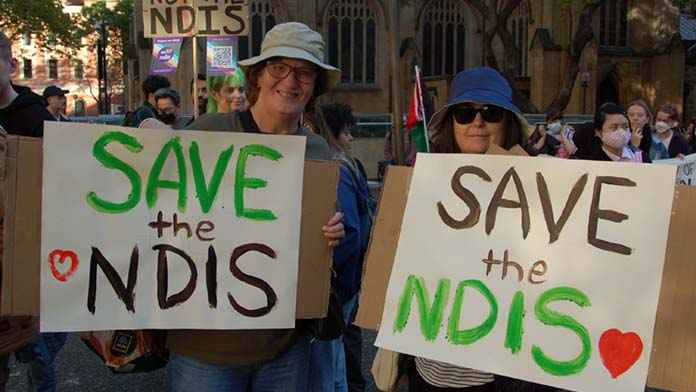
The NDIS was introduced in 2013 with bipartisan political support.
Behind the talk about human rights, choice and control was the prediction by the Productivity Commission that without change, the old system would have ended up costing more. This turned out to be wrong, but it secured the backing of big business, which believed that introducing market competition would constrain costs and drive innovation in a new disability system.
The Productivity Commission seriously underestimated the scale of unmet need and the NDIS has grown to support many people who have never received support before.
This improved access and funding is something our rulers cannot tolerate. They would prefer that disabled people are shut in their homes and rely on unpaid carers than spend the money necessary to support them.
Instead of containing costs, unleashing private providers into disability care has led to about $3.7 billion a year of waste through fraud and “inadvertent non-compliance”, according to the NDIA.
Even if outright fraud is reduced, the market model is inherently wasteful. Overcharging and over-servicing are rife in the fee-for-service NDIS market.
Plan managers, whose sole purpose is to pay providers from NDIS participants’ budgets, cost the government over $600 million a year.
Most people on the NDIS have cognitive impairments or difficulties with executive function, and their carers often can’t cope. This makes them vulnerable to predatory providers.
The peak body for providers, National Disability Services (NDS), has urged its members to embrace the government’s NDIS reforms. No doubt NDS is supporting cuts in exchange for more funding certainty and reduced competition from unregistered providers, especially in supported independent living (SIL), where services will be commissioned by government instead of a “free-for-all market” as Butler put it.
Disaster for workers
As the big providers line up behind the Albanese government, they are also turning the screws on their workers.
The NDIS has been a disaster for workers’ rights. Disability workers often work without pay when the individual budgets of the people they care for run out, rather than leaving them without support.
The NDIS Review noted that, “Three out of four NDIS workers are employed either part-time or casually.” Staff turnover was 24 per cent in 2024, according to the Health and Community Services Union (HACSU). This means that NDIS participants struggle to find and keep good support.
Workers and the disabled people they support share a common interest in fighting for better services. Disability activists need to build stronger alliances with trade unions, which have the collective power to stop these cuts.
Shamefully, the Health Services Union has come out in support of the government’s reforms. But union members are passing motions in their workplaces and demanding that union leaders campaign against the cuts. The changes mean pay and conditions of workers in the disability sector will come under even more pressure.
The NDIS market has failed to deliver consistent, quality care and support.
We need to demand that the government takes over and runs services instead of just letting them collapse.
The closure of the 11 AEIOU daycare centres for children with Autism in March was a disgraceful abandonment of children, parents and workers. The market is undermining choice and control by driving services out of business.
In Victoria HACSU is campaigning against the closure of hundreds of group homes and pay cuts for workers. On 31 December a state government subsidy that covered the gap between NDIA funding and the cost of these higher quality services ended. Over 90 homes have already closed, throwing the lives of workers, residents and their families into turmoil.
Aruma, one of the providers that took over these privatised group homes, has applied to the Fair Work Commission to terminate its enterprise agreement with its workers, threatening massive pay cuts.
Many disability advocates see these group homes as outmoded. But disability housing in the rest of the NDIS market is woefully inadequate.
HACSU workers in the former state government-run homes have won decent pay and quality support for the people they care for, including house supervisors and mandatory training for workers—something that is shamefully lacking in the rest of the disability sector. They need our solidarity.
Demanding government ownership and provision of services doesn’t have to threaten choice and control. Well funded public services can provide a diversity of choices, and also deliver quality services and quality jobs. But it will take a mass movement to win it. Unions have the power to hurt the system that hurts disabled people. Workers, alongside disabled people and their carers, can force the government to put serious resources into the services we need.
By an ASU member