

The death toll from catastrophic flash floods and landslides in Nepal and Tibet reached 950 as Solidarity went to press, with more than 4000 people still missing.
The disaster was triggered by the collapse of glacial ice and rock in the Himalayas.
One quarter of the world’s population relies on water that comes from Himalayan glaciers, which could shrink by 80 per cent by the end of the century if carbon emissions continue.
Australia is the second largest fossil fuel exporter in the world, the source of almost 5 per cent of global emissions.
But the Albanese government continues to approve major gas and coal export projects and only has emissions reduction targets for domestic industry.
Even these pathetic targets are failing badly and set to be blown out of the water by the AI boom.
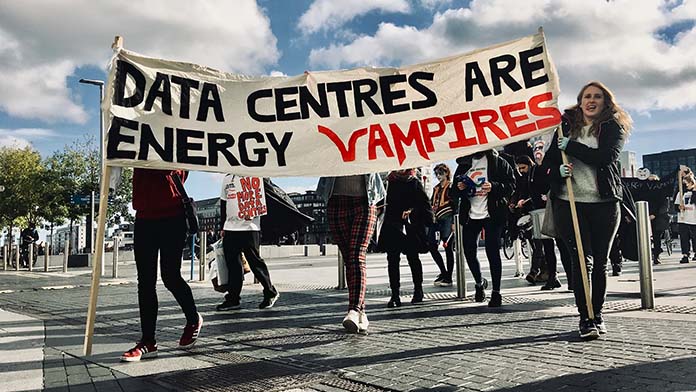
US tech companies are lining up to invest hundreds of billions of dollars rolling out energy-guzzling AI data centres across Australia.
The US ruling class sees AI as crucial for maintaining economic and military advantages over China.
Our rulers agree, with Deputy PM Richard Marles visiting the US in August for an AUKUS summit and meetings with tech executives about making Australia a “second home” for AI infrastructure. Marles said AI would soon be driving F-35 fighter jets and submarines insisting, “we’re with the United States on this”.
Plans in NSW alone would see data centres draw 13GW of power—more than the state’s current average daily energy use.
Despite Albanese’s claims that new data centres will be powered with renewables, he knows this is not possible in the timeframe available to cash in on the boom.
He is certainly hoping data centres might help turn around collapsing renewable energy investment, but Albanese will not stop state governments approving huge new gas-fired power stations to run data centres.
Market failure—and fraud
Since Albanese took office, Australia’s domestic emissions have essentially flatlined, decreasing just 1.8 per cent since 2022.
Labor’s flagship policy, the “Safeguard Mechanism”, places emissions reduction requirements on the heaviest polluting companies. But these obligations can be met entirely through purchasing carbon credits.
This “offset” system relies on the fraudulent claim that vegetation growth can compensate for the burning of fossil fuels.
The lack of pressure for any real action saw Rio Tinto and BHP recently walking away from a combined $12 billion worth of investment in decarbonisation.
Renewable energy has increased under Labor, from 33 per cent of the national grid in 2022 to 42 per cent today. But this has primarily come from uptake of rooftop solar. Investment in new renewable power generation infrastructure is at a ten-year low.
Climate Minister Chris Bowen has conceded that Labor’s target of 82 per cent renewable energy by 2030 looks unlikely.
At the centre of his failing strategy is the Capacity Investment Scheme (CIS), where the Commonwealth underwrites renewable energy generation through paying companies directly to guarantee a minimum price for the power they generate.
But only 14 of the 89 major projects given CIS contracts have gone ahead.
A major part of the problem is the energy transmission system. New transmission infrastructure required to bring power from renewable projects to the grid is well behind schedule.
Uncertainty about when they might be able to connect and sell their power means investors simply aren’t putting up the cash to build projects.
Labor is scrambling for solutions, hoping data centres could be a silver bullet. Albanese and Bowen have floated yet another market scheme, where data centre developers purchase certificates for the supply of future renewable generation to “offset” the use of fossil fuels.
Labor applied a similar strategy in August to placate Rio Tinto executives threatening to shut down the aluminium smelter at Tomago, which uses 11 per cent of NSW’s electricity.
Rio had come to the end of a 20-year power deal signed with the state government prior to power privatisation. It claimed energy prices were now too high to make the business viable.
So Albanese and Minns put up a combined $2.5 billion over ten years to fund long-term purchasing agreements with renewable energy developers, again hoping to stimulate new investment.
Power from these projects will be on-sold to Rio for a fraction of the market rate.
Rather than hand huge subsidies to private energy companies and resource giants, the whole electricity system needs to be taken into public hands, along with essential infrastructure like the Tomago smelter.
This is the only way to drive the urgent transition needed to move away from fossil fuels and stop catastrophic climate change.
By Paddy Gibson