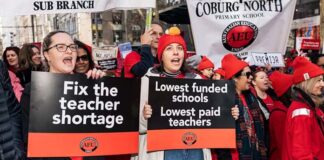

NSW TEACHERS are still seeking a salary raise of 5 per cent or more and an end to restrictions on transfers. The October state council meeting of the New South Wales Teachers Federation (NSWTF) is to consider renewed state-wide industrial action over both issues.
Other public sector workers have done a great job of progressively breaking NSW Labor’s salary cap of 2.5 per cent. The fire fighters have settled with rates up to 4.7 per cent per annum, over the train drivers’ previous settlement of 4 per cent per annum and the nurses’ initial 3.7 per cent per annum.
The NSWTF should be able to build further on the public sector settlements to date and break through the 5 per cent barrier. The NSWTF is the largest NSW union, the last to settle and has avoiding taking the claim to the Industrial Relations Commission.
The NSW government is in crisis and has had to manufacture a “budget deficit” as a smokescreen for years of under-funding of NSW public services.
Their attempt to shift staffing appointments from a state-wide, points-based system to a school-based interview is part of pushing responsibility and blame onto schools themselves, especially in disadvantaged communities. Localised strikes are continuing to expose the fact that teachers in disadvantaged communities are being refused transfers.
New education minister Verity Firth (nominally of the Labor Left) has repeated the Treasury mantra that pay offers will be just 2.5 per cent, unless productivity tradeoffs are made.
The NSWTF October state council meeting should call for recommencing industrial action with a rally at Parliament House. Despite the bitter power privatisation dispute and public sector pay campaigns across a half dozen unions, Unions NSW and its affiliates have not held a sizeable rally at Parliament House since February.
Labor may point to the growing economic crisis as a reason to oppose pay rises, but this would be hypocritical as to date they have loudly trumpeted investment in infrastructure and education as strategic long-term investments for the state and national economy.
With Labor and its market reliance on the nose, it is time for teachers to be at the gates of parliament, demanding direct funding for pay and conditions and full government accountability for that state for public services.
By John Morris, Secretary, Canterbury-Bankstown Teachers Association