
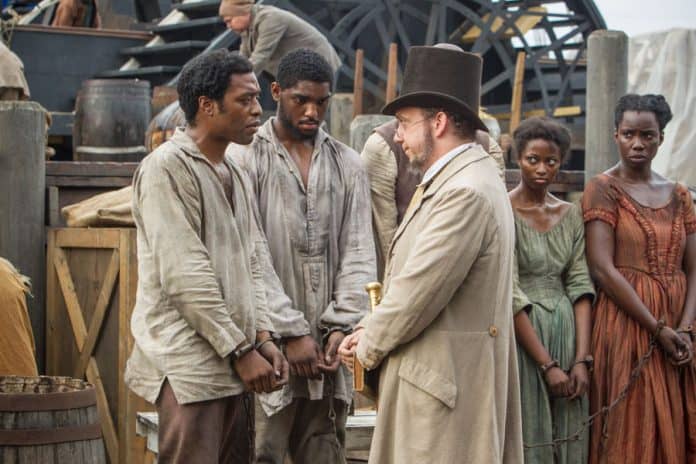
Twelve years a slave, drected by Steve McQueen
In cinemas now
WITH 2013 marking 150 years since the end of the US civil war, Hollywood has produced a number of movies on the topic. Yet, Hollywood has always been reluctant to tackle the issue of slavery.
Steve McQueen’s Twelve Years A Slave is different. Based on the life of Solomon Northup, published as a book in 1853, it is a serious attempt to deal with the substance of slavery. In contrast to other popular slave narratives at the time, like Frederick Douglass’s Bondage, which told the story of a slave who escaped slavery in the South, Twelve Years tells the story of a “free” black man in the North kidnapped and sold into slavery.
Northup escaped slavery after 12 years by finally managing to contact his family, who sent a man who could vouch that Northup was a freedman. After his release he became active in the movement to abolish slavery.
A real strength of the film is that it does not shy away from depicting the systemic violence and dehumanisation that characterised the slave trade and plantation life.
The blockbuster Lincoln by Steven Spielberg ignored the role of activists in mobilising political opposition to slavery and steered clear of showing the brutality of slavery itself.
Quentin Tarantino’s western, Django Unchained was seen by some as an alternative to the traditional Great (white) Man history of Lincoln. However, while it gave centre-stage to a black protagonist, the film was stupefyingly absurd. Especially troubling was the use of the word “nigger” (over 100 times) which became disturbingly trivial, instead of disturbingly racist. It is not surprising that Django received accolades in The Australian for breaking the “taboo” of political correctness in the cinema.
Twelve Years is based on raw historical material and gripping cinematography. The scenes where slave owner Mr Edwin Epps forces his exhausted slaves to wake up in the middle of the night to play music, for one of Epps’s “dancing moods” will leave a lasting impression. In Northup’s book, these moods are described alongside his “whipping moods”, where he marched slaves around to be whipped for fun.
Of the many lingering shots of the violent beatings, none are as memorable as the attempted lynching in which Northup is left struggling to breathe in front of the plantation mistress and other slaves, who carry on as if nothing has happened.
Unfortunately some significant changes to the real story tend to present the slaves as one-dimensional, passive subjects.
At the beginning of the film, Northup and other slaves hatch a plan to revolt on the ship, but it fails even before it begins when his co-conspirator, Roberts, is knifed trying to stop a rape. In Northup’s written account however, the plan to revolt is thwarted because Roberts contracts smallpox and dies. What seems like a minor detail, however, has the effect of diminishing the role of slave resistance and contributes to a despairing mood that hangs over the film.
Twelve Years makes little effort to explore the issues of slavery and racism. However, towards the end of the film, Bass, the Canadian carpenter who ends up helping Northup, engages in something of a debate on the status of slaves as mere “property”.
But presenting the issue of slavery as one of people becoming property misses the specific way the ideology of racism justified slavery in the US, a point strongly emphasised in Northup’s book. In ancient Greece for example the right to own slaves was justified as a right of the rich or as booty from military victories. In early capitalism however, slavery was underpinned by a new racial ideology that regarded non-whites as sub-human.
It was this racism that explains how a country like the US that professed to stand for freedom and democracy could enslave 12 million Africans, and ship them like cargo across the Atlantic to work on the plantations of America’s Southern states.
Racism allowed the new bourgeois ruling classes in Europe and America who had fought against feudalism under the banner of “liberty, equality and fraternity” to nonetheless embrace slavery, a social system worse than the bondage of peasants that had underpinned feudalism.
The stand out strength of Twelve Years A Slave is the powerful imagery and detailed depiction of the violent and systemic reality of slavery in the South—more than enough reason to see the film.
By Jasmine Ali