

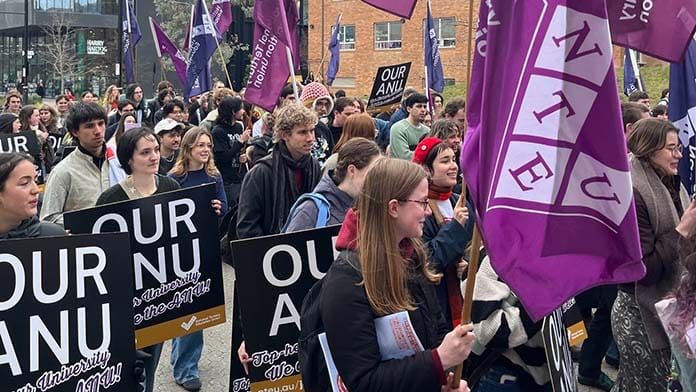
On Wednesday 30 July, more than 100 ANU students marched against the university’s proposed Renew ANU cuts. Vice-Chancellor Genevieve Bell has already slashed 1092 jobs since March last year, according to the staff union, the NTEU.
Students are demanding that the cuts are reversed, that Bell resign and that the government provide funding for quality education at universities.
In early July, ANU released its “organisational change proposals” for further staff cuts. In Arts and Social Sciences, there will be 63 job redundancies.
The university is justifying its cuts to specific disciplines based on research rankings and expectations of external funding. Sub-disciplines like biological anthropology and quantitative research in sociology will effectively cease to exist.
A merger between the schools of art and design, music and museum and heritage studies will cut one visual arts course and funnel students in the three areas of study into another. Students at the school of music will no longer be able to specialise in performance, composition or theory.
Also notable is the merger between political science, international relations and public policy. The three initially separate undergraduate degrees will now become one, leaving students lacking the opportunity to gain specialised knowledge in each.
In Science and Medicine, there are 68 redundancies. The university is gutting the Biology Teaching Centre, which provides crucial specialised teaching to first-year biology students.
The proposed changes will deprive staff of their livelihoods and force those who still have a job to work harder. Students, who come to university on the promise that they will be able to explore ideas in whichever discipline they choose, will find their study options severely restricted.
The corporate university
The Vice-Chancellor has justified the cuts by suggesting that the university has a $250 million budget deficit. But the Financial Review reported that chief analysts at the university have revised that figure down by $60 million, and there are other competing estimates.
Bell’s manipulation of the budget deficit figures underlines how her role is to preside over a corporatised university.
Government funding as a percentage of university revenue has more than halved over the last 40 years: in 1989, 80 per cent of university funding came from the government while in 2019 it was 33 per cent. Meanwhile, the private sector has enjoyed lower corporate tax rates.
To deal with underfunding, universities have appointed representatives from industry. Bell retained a salary from chips company Intel on top of her $1 million salary at ANU in 2024.
Universities as a result have increased student fees, competed for private funding and cut staff. These cuts have typically but not exclusively affected areas where it is difficult to get private funding, such as the humanities.
It is not surprising that other universities around the country, including Wollongong, UTS and Macquarie, have copied ANU’s cuts: each must make itself more attractive than its competitors for industry.
Fightback
Students and staff returning to ANU for second semester were quick to express their anger at the cuts with a rally of more than 400, which marched to the Chancelry on 23 July.
Music students played on the march and then launched an overnight, 12-hour protest concert against the music cuts.
To build the 30 July rally, student activists took votes in classes around the university, calling on Bell to resign, the cuts to stop and the government to fund quality education. In many classes, students overwhelmingly if not unanimously voted against the cuts.
At the rally, we marched to the schools of music and art and design, then marched back into a teaching building and voted to continue to disrupt business as usual until ANU stops the cuts.
The extra step of entering the building was important in showing that the fight against the cuts must be one of mass disruption, not lobbying or convincing Bell, because the cuts have a structural cause.
A poll in an NTEU meeting the next day showed that 35 per cent supported unprotected industrial action to save their jobs, while only 18 per cent voted against.
The campaign has also demonstrated the need for a socialist organisation which can respond to the compounding crises of capitalism.
The capitalist system prioritises war over education: at the same time as Bell cuts courses in arts and STEM, she refuses to cut scholarships and research programs with arms companies complicit in the genocide in Gaza.
We need everyone who attends a cuts rally today to help organise and politicise the fightback tomorrow.
By Finnian Colwell