
The terrorist attack in Bondi has been followed by an avalanche of new laws aimed at blaming the movement for Palestine.
NSW Premier Chris Minns, already known for his gung-ho support for Israel and efforts to attack Palestine protests, was the first to respond, with a raft of new anti-protest laws.
He has banned protest marches, allowing police to extend the restrictions every two weeks for as long as three months following a terrorist attack.
Minns declared Sydney was a “tinderbox” saying that “we can’t let unrestrained violence or disunity in our community run”.
This was despite zero evidence there was any sympathy for the Bondi attack among Palestine supporters or increased threat of violence—or that protests might cause it.
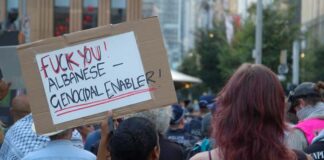
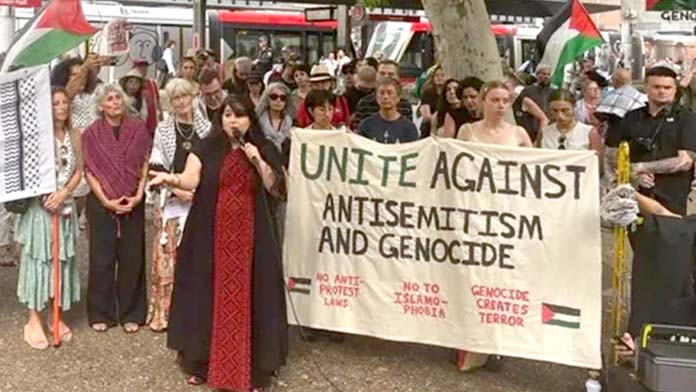
Minns’ real aim was to spread the lie that Palestine protests had increased antisemitism and were a threat to the community. But as any of the hundreds of thousands who have marched for Gaza know, the protests have never tolerated antisemitism.
Increasing numbers of Jewish people have criticised Israel and reject Zionism, even if they are still a minority within the Jewish community. Jewish activists have frequently been invited to speak and Jewish contingents have joined almost all the protests.
Minns is also passing new laws to ban the chant “Globalise the intifada”, claiming it is a call for violence. But as Law Professor and UN Special Rapporteur Ben Saul puts it, this “is commonly understood as a call for (peaceful) global solidarity and action to resist Israel’s systemic violations of international law in Palestine”.
Some have argued to suspend our protests and say it will play into the government’s hands to defy bans on chants.
Palestine Action Group (PAG), the organiser of the major Sydney protests, responded by saying it opposed Minns’ anti-protest laws but wasn’t planning any protests. It eventually supported other Palestine activist groups when they held a rally on 16 January against the laws.
Although PAG says it hadn’t led the chant “Globalise the intifada”, it has been common at the Sydney rallies. And rally organisers have also led other chants calling for “intifada”.
Accepting Minns’ ban can only be understood as an admission there is a problem with the chant, and that the rallies are doing harm. It needs to be defied.
The media may attack protests that chant “Globalise the intifada” and use it to further their smear campaign. But it is only through standing our ground that we can raise arguments against their attacks and begin the debate in society needed to win people over.
If we accept the ban on “Globalise the intifada”, that won’t be the end of the attacks. Supporters of Israel have also targeted the slogan “From the River to the Sea” and any expression of support for Palestinians’ right to resist Israel’s occupation.
They will keep pushing for further restrictions on protest as well as sackings and disciplinary action against pro-Palestine activists.
Defiance
But if we stand up to the attacks we can push them back.
Shortly after 7 October, Solidarity students at Sydney Uni were banned from holding a meeting on campus because it contained the phrase “Globalise the intifada”. But the meeting went ahead outside university grounds.
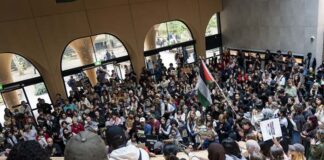
When university managements tried to shut down the student encampments for Gaza through threatening disciplinary action against students, they had to back down. When ANU tried to expel student activist Bea Tucker, a defence campaign saw the decision reversed.
Activists at Sydney Uni have successfully defied restrictions on protests, stalls and freedom of speech. When management removed Palestine flags flown by staff from their offices, other staff members put up more flags.
We need more of this spirit of defiance to stand up to the assault on the movement now.
It’s easy to feel isolated when the whole media and political establishment is lining up to target the Palestine movement.
But we shouldn’t forget the enormous shift that has taken place over the last two years, as hundreds of thousands of people have begun to understand the scale of Israel’s crimes for the first time.
It’s not just the 300,000 who marched for Gaza over the Sydney Harbour Bridge, and tens of thousands more in other cities. A poll in October found 57 per cent of people supported sanctions on Israel similar to those imposed on Russia and Iran.
Supporters of Israel have been losing the argument—which is why they are so desperately seizing on the Bondi attack to try to undermine support for Palestine.
This is no time for the movement to go quiet. Israel’s genocide continues and so must our protests.
By James Supple