
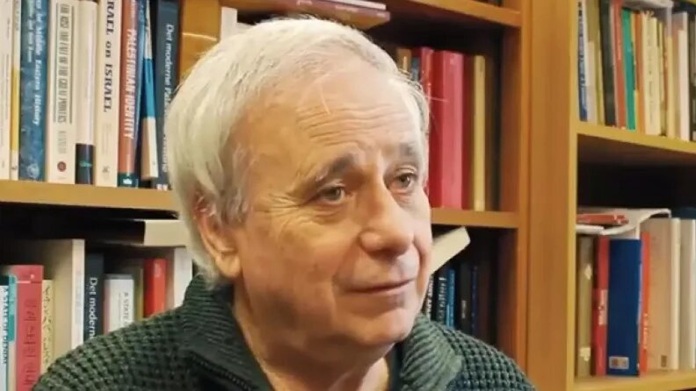
Ilan Pappe’s historical research has delivered a signal service to the Palestinians and all those who long for the liberation of Palestine.
He backs an academic boycott of Israel and has organised in support of the Palestinians’ right to return to their homeland.
The Israeli academic, now living and working in exile in England, has systematically uncovered the dirty, hidden story of how the Zionist colonial settler conquest of Palestine came about.
Books like The Ethnic Cleansing of Palestine (2006) have helped tear away the mask of respectability and “civilisation” with which Israel tries to hide its crimes.
In Israel on the Brink: Eight Steps for a Better Future Pappe steps away from history to argue about Palestine’s future.
Arguing that contradictions within Israel will lead to its collapse, his focus shifts here to the transition to a single democratic state of Palestine in which Arabs and Jews live together.
Pappe is a great historian. But his proposals for how to achieve a new Palestine fall frustratingly short.
Messianic
Pappe argues there are profound cracks in the foundations of Israel. “I believe their causes can’t be addressed by Israel as it is. And so the cracks are destined to multiply and deepen, until the structure can no longer remain standing.”
Pappe outlines seven “cracks”, with the first and most important being the division among Israeli Jews between the previously dominant and largely secular “liberal” population and what Pappe calls the State of Judea—conservative, highly religious and often messianic.
Both wings of the Jewish population agree on dehumanising Palestinians and denying them their rights.
But Pappe argues that the State of Judea, whose supporters won the November 2022 national election, is for now in command. It is seeking to extend Israel’s boundaries, drive out the Palestinians and wind back liberal democratic norms.
“In 2025, there are two Jewish peoples living in Israel with practically nothing in common,” he writes. Emigration—more than half a million secular Jews have migrated since 7 October—is likely to tip the balance to the fundamentalists.
Other faultlines that Pappe identifies in Israel include the massive and growing global support for the Palestinians; the growing rejection of Zionism by diaspora Jews; the disfunction of the state; and a newly emergent, young Palestinian movement of resistance.
These will bring a cheer to the lips of all supporters of Palestine. But Pappe cites two further “cracks” for which the evidence is much less compelling.
The first is an “inevitable” economic slump. Yet even by the figures Pappe cites, the Israeli economy was growing handily before 7 October—GDP per capita rose 6.8 per cent in 2021 and 4.8 per cent in 2022.
Yes, the cost of the genocide and the disruption caused by calling up tens of thousands of reservists for active duty led to a massive fall in GDP of 19.4 per cent.
However, the OECD forecasts, “Economic activity is on a path to expand by 3.3 per cent in 2025 and by 4.9 per cent in 2026. The ceasefire in Lebanon at the end of 2024 brought a significant improvement in the economic environment.”
Israel has now established a significant cyber-military-industrial complex. The Times of Israel reported in June that annual Israeli arms sales brought in $22.6 billion in 2024, a new record for the fourth consecutive year.
The other factor Pappe cites—the ineffectiveness of the Israeli army—seems incongruous given Israel’s attacks over the past year on Gaza and the West Bank, Lebanon, Syria, Iran, Yemen, Qatar and Tunisia.
Pappe says the IDF is trained to police Palestinians rather than fight conventional armies. But with its US-guaranteed “qualitative military edge”, the Israeli military towers over the region.
I am not convinced that Israel will go into terminal crisis, let alone of its own accord.
Idealism
Pappe says that he doesn’t know when these faultlines will bring Israel down. But the implication is that Israel’s collapse may take place relatively soon.
“A vacuum will be created by the significant weakening or collapse of Israel, which, as I’ve shown, seems all but written on the cards now.”
In the final section of the book he writes an imaginary diary of his life following the Wathba—“the revolution of 2040 that turned Israel into the new Palestine”.
There are some thought-provoking passages, studded with nuggets of history. Pappe’s discussion of how to implement the Right of Return is helpful, as is his discussion of co-existence among religious and cultural minorities under the Ottoman Empire.
His explanation of the development of messianic Zionism is valuable and his evisceration of the “Two-state solution” is short and beautifully brutal.
The problem is that Pappe’s fatalism about Israel’s demise flips all too easily into idealism about how Palestinians and anti-Zionist Jews should organise.
He rightly looks to Palestinian youth for hope but has little to say about how they should exercise their agency.
The historic debates among Palestinians about armed struggle, whether to look to Arab regimes for support or what can be learned from the effective demise of the PLO are glossed over—the implication is that they are no longer relevant.
He chides factionalism among Palestinian organisations as if strategic arguments between the likes of Hamas and other Palestinian groups are simply self-indulgent.
He acknowledges the liberatory importance of the Arab Spring of 2011 but then cites authoritarian regimes like Turkey, Russia and China as playing a role in shepherding a new Palestine into existence.
In Pappe’s utopian postscript, the US President supports sanctioning Israel and Palestine gets backing from the “new” governments in Syria and Jordan and from a new military regime in Egypt.
Because Pappe expects Israel to fall rather than be brought down, he doesn’t comment on how the strategy of armed struggle initiated by Fatah and the PLO and continued today by Hamas, Islamic Jihad and smaller groupings has failed to bring liberation.
Neither does he account for the treachery of the Arab ruling classes, whose lip service to the Palestinian cause is derisory and whose enthusiasm for US imperialism’s domination of the region is sickening.
As a result, he is silent on the need for the Palestinian resistance to make common cause with the Arab working class, not least workers in Egypt with its population of 110 million.
Yet Palestinians and the Arab masses have a joint interest in challenging the triad of the Zionist colonial settler state, US imperialism and the region’s grasping, authoritarian rulers.
In short, the book is sadly primarily a piece of wishful thinking, not a guide to action. Palestinians cannot wait for Israel to collapse—the apartheid state needs to be swept away as part of a region-wide revolution.
Pappe is a great historian, a strategist not so much.
By David Glanz
Israel on the Brink: Eight Steps for a Better Future, by Ilan Pappe. OneWorld, 2025.