
More than eight months after the protest against Israeli President Isaac Herzog’s visit to Sydney, court proceedings and the inquiry into police conduct are exposing new evidence about the shocking events at the protest.
In the wake of the Bondi attack in December 2025, the NSW government attempted to ban all protest and shamelessly joined in the effort to blame the attack on the Palestine solidarity movement.
Then Anthony Albanese invited Herzog to Australia and the NSW government extended the protest ban to cover his visit.
Ordinary people were outraged and the Palestine movement declared the intent to protest and march to the NSW Parliament.
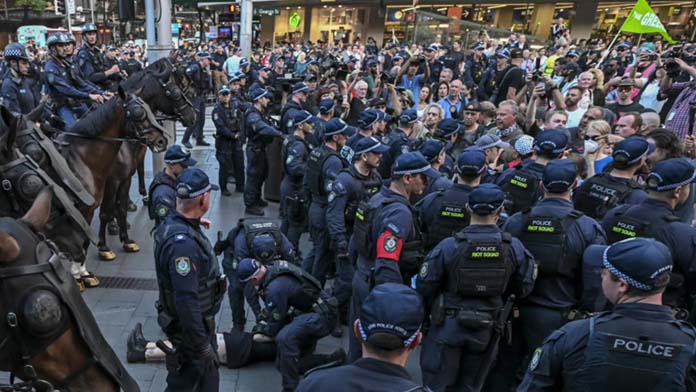
Tens of thousands gathered but police refused to allow a march, or even safe dispersal of the crowd. Instead, people were kettled, dragged, pushed and pepper sprayed. That evening hospital emergency rooms were full of protesters with concussions and broken bones.
Legal Observers NSW have outlined the police abuses in a brief published on their website.
Despite a court ruling that a key part of the anti-protest regime used to suppress the rally was unconstitutional, the police are continuing to press charges against about 18 people—although charges against about one-third have been dropped.
Lawyers Nick Hanna and Felicity Graham are engaged in a court battle to subpoena materials from the police for their defence, ranging from police documents and instructions through to overhead drone footage, decisions about the anti-protest regime that covered Herzog’s visit and communications between police and government Ministers.
On 19 October, a judge ruled that these documents are relevant and must be provided. The police will now try to avoid producing them on the basis of “public interest immunity” at a court hearing on 30 October.
Lawyer Nick Hanna explained that, “The police went to great lengths to avoid producing these documents, arguing that they weren’t relevant, but we have been vindicated.”
Hanna said the legal team is arguing not only that the defendants did not commit any offences, but that, “They were the victims of police violence and police criminal activity. We will be arguing that the entire police operation was unlawful, and … unparalleled in living memory.”
This goes right to the top, with NSW Premier Chris Minns defending police actions in the days after the rally saying that “we can’t blame the police for doing what we asked them to do”.
The first Herzog protest cases are scheduled for hearings in the week of 8 March—days before the NSW election, with further trials in July. Lawyers are seeking to call the Premier and multiple Ministers to give evidence.
Investigating police conduct
Separately, the official NSW Law Enforcement Conduct Commission (LECC) investigation has finally begun, after receiving a record 800 complaints. Public hearings were supposed to begin in September. Days before, the NSW police attempted to have the opening address and all interviews and evidence given in private.
Ridiculously, the LECC accepted that public hearings “may have an adverse impact … on social cohesion” because they could lead to more protests.
The result is that senior police will give evidence in public but junior police and all protesters will give their evidence in private.
Greens MLC Sue Higginson points out that this outcome means that, “The people who experienced the [police] violence will not have the same opportunity to publicly give their accounts as the senior Police officers responsible for the operation.”
Nevertheless, the LECC process is starting to reveal interesting information. Its first public hearing took place on 19 October with opening statements.
LECC say that the major themes they are exploring are:
- Police planning
- Police conduct, including the violent prevention of dispersal and dispersal process, and the prevention of first aid
- Allegations of unjustified use of force, including use of pepper spray
- Police use of arrest powers, including whether it was lawful to exercise arrest powers on protesters seeking to march.
However, many of those who have lodged complaints will be shocked to hear that the LECC will investigate only selected case studies that illustrate problems and can lead to recommended improvements. The evening prayer disrupted by police will be one case study.
Part of the police preparation was an operational briefing for officers at 1pm on the afternoon just before the protest by Police Commissioner Mal Lanyon and other senior police at the Sydney Cricket Ground.
Police have told the LECC there is no recording of this event, or notes taken at it, and that senior police did not use speaking notes. The LECC say that so far accounts of the briefing are consistent on one point: that police said the protest would be a static rally with no march permitted. They will be examining this further.
It was clear to anyone attending the Herzog protest that the police were solely concerned with preventing a march, no matter what hazard and violence this required to those attending. The overriding police priority to prevent any march meant that inevitable police violence as the 30,000 people both asserted their right to march, and as people also attempted to leave safety, as happens at any rally.
Bizarrely, police have told the LECC that the closure of Bathurst Street, which prevented people from dispersing towards Central Station later in the evening, was simply a “miscommunication or misunderstanding within police”. LECC also explains that police had a helicopter and multiple operation centres with screens showing live footage of the evening, and drones.
LECC says that it will also be exploring the frightening police charges down Bathurst Street and George Street, and the legal basis for police pushing people well outside the declared Public Assembly Restriction Declaration (PARD) and “Major Events” area.
Counsel for the NSW Police Commissioner also addressed the opening hearing. They explained that in the two years before February 2026, police facilitated at least 200 protests in the CBD, many with the same organisers, without incident.
Based on the opening remarks, it seems that the police are seeking to blame protesters for rejecting the option to march from Belmore Park in the days leading up to the protest. Police are also blaming protesters for moving towards George Street and attempting to march out of Town Hall Square, instead of accepting police offers of “controlled dispersal”.
Finally, police claim they experienced “an unprecedented level of serious verbal abuse directed at police”. In contrast, counsel assisting the LECC say that:
there is limited evidence of physical violence on the part of the protesters. The protest appears to have been largely peaceful in its early stages. Later conduct by protesters described in the evidence of police as “aggressive” was, for the most part, verbal and connected to a desire to march.
There are obvious weaknesses in the LECC process. However, counsel assisting the LECC say they are clear on the importance of the right to protest and say this principle will underpin findings and recommendations in their report to Parliament next year.
It is clear that complicity with genocide, supported by laws passed by parliament and decisions made by the Premier, were the root cause of the police violence in February.
The Palestine solidarity movement will need to continue to work to demand charges against those arrested on the night are dropped and expose the truth about how far the NSW government went to smother protest against the Israeli President, and how many they injured in the process.
By Penny Howard