
Clinton Fernandes’ new book exposes Albanese’s own imperialist agenda in backing Trump and Israel, writes Adam Adelpour
Clinton Fernandes’ latest book Turbulence is an ambitious attempt to outline Trump’s domestic and foreign policy agenda and what it means for Australia. He says that Trump wants US global primacy over China above all else.
The book was written before Trump’s inauguration and in the months that followed. Albanese’s disgraceful pandering to Trump throughout the year has made the book only more relevant.
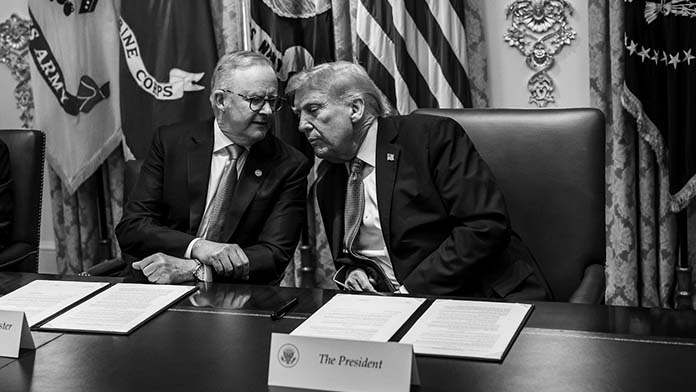
It was sickening to see Albanese grinning alongside Trump during his visit to Washington in September. Trump is an appalling far-right bigot and chief arms supplier to Israel’s genocide.
In 2017 Albanese said Trump “scares the sh*t out of” him. But now he is ploughing full steam ahead locking down the AUKUS military pact with the US. He announced $12 billion in September for a submarine base in WA that can house and maintain US nuclear subs and has given the US $1.6 billion directly so far to expand production of nuclear submarines.
The subs the US produces are armed with nuclear weapons meaning Australia is helping build key components of the US nuclear strike force. Now Albanese has signed a $3 billion critical minerals deal with Trump as well.
Fernandes tears Albanese’s embrace of US imperialism to shreds, along with the platitudes used to justify it.
As he puts it, AUKUS is “not an investment in national building” but a contribution to the “war fighting capabilities of the United States”. He argues the defence of the “international rules-based order” used to justify the military build-up is a euphemism hiding the US’s defence of its empire.
One of the stand-out sections of the book takes up the issue of Israel’s genocide in Gaza. He explains why the US has backed Israel to the hilt and why the Albanese government is so determined to support Israel.
But the book largely leaves the question of what is to be done open, while at times suggesting the way forward is for Australia to adopt an independent foreign policy separate from the US. This is the weakest aspect of Turbulence.
There are systemic forces behind the drive to war on China, the US’s and its allies’ support for the Gaza genocide and Australia’s alliance with the US. This means we need much more radical solutions.
US imperialism and Albanese’s complicity in genocide
Swathes of people have been horrified that Albanese has continued to arm and provide political cover to Israel through two years of genocide.
The go-to explanation for the Albanese government’s criminal stance is the influence of the Zionist lobby.
For example, in a recent interview with former Labor Foreign Minister Bob Carr titled “Exposing the disturbing Israeli lobby inside Australia”, viewed 339,000 times on YouTube, he says:
“The Jewish lobby in Australia is a foreign influence operation. It’s designed to put the interests of Israel above the interests of Australia in its foreign policy … No one organises donations to attempt to elevate its influence in the way the Jewish lobby does in Australia.”
There is no doubt about the tenacity of the Zionist lobby. But the chapter on Trump’s Middle East policy in Turbulence presents a powerful argument as to why the interests behind the US and Australia’s support for Israel go far deeper than lobbyists and donations.
Fernandes begins by saying that “control of Middle East Oil is the main goal of US strategy for the region”. He notes that the imperialist concern with the region’s oil dates back to the First World War. British Foreign Secretary Lord Curzon said the Allies “floated to victory upon a wave of oil”.
Arthur Balfour, British Foreign Secretary during the war, described the region’s oil supplies as “all important” not long after he made the infamous Balfour Declaration supporting a Jewish colonial project in Palestine in 1917.
Fernandes stresses that the goal of US policy today continues this tradition. It aims to control the region’s oil using Israel as its attack dog. The value of having a stranglehold on oil isn’t just to extract profit, it can be used to discipline other states dependent on it.
He provides a 1981 quote from US Secretary of State Alexander Haig saying, “A central aspect of US policy since the October 1973 war has been to ensure Israel maintains a qualitative military edge in the region.”
This policy is very much alive today. In the last two years Israel has used its US-supplied arsenal not only to decimate Gaza but to bomb Lebanon, Syria, Iran, Yemen, Qatar and Tunisia as well.
In November this year Benjamin Netanyahu responded to news that Saudi Arabia would acquire US-made F-35 fighter jets by saying that US Secretary of State Marco Rubio had assured him that the US would supply Israel with advanced weapons to maintain its “qualitative edge” in military power.
Fernandes argues that support for Israel is a way for Australia to “demonstrate its relevance for US global strategy”.
The conclusions that flow from this understanding are critical. If Australia’s support for Israel was simply a result of a well organised Zionist lobby then by implication a well organised counter-lobby could break it.
But key imperialist interests are at stake. As a result it will take far more to break the West’s support for Israel. It will take a sustained struggle that is powerful enough to challenge Australian imperialist policy and the US alliance.
AUKUS and the drive to war on China
The chapter “Frontline China” paints a vivid picture of the stakes in the drive to war on China.
Fernandes brings a sharp focus to the way the shadow of nuclear war hangs over the escalating contest between the US and China in the South China Sea and over Taiwan. He details how the US has repeatedly threatened China with nuclear strikes.
During the Korean War, where China supported North Korea and the US supported the South, the US repeatedly threatened to use nuclear weapons.
In 1955 during escalating tensions between Chinese Nationalists in Taiwan and the Chinese Communist government in China, President Eisenhower publicly threatened to use tactical nuclear weapons if fighting broke out.
B-36 bombers were deployed to Guam and targets in mainland China selected. This was repeated during similar tensions in 1958. China did not detonate its first nuclear device until 1964.
There is a chilling description of how today US military strategy in the South China Sea is directed at neutralising China’s ability to retaliate in the face of a US nuclear strike on the Chinese mainland.
To deter the US, China is developing a “second strike” capability using nuclear weapons-capable submarines. The idea is that even if mainland China was destroyed these submarines could launch ballistic missiles that would hit the continental United States. This is supposed to act as a deterrence against the US launching a major nuclear attack.
The US presence in the South China Sea and around Taiwan is designed to make this impossible by preventing Chinese subs getting within the range required for such a strike, and making them easier to detect and destroy. The undersea geography around Taiwan is littered with sensors for anti-submarine warfare.
This is the context in which Australia is assisting US “freedom of navigation” exercises in the South China Sea and pursuing the AUKUS nuclear subs.
Far from being designed to defend Australia or secure the “rules-based international order” the AUKUS subs are designed to assist the US nuclear war fighting capability in its bid to maintain primacy over China.
Fernandes succinctly sums up Australia’s imperialist motives in deepening the US alliance, saying, “Australia’s foreign and defence polices remain resolutely sub-imperial: attempting to preserve dominance over the southwest Pacific and smaller neighbours in Southeast Asia such as Timor-Leste while demonstrating relevance to US global primacy through AUKUS.
“The declared goals are ‘deterrence’ and ‘freedom of navigation’. The real goals were expressed candidly by Douglas MacArthur [an American general during the Second World War]: ‘we can dominate with sea and air power every Asiatic port from Vladivostok to Singapore’.”
Resisting imperialism
The strength of the criticism of Australia’s alliance with the US in Turbulence demands an equally strong answer about what is to be done.
Fernandes says in the introduction to the book, “It is an assessment written to inform the public about what the real goals [of Australian and US policy] are, not what they ought to be. The latter can emerge from discussions once the former is understood.”
However, throughout the book Fernandes does in fact nod towards his preferred alternative—an independent, sovereign foreign policy including conventional submarines outside US control. There is a whole section on why Australia should acquire air independent propulsion submarines instead of the AUKUS subs.
The Greens moved in this direction at the last federal election too, with the party adopting defence policy for the first time that included sovereign missile and drone capabilities.
This is a mistake. Australia is an imperialist bully-state in the region and it will wield its weapons accordingly.
Many of the strongest parts of the book point towards the systemic roots of imperialist policy in the Middle East and towards China.
But systemic problems require radical solutions. A “democratic” world order cannot be grafted onto global capitalism, any more than a benign foreign policy can be grafted onto an Australian capitalism sustained by its role in imperialist brutality alongside the US.
Turbulence paints a vivid picture of the increasingly unstable world order under Trump, his imperialist ambitions and Albanese’s disgraceful support for them. In response we need a strong anti-war movement and international solidarity, not suggestions about how best to arm Australian capitalism.