

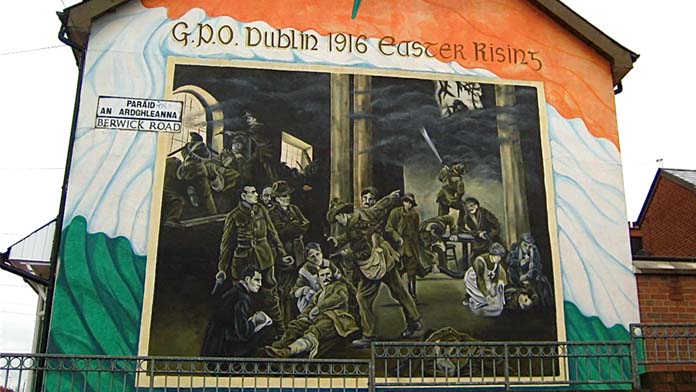
Ireland’s uprising against British rule in 1916 was designed to strike a blow against Empire and war. Liam McMullen looks at the attitude socialists took to it
The Easter Rising of 1916 was a pivotal moment in the struggle for Irish national liberation against British colonial rule and sent shockwaves around the world of empire.
Despite decades of conservatism, a radical Irish Republican tradition lives on, encapsulated by rap trio Kneecap and their staunch anti-imperialism in the face of the West’s role in the genocide in Palestine.
Despite the so-called “ceasefire” in Gaza, the genocide continues. The US and Israel have bombed Iran and provided Israel with a pretext to re-occupy southern Lebanon.
As Kneecap’s Mo Chara put it recently, “For as long as there is oppression, there will be resistance.”
The German revolutionary Frederick Engels described Ireland as “England’s first colony” whose conquest in the 16th century brought devastation.
In 1874 Tory Prime Minister Benjamin Disraeli admitted Ireland was “governed by laws of coercion that do not exist in any other quarter of the globe”.
The occupation’s savagery provoked a succession of armed nationalist movements. The Irish Republican Brotherhood (IRB), or Fenians, formed in 1858 in the aftermath of the famine when Britain allowed the death of more than one million people.
Empire and war
In 1914 the bloodbath that was the First World War began, as European powers fought over the division of the globe.
With the outbreak of war moderate Irish nationalists encouraged enlistment, receiving vague promises of Home Rule from Britain in return.
Enthusiasm for the war waned quickly and the IRB Military Council saw the strain on the British empire as a major opportunity.
On Easter Monday, 24 April 1916, insurgents commandeered a tram and detonated a bomb, blocking Sackville (now O’Connell) Street in Dublin.
The Rising caught the empire by surprise as 1300 insurgents seized key locations in central Dublin and held back 20,000 troops for six days.
Its crescendo was the seizure of the General Post Office and the declaration of an Irish republic.
The British authorities’ response was savage. In the aftermath of the uprising’s defeat 15 leaders were executed, including James Connolly and Patrick Pearse, 3500 people were arrested and 1867 deported.
This produced a surge of support for Republicanism that less than three years later led to what is known as the War of Independence. This was much more than a guerilla struggle against the British. The armed national liberation struggle spilled into a wider social revolt.
The Russian socialist Vladimir Lenin welcomed the 1916 uprising as an example of the way “the flames of national revolt [had] flared up both in the colonies and in Europe” because of the war.
This response was not universal within the socialist movement. Polish socialist Karl Radek said that Easter 1916 was nothing more than a “putsch”, a diversion from “real” working class struggle.
Lenin countered that, “Whoever expects a ‘pure’ social revolution will never live to see it.” Revolutions involve a whole range of struggles against national oppression that socialists should support—even when not led by the working class.
Socialists are obliged to support the right to self-determination of oppressed nations because “without this there can be no internationalism”, Lenin wrote.
The nation state and the ideology of nationalism are foundational to the system of capitalism. However, there is a gulf between the nationalism of dominant imperial powers and the revolutionary nationalism of the oppressed—which can ignite struggles to break free of an imperial power.
Lenin saw that only through winning workers in imperialist countries to supporting the right of oppressed nations to self-determination was there the potential to break the national chauvinism which bound them to their respective ruling class.
He wrote, “To imagine that social revolution is conceivable without revolts of small nations in the colonies and in Europe, without revolutionary outbursts by a section of the petty bourgeoisie with all its prejudices, without a movement of the politically non-conscious proletarian and semi-proletarian masses … to imagine all this is to repudiate social revolution.”
Lenin argued for unconditional but critical support for national liberation struggles.
While revolts against national oppression would not end the imperialist system, they were an expression of the oppressed that could weaken the grip of the imperialist state and spark mass revolutionary change.
Lenin was clear that being on the side of an imperialist oppressor is never an option. But forging a temporary alliance with the bourgeois leaders of national liberation movements in an oppressed country against foreign domination is sometimes necessary.
At the same time socialists are critical of the leadership and strategy of national liberation struggles, recognising that the only social force that can smash the imperialist system is the organised working class.
He stressed that workers’ movements and national liberation movements had different aims and that socialists and the working class should not dissolve themselves into the latter.
Independence struggle
The experience in Ireland bears this out. The Rising was a turning point in the struggle for Irish freedom and was followed by six years of revolt.
The years following it were marked by waves of strikes, workers’ occupations, land seizures, boycotts and the establishment of an underground rebel state known as “The Republic”.
It was a revolutionary period which saw a general strike that stopped the British imposing conscription in 1918, the declaration of the Limerick soviet in 1919, and coordinated workers’ action which severely limited the mobility of the British war machine for six months.
But, as socialist Kieran Allen writes in his book 1916: Ireland’s Revolutionary Tradition, “The Irish Revolution was defeated because there was no political force that could combine aspirations for national and social freedom.”
For the most part the Republican leadership saw class struggle as a distraction from the struggle for national self-determination.
However, James Connolly, Ireland’s pre-eminent revolutionary socialist, had argued to link together the nationalist movement and the working class movement.
Connolly opposed the idea of a “union of classes” to win national liberation. In Labour and Irish History he illustrated how the wealthy Irish “were tied by a thousand strings in the shape of investments binding them to English capitalism”.
He argued that the struggle for Irish freedom needed to culminate in a workers’ republic, not “simply be a change from the devil [the Irish workers] do know to the devil they do not”.
He saw a socialist solution to Ireland’s national question as crucial for smashing the sectarian divisions in the Irish working class. Connolly foresaw that partition of Ireland would bring a “carnival of reaction”.
Despite the political concession he made in allying with republicans to stage the Easter Uprising, Connolly’s lifelong commitment was to socialist and working-class politics.
In the period following the Rising, the Irish Republican Army (IRA) waged a courageous struggle against the superior British Army.
Their decision to limit themselves to waging an armed conflict instead of appealing to workers and peasants’ demands meant the IRA was unable to mobilise the social power of the working class and necessarily compromised with the system of capitalism and imperialism.
Britain paired repression with the endorsement of partition between the Unionist statelet in the North and a Free state in the South, negotiated with the conservative elements of the republican leadership.
This created two deeply conservative, sectarian states that repressed all revolutionary aspirations for decades to follow–the “carnival of reaction” Connolly had predicted.
Ireland’s national liberation struggle led to the consolidation in power of a local Irish ruling class.
This is not a unique phenomenon. The result was the same throughout the wave of colonial independence struggles through the 20th century.
These movements were often led by elements of the local ruling class against the colonial power that held back local economic development and humiliated and oppressed national cultures and groups.
They were prepared to lead a mass political movement against national oppression, typically with a strategy that combined mass action and armed struggle. But they almost always made compromises that betrayed the radical hopes generated through the struggle.
These aspiring ruling classes were ultimately willing to come to terms with the system of capitalist states and dominant powers within that system.
For example, the First Intifada in Palestine that began in 1987 was a mass uprising that shook the US and Israel. However, it ended with the Palestine Liberation Organisation (PLO) signing a compromise in the form of the Oslo Accords that betrayed the aspirations of the mass uprising and accepted the illusory promise of a two-state solution.
The decision saw the PLO become collaborators with Israel’s occupation in exchange for limited powers through the establishment of the Palestinian Authority in the West Bank and Gaza.
The lessons of the Rising and its aftermath are crucial to guiding the left’s approach to national liberation struggles today.
It is crucial that we unconditionally support the right of Palestinians to resist Israel’s occupation and their right to self-determination. To do otherwise is to accept Israel’s “right” to wipe out resistance and to side with Western imperialism.
At the same time, armed struggle in Palestine cannot defeat US imperialism and the Zionist occupation.
The Irish revolutionary tradition, the First Intifada and the Arab Spring show us hope lies with mass movements and the organised working class. Without the support of mass workers’ struggles across the region, the Palestinians will never win liberation.
Only a workers-led revolution can do away with the system that necessitates national oppressions. A revolutionary socialist party is key to building the kind of struggles that can win real liberation.