
Casey Forsyth explains why revolutions happen and why such major social upheavals always involve violence
There is widespread recognition that there are deep problems with the way society is organised.
The genocide in Gaza, the climate crisis, the rise of Donald Trump and the far right, all underline this.
Socialists say we need a revolution. What do we mean?
Revolutions are often characterised as violent and chaotic. But what typifies them is the mass of the population moving to change society themselves. The Russian revolutionary Leon Trotsky described revolution as the “forcible entrance of the masses into the realm of rulership over their own destiny”.
Revolutions are a consequence of a deep crisis in society. Lenin famously argued that a revolutionary situation required the unwillingness of the mass of people to continue to live “in the old way”, combined with an inability of those in power to continue to rule “in the old way”, leading to splits at the top of society.
The modern world was created by revolution. The rise of capitalism required revolutions in Europe from the upheaval of the mid-1600s in England that established the supremacy of Parliament to the French revolution. Anti-colonial revolutions swept Africa and Asia in the mid-20th century.
Any revolution involves an element of violence, not because of the actions of revolutionaries but because any major challenge to the interests of the ruling class is met with violent repression.
The mass arrests in Britain of supporters of Palestine Action, which has been designated a terrorist organisation, shows how state repression is used to protect the interests of the system.
Routinely, police are used to break picket lines of striking workers and to squash working class resistance.
The police and the army are the hard core of the state apparatus. Although the state presents itself as existing “above” society as an independent force, it serves the interests of the capitalist class because they control the economy on which the state depends.
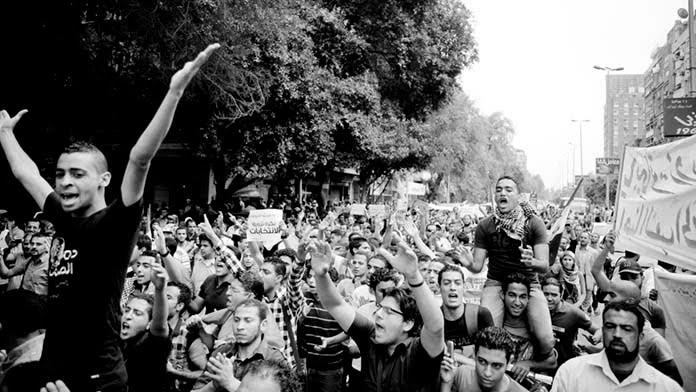
After the Egyptian revolution of 2011 it was the army that worked to re-establish a murderous dictatorship to end continuing strikes and protests that threatened the interests of capitalism in Egypt.
The military is willing to use violence even against a democratically elected government.
The ultimate example of this is what happened in Chile in 1973, when the Allende government was seen by the ruling class to be encouraging rather than suppressing the combative workers’ movement. As a result, it was overthrown by generals, who oversaw a brutal right-wing dictatorship that crushed all opposition from the left and trade unions.
This means that any challenge to capitalism will require a confrontation not only with the economic power of the ruling class but also the armed forces that defend it.
Revolutions rarely succeed without winning over or neutralising the rank-and-file of the army, as opposed to direct armed confrontation with them. For this reason, revolutionary violence can be quite minimal—directed against those that would use violence to try to preserve the old system against the overwhelming majority who want it gone.
That’s what happened in the October revolution in Russia in 1917. So few were willing to defend the old regime that not a single person was killed during the insurrection in Petrograd that brought the working class to power. It was the old ruling class that began the civil war that followed when it sought the support of imperialist countries to invade Russia to crush the new workers’ government.
The experience of countless failed workers’ revolutions—such as Germany in 1919, Spain in 1936, Hungary in 1956, Chile in 1973—has proven that any major challenge always leads to the most violent backlash from the ruling class, who will employ mass murder to defend their rule.
Revolution is not about introducing violence. It’s about ending it. We are faced with a system that delivers ever more catastrophic wars and genocide. It encourages racist violence and attacks on LGBTIQ+ people to defend its rule. And it daily uses violence against strikers and protesters to defend its profits and maintain the misery and inequality on which the system depends.
What kind of revolution?
There is also a difference between a revolution that replaces the existing political elite and one that transforms the social system itself.
When only the form of rule or regime changes, this is called a political revolution.
The revolutions in Egypt and Tunisia in 2011 for instance toppled dictators but control over the factories remained in the hands of the capitalists.
A social revolution involves the transfer of power from one class to another.
The revolutions in England in the 1600s and France in 1789 were social revolutions because they destroyed feudal monarchies and opened the way for capitalist rule.
Under capitalism, many revolutions begin as a challenge to the political elite. But during this fight, working class power can emerge as an alternative to the capitalist system.
This raises the potential for the political revolution to become a social revolution that replaces the rule of the capitalist class with the rule of the working class, which can organise society democratically on the basis of need rather than profit.
The Russian Revolution of 1917 was an example of this. In February, mass strikes and mutinies toppled the Tsar’s dictatorship. But landowners still controlled the land, capitalists still owned the factories and the new Provisional Government continued the war that had driven people into revolt.
Over the following months, however, workers, peasants and soldiers built their own organs of power through the soviets (Russian for councils). This created a situation of dual power that posed the question of whether the capitalist class or the working class would run society. In October, under the leadership of the Bolshevik party, the soviets seized state power.
Getting rid of capitalism requires such a social revolution. It is only by developing the working class’s power to challenge the system that socialism and the radical change needed is possible.