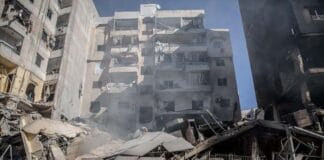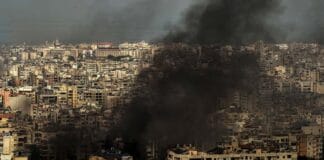

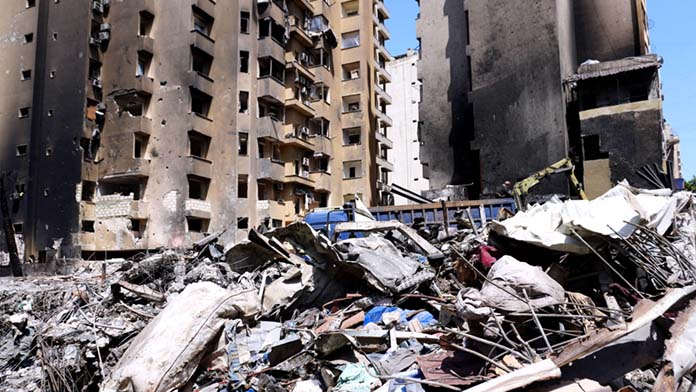
Within hours of the ceasefire announced with Iran, Israel launched its biggest and most destructive assault on Lebanon to date. Over 100 strikes rained down without warning in ten minutes, hitting densely populated areas of Beirut, killing at least 300 people and injuring more than 1500.
Pakistan, which oversaw negotiations between the US and Iran, said the ceasefire explicitly extended to Lebanon. Israel refused to comply, and the US backed its continued onslaught.
The Lebanese Health Ministry says that at least 2214 people have been killed since the war resumed. As in Gaza, Israel has targeted medical workers and journalists.
This is another example of Israel’s brutal “Dahiyeh Doctrine” practised during the 2006 war on Lebanon, which involved intense bombing including of Beirut’s southern area of Dahiyeh inflicting the deliberate destruction of civilian infrastructure as an intentional strategy of collective punishment of civilians.
After the November 2024 ceasefire agreement, Israel never stopped bombing Lebanon. During the ceasefire it killed around 400 people in over 1400 military attacks inside Lebanon.
Its new assault is aimed at finally crushing Hezbollah and driving it back far from Israel’s border in order to end any resistance to Israeli domination.
This is part of its broader aim to secure regional dominance, or as Israeli Prime Minister Benjamin Netanyahu put it, to make Israel a “super-nation in the region and globally”.
Israel has again launched a ground invasion of Lebanon, declaring the whole area south of the Litani River, roughly 10 per cent of Lebanese territory, a “military zone”.
This has forced 1.2 million people, roughly one fifth of Lebanon’s population, to flee their homes.
Israel says it intends to set up a new “buffer zone” inside Lebanese territory and keep permanent control of a wide area of territory. Israeli Defence Minister Israel Katz has pledged to demolish entire towns “like in Rafah and Beit Hanoun” in Gaza. It has already carried out mass detonations of buildings in the villages of Taybeh, Naqoura and Deir Seryan near the border.
This is designed to permanently displace residents from these areas.
This campaign is part of a decades long imperialist project that researcher Hassan Nizar describes as “reshaping the demographic and geographic landscape through destruction, displacement, and making areas uninhabitable”.
Far right Israeli Finance Minister Bezalel Smotrich has called for extending Israel’s border all the way to the Litani River. Since Israel’s founding, right-wing Zionist organisations have viewed control of this area of Lebanon as part of a future “Greater Israel”.
During the Nakba in 1948, 100,000 Palestinians were violently displaced into Lebanon where they and their descendants continue to live as refugees. Israel has invaded Lebanon six times before, including major invasions in 1978 and 1982 that saw it continue to occupy Southern Lebanon until early 2000.
Lebanese resistance
Hezbollah emerged as a resistance movement to Israel’s occupation after the war in 1982.
Although Israel has held direct talks with the Lebanese government it has refused to discuss any ceasefire with Hezbollah.
The new Lebanese government formed in February last year with the support of the US and France is committed to collaborating with Israel and Western imperialism to weaken Hezbollah. After “exploratory” talks in Washington, the Israeli ambassador to the US declared that the Lebanese government was on “the same side of the equation” as Israel in seeking to disarm Hezbollah.
Israel’s foreign minister has explicitly called for Lebanon to work towards normalising relations with Israel, which Lebanon has never recognised as a legitimate state.
But resistance to Israel and the West’s imperialist aims to dominate Lebanon predate Hezbollah. It is part of a broader history of resistance to occupation and western imperial control of the region, reflected in the deep-seated Lebanese solidarity with Palestinians and the resistance to Israel’s colonial violence.
This sentiment is seen today in the streets of Beirut where hundreds protested in defiance of the talks and in support of the resistance.
Israeli military operations in Lebanon, Gaza, and Iran are not possible without direct US support.
The US endorsement of continued strikes on Lebanon is part of enabling and legitimising Israel’s violence, as part of a broader project to eliminate Iran as a regional counterweight and consolidate Israeli dominance in the region.
The Australian government is a firm supporter of this agenda. The Labor government has only called for a ceasefire in Lebanon as a result of growing pressure. We have to keep demanding sanctions and a complete end to Australian support for Israel, whose expansionism and genocide are the key cause of the violence across the region.
By Georgie Marks