
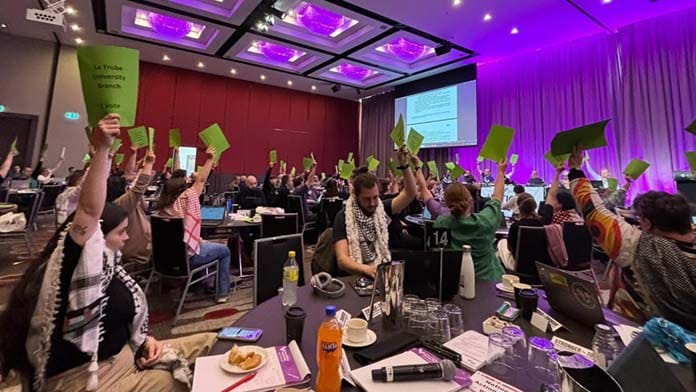
On 5 October, the National Council of the National Tertiary Education Union (NTEU) voted to endorse an institutional academic boycott of Israel.
The National Council includes more than 100 rank-and-file delegates elected from all NTEU branches. More than 90 per cent of delegates voted to support the boycott motion.
The motion commits to union to boycott terms outlined by the Palestinian Academic and Cultural Boycott of Israel (PACBI), a campaign initiated by Palestinian academics and cultural workers in 2004. This includes prohibition on any forms of co-operation with Israeli academic institutions.
The motion also commits the NTEU to a campaign aimed at university administrations, demanding an end to ties with Israel, along with cutting all ties “with the weapons industry and militaries in general”.
This vote was a major breakthrough for the pro-Palestine campaign on campuses and broader efforts to commit Australian unions to Boycott, Divestment and Sanctions.
Pro-Palestine activists in the NTEU have worked for more than a decade to build support for the academic boycott, with similar resolutions vigorously debated at previous National Council meetings, but failing to pass.
A large influx of university workers into the movement since the beginning of the current genocide in Gaza, and focussed rank-and-file organising, has transformed the debate in the NTEU.
NTEU branches across the country supported the wave of student encampments earlier this year, helping to build understanding of links between Australian universities and the genocide in Gaza and popularise the demand to cut campus ties.
In May, over 300 staff at an NTEU meeting at Sydney Uni voted to support the academic boycott. This was followed by similar resolutions at members meetings at Melbourne University, UNSW and UTS, along with the Tasmanian and ACT Divisions.
In September, a mass online meeting held by the rank-and-file group NTEU for Palestine endorsed the resolution that was taken to National Council, and called a National Day of Action on 23 October to press demands on university administrations.
As a result of the National Council motion, the NTEU promoted 23 October through emails to all members. Events were held at more than ten campuses.
At UTS, the biggest staff mobilisation since the genocide began joined with students for a lively rally.
After merging with a march from Sydney Uni and students and staff from other campuses, students led a brief occupation of the UTS Engineering building, demanding UTS break its partnership with the Israel Institute of Technology (Technion).
With strong union policy behind them, the challenge facing pro-Palestine staff on campuses is now to keep building momentum and take focussed action that can force universities to cut ties with Israel.
By Paddy Gibson