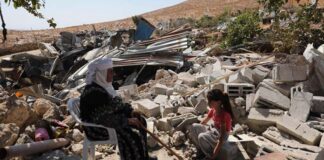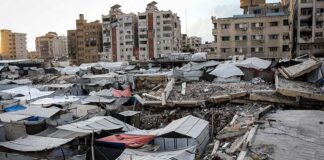

Despite Israel’s declaration of ceasefire, the number of dead in Gaza continues to rise. Bombings and incursions into the Strip are still claiming civilian lives. Israel’s blockade still restricts access to basic supplies like water and food. As Palestinian activist and English Professor Haidar Eid puts it “we still have 24-hour surveillance by Israeli drones flying overhead, we still hear the F-16’s and Apache helicopters”.
Likud leader and advocate of ethnic cleansing Benjamin Netanyahu swept to power in the Israeli elections on January 13. Netanyahu won favour by criticising Ehud Barak’s Labor Party for failing to “finish the task” in Gaza.
Instead of seeking a genuine ceasefire, the West is backing Israel’s efforts to secure Hamas’s capitulation. UN General Secretary Ban Ki-moon has supported the latest ceasefire and called it “the first step leading to the full withdrawal of Israeli troops from Gaza”.
Many around the world are looking to the Obama administration to restart peace negotiations. According to the administration: “lasting peace is our objective and the United States will sustain an active commitment to reaching the goal of two states living side by side in peace, stability, and security.”
But Obama’s peace envoy, George Mitchell, emphasises the key to a “durable ceasefire” as “preventing illegal arms trafficking” to the resistance in Gaza. Obama has sought to justify Israel’s attacks, saying “If somebody was sending rockets into my house, where my two daughters sleep at night, I’m going to do everything in my power to stop that… I would expect the Israelis to do the same thing.” Mitchell and the US have ruled out negotiations with the democratically-elected Hamas.
Peace process a fraud
The closest the peace process has come to a settlement was during the negotiations following the signing of the Oslo Accords under the Clinton administration. Over the seven years of negotiations the Israeli government used “urban planning regulations” to illegally annex territory and demolish Palestinian homes. The rate of Israeli settlement in the West Bank and Gaza Strip almost doubled. Arbitrary border closures cut off families and means of survival for thousands. From Israel’s point of view the negotiations were both a response to their failure to crush the earlier Intifada of 1987-1992, and an attempt, in the words of Edward Said, to “repackage the occupation”.
Supporters of Israel often refer to its “offer” of 90 per cent of the occupied territories as a Palestinian state at the Camp David negotiations in 2000. Though the figure is an exaggeration (others estimate it was between 17-50 per cent of the territories) what Israel actually offered was a series of non-contiguous areas, surrounded by Israeli settlements and military bases. They were split into disconnected areas without independent borders.
As one Israeli leftist put it “it is like saying that prisoners are in control of the prison because they occupy 90 per cent and the governor and the wardens only 10 per cent”.
Israel inflicted a catastrophic decline on the Palestinian economy, intensified by the 20-month siege and punctuated by military offensives like the one we have just seen.
The second Intifida of October 2000 was the Palestinian response to a “peace process” that left them more disenfranchised than before it had begun.
Israel has continually refused to offer a real, just peace by recognising the right of return for Palestinian refugees forced to flee in 1948 and after, and constitutional rights for non-Jews still living inside Israel. This can only be achieved in the context of a single democratic, secular state that would include and benefit equally all residents of historic Palestine.
While the ideology of Zionism—that of an apartheid “Jews-only” state—remains, and while Israel continues to be the US’s chief guarantor of control of the Middle East, all attempts at a peace will start from the assumption of Palestinian surrender.
Western leaders like Obama and Rudd have signaled their intentions to carry on along the same lines as Bush, Howard and those before them. They hope to stabilise US-domination in Iraq, push more troops in Afghanistan and make “diplomatic” threats to Iran and Pakistan. Preserving this status quo means preserving Israel as the US watchdog and all the repressive conditions that go along with that.
The hope for change lies not in Western-backed “peace processes”, but in the movements of resistance across the Middle East and the enormous outpouring of solidarity with the Palestinian struggle across the globe.
By Amy Thomas