

Albanese and the world’s most powerful governments have facilitated seemingly endless barbarism in Gaza in service of their own imperialist interests, argues David Glanz
As we tried to escape, the school was bombed again and Sila was hit in the head by shrapnel. Her head was covered in blood. I hugged her and screamed for help. My son Muhammad took off his shirt and tried to bandage Sila’s head to stop the bleeding. I shouted for an ambulance, but no one paid attention.
—Aya Husu, 25 August
There are hundreds of thousands of such stories among the Palestinians of Gaza, who have withstood non-stop horror in the two years since Israel launched its genocide.
The official death rate has passed 68,000 but everyone knows there are many more bodies that will never be counted.
Even Israeli military intelligence acknowledges that five out of every six Palestinians killed in Gaza have been civilians.
“The future feels destroyed—no one knows what to do,” Abed Alaleem Wahdan told Al Jazeera as he fled his home. “The bombing is everywhere, even in the south.”
Palestinian children have taken much of the brunt. Gaza has the highest proportion of child amputees in the world.
In August, 19 per cent of children in Gaza City were suffering malnutrition—before Israel launched its latest major attack on the area.
But Gaza continues to resist, demonstrating the Palestinian value of sumud—of steadfastness.
Sometimes the resistance takes the form of armed struggle. A roadside bomb killed four Israeli soldiers and wounded three on 18 September.
More often it takes the form of refusing to surrender. As a journalist in Gaza City wrote,
“In Gaza today, many of us feel we are living through another Nakba—one even more devastating than that of our grandparents. But unlike in 1948, Palestinians today understand that what is presented to us as ‘temporary’ displacement almost always becomes permanent. That is why so many of us refuse to leave, even as our homes come under fire.”
Meanwhile Israel continues to bomb—and not just Palestine. In the past year it has attacked Iran, Syria, Lebanon, Yemen, Qatar and Tunisia … without any consequences from its Western backers.
Global movement
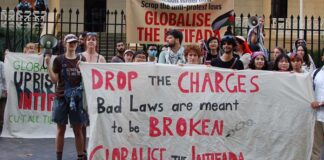
It has taken a global movement of historic proportions to force some governments in the West into token action.
Millions have taken to the streets again and again—dwarfing the massive rallies against the Iraq War in 2003 and against the Vietnam War in the 1970s in size and worldwide reach.
The movement is penetrating deeper into society, as evidenced by the 300,000 who marched across the Sydney Harbour Bridge in August, the motions calling for sanctions carried at the Victorian Labor state conference, the flowering of community, student and union groups, and the growth of a boycott movement, seen vividly with the mass withdrawals from the Bendigo literature festival.
Regardless of all this, Prime Minister Anthony Albanese insisted that he would not budge.
On 27 July, he said about recognising Palestine, “Is the time right now? Are we about to imminently do that? No, we are not.”
Just two weeks later, on 11 August, he announced that Australia would recognise Palestine.
Albanese’s aim in criticising Israel over the deaths of Palestinians is to save it. His statement on recognition boasted of Labor’s role in establishing Israel in 1947-48 and made it clear that Labor stood in solidarity with the Zionist project.
But he was forced to concede recognition because of the strength of the Palestine solidarity movement. His backflip is a tribute to our rallies, university encampments and union and community organising.
But recognition and mealy-mouthed talk of a two-state solution will not save a single life in Gaza.
The urgent priority is to demand that the Albanese government sanctions Israel and ends the two-way arms trade.
And union members need to build support in workplaces to open the way for bans on Israeli trade and services—sanctions from below.
We can take inspiration from the Greek and Italian wharfies who have refused to handle Israeli cargo and from the general strike for Palestine in Italy in late September.
Arms sales
Gaza is in ruins. Hamas has been severely degraded as a fighting force. A ceasefire and IDF withdrawal would see the remaining hostages released. So why does Israel persist with the war?
The first answer is, because it can. For two years, with one small, temporary exception under Joe Biden, the US has poured weapons and ammunition into Israel. In just the first two months of the new Trump administration, the US approved $18 billion in arms sales.
In mid-September, the White House announced that the US would sell Israel another $9 billion in weapons, including 30 Apache helicopters and 3250 infantry assault vehicles.
Meanwhile, the ABC reports that the Department of Defence is allowing at least 35 military export permits to Israel to go ahead.
Israeli Prime Minister Benjamin Netanyahu benefits personally from the continuation of the genocide, which pleases his far-right coalition partners and keeps his government afloat.
If his government fell, he would face corruption charges.
But he is playing for much bigger stakes. Netanyahu sees an opportunity to dramatically expand Israel’s borders with Trump’s support.
Israel has already seized more territory from Syria in the Golan Heights. It controls a zone in southern Lebanon after destroying villages to drive out residents. In February, Israeli Defence Minister Israel Katz said his forces were “staying indefinitely”.
And while the world watches the horror in Gaza, Israel is stepping up ethnic cleansing in the West Bank as a prelude to possible annexation—meaning the land would become part of the Israeli state.
In January, it sent tanks into Jenin and neighbouring Tulkarem—nominally under the control of the Palestinian Authority—razing large areas of the Palestinian refugee camps in both cities and demolishing buildings in other areas.
The mayor of Jenin told the BBC that about 40 per cent of the town was now held by the Israeli military, with about a quarter of residents—including the entire camp—driven from their homes.
In a statement that should finally bury the illusion of a two-state solution, Netanyahu declared, “A Palestinian state will not be established west of the Jordan River … Moreover, we doubled Jewish settlement in Judea and Samaria [the West Bank] and we will continue on this path.”
He told Israeli settlers on the West Bank, “This place is ours. We will see to our heritage, our land and our security.”
With the endorsement of Trump’s grotesque real estate fantasy for the Gaza waterfront, Netanyahu seems intent on ethnically cleansing the Strip and annexing it, too.
Israel lobby
Why does the US and its allies like Australia let Israel continue with these crimes against humanity?
A common response is that the US is controlled by the dictates of the Israel lobby, which funds politicians and organises lavish free trips to Israel.
But that gets things around the wrong way.
The Israel lobby has influence because it is pushing at an open door—it is in the interests of US imperialism to have a strong and dependable ally in the region.
Israel can be relied upon to punish those who endanger the West’s vital interests in the Middle East, which contains 50 per cent of the world’s oil supplies.
Those interests are not only fossil fuel profits but access to the Red Sea and the Suez Canal, which handles up to 15 per cent of worldwide trade and about 30 per cent of global container traffic.
The US is not motivated just by immediate profits. Control in the region gives it leverage over its main rival, China, as well as India and even Asian allies, all of which rely heavily on Middle Eastern oil.
China buys about 90 per cent of Iran’s shipped oil. In addition, 60 per cent of China’s trade with Europe passes through the Suez Canal.
It is these imperialist interests that ensure that US politicians line up to pledge support for Israel and are keen to punish those who denounce the genocide in universities and elsewhere.
Albanese has broken ranks with Trump on the token issue of recognition but he and the rest of the Australian ruling class remain just as committed to Israel as an ally in the Middle East.
World politics
Over the two years since 7 October 2023, Palestine has been at the centre of world politics and political activism.
Gaza has become for millions a symptom of a rotten system.
Politicians spout about Western “values” while watching Palestinian children starve. University leaders talk of diversity and inclusion while witch-hunting staff or students who speak up against the genocide.
The media falsely accuses Palestine protesters of antisemitism while promoting March for Australia rallies led by Nazis.
We’re told that Hamas are terrorists and that Palestinians have no right to resist—while the government is spending $368 billion on nuclear-powered submarines to be used in a war with China.
As we enter the third year of mass slaughter in Gaza, we need to turn our disgust and anger with this hypocrisy into ever greater action.
There will be demonstrations across the country on 12 October to mark the second anniversary of the genocide.
We need to carry the message of solidarity with Palestine and the demand for sanctions into workplaces, lecture theatres and the streets.
We need to build the largest possible turnout and deliver a message that Albanese cannot ignore.