
The ACTU has announced what is says is an industrial strategy to fight the budget. The recognition that unions have the power to fight the budget through strike action to make bosses pay is welcome.
This can be the basis for forcing a discussion inside the unions about what a real industrial campaign can look like.
But sadly, the ACTU is not talking about an industrial strategy to actually defeat the raft of nasty budget reforms, which are currently in crisis due to blockages in the Senate and a massive public backlash.
Instead, the ACTU plans seem to accept that the reforms will pass into law, and restrict union action to a push for new clauses in enterprise bargaining agreements to make bosses pay the costs.
As ACTU Secretary Dave Oliver explained, “More than 4 million Australian workers are covered by enterprise bargaining agreements and unions will be fighting to get clauses into all new agreements to help workers cope with the harsher budget measures.”
This will include plans for employers to pay the $7 GP fee on every occasion a doctor’s certificate is required for a day off sick, compensation for any increase to fuel tax and a “working parents allowance” of $13.75 a week to make up for freezes to the childcare rebate.
As the Save Medicare campaign in Sydney pointed out in an open letter responding to the ACTU announcement, “we are extremely concerned with a strategy that seemingly accepts and is framed solely on the basis that Abbott’s attacks, including the destruction of Medicare, will actually pass into law.”
A strategy based on fighting to recoup the costs of the budget attacks in enterprise agreements will no nothing to help workers not in unions, or those in workplaces without the industrial muscle to force employers to accept the clauses. It accepts a sectional response to the budget attacks, rather than looking to mobilise the whole union movement to fight on behalf of the working class as a whole.
Worse, the aim of some of the key budget changes is far broader than simply the direct costs it will impose on workers in the here and now. The GP fee for instance is primarily an ideological attack aimed at destroying Medicare as a universal health system.
This point was also made by Save Medicare in their letter, “what is at stake in the current struggle over Medicare is not simply the economic impact of $7 co-payments for low income people (as real as this will be), but also that any co-payment opens the door to constant attempts to shift increasing costs onto workers and the poor once the hold of bulk-billing is lost.”
Stopping the plans outright
According to the ACTU’s Working Life website, “unions reiterated their main priority will be to stop measures such as the $7 GP co-payment and the reintroduction of fuel excise indexation from ever being implemented”.
But instead of outlining how this aim can be achieved through struggle, senior union leaders have simply talked of a campaign focused on voting Abbott out in two and a half years’ time.
Some of the budget cuts have already been allowed to go through, with jobs already going at CSIRO and in the federal public service. These cuts could have been stopped. They remain deeply unpopular.
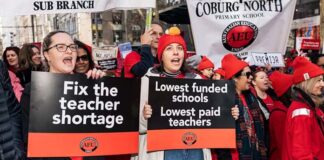
What is needed to defeat the remainder of the budget is a campaign of large, angry demonstrations and ongoing stopwork rallies. This means a union mobilisation at least on the scale of the Your Rights at Work campaign against WorkChoices. This saw tens of thousands of unionists take part in co-ordinated national days of stopwork action in 2005 and 2006.
Such a campaign could cost the bosses millions and make big business think the agenda of cuts is not worth the pain.
The ACTU has set a date for a national day of action on a weekday on 23 October. But as yet there is no indication of whether this will involve serious stopwork action.
As we go to press the date for union delegates meetings planned in September is barely a month away, but the meetings have not been officially announced.
Every union member need to start the discussion in their union about mobilising for the October day of action now. Motions passed at union branch meetings pressing union leaders to stage stopwork action on the day can help make sure they take the mobilisation seriously.
In Sydney union activists are organising a meeting on Saturday 6 September to discuss what can be done to push for a more serious campaign against the budget. Abbott is in a world of trouble. We can’t afford to let him off the hook.
By James Supple