

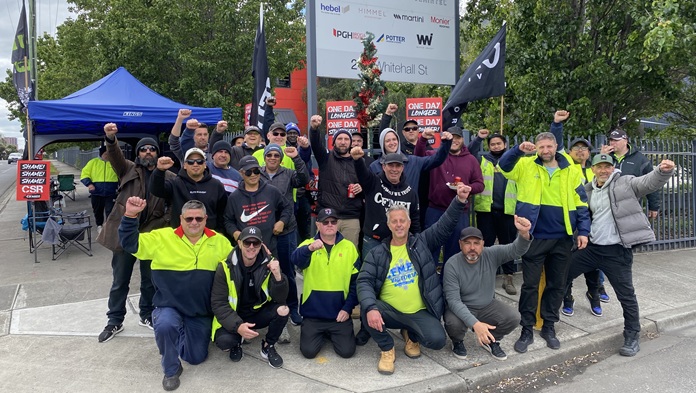
Some 68 skilled production and warehouse workers at CSR Gyprock in Yarraville, Melbourne, have been on strike for almost three weeks. They are fighting for an above-inflation pay rise and an increase in the skills allowance from 65c to $1 an hour.
The strikers, members of the Construction Division of the CFMEU, now under Administration, were forced to walk out on 15 November by a hard-nosed management, intent on undercutting the union by increasing the use of casual labour.
When workers began limited industrial bans after 21 weeks of EBA negotiations had gone nowhere, the company refused to pay them, giving them no choice but to strike.
The company is only offering 4 per cent in each of the first two years, 3.5 per cent in the third and 3 per cent in the fourth, whereas the strikers want 4 per cent for each year. With inflation back to almost 4 per cent, the company’s offer is likely to deliver a pay cut after inflation and comes after pay rises in the last EBA failed to keep up with the cost of living.
“The pay rise is one thing but the company is keen to change the employment clauses about casuals becoming full-time. We will fight them on this,” one of the strikers, Con, told Solidarity.
Another striker, Frank, said, “They’re trying to screw us. They are using casuals who aren’t trained up to make plasterboard properly.”
The company is digging in its heels despite it raking in the profits.
CSR Gyprock’s parent company CSR, a multinational industrial conglomerate, made $231 million profit last year, an increase of 7 per cent.
The company makes Gyprock plasterboard used in residential and commercial construction. CSR is the largest plasterboard maker in Australia and the only brand stocked by Bunnings.
CSR was bought out by French multinational Saint-Gobain (SG) in July 2024 for $4.5 billion.
In 2022 Benoit Bazin, its French Executive Director, was on $3.3 million a year. Ludovic Weber, his Australia-Pacific CSR CEO, is estimated to be on $500,000.
The last EBA saw the same workers forced to strike for four weeks in November 2021. During that strike management stopped production and brought forward its annual two-week maintenance period.
This time, in a sign of their intent to take on the union, they are using salaried staff and casuals to keep production going. They have also tried to fill warehouses so they have enough stock to wait out the strike.
The workforce is determined to hold out “one day longer, one day stronger” than the company. But they risk being starved back to work.
In August 2024, CFMEU members at building materials manufacturer Etex in Sydney were pushed into accepting a lousy pay offer after seven weeks locked out.
A hard picket line to stop the company moving trucks and plasterboard out of the factory could force it to give in.
This requires defying the Fair Work laws—which make effective picket lines illegal.
But the CFMEU’s control by Administration stands in the way of this. Administrator Mark Irving has made it clear he wants to end any efforts by the CFMEU to defy the anti-strike laws.
The workers need all the support they can get.
Supporters are welcome to visit the picket line at 277 Whitehall Street, Yarraville.
CSR’s history of exploitation
CSR has a history of screwing its workforce from its very beginning.
CSR started out as the Colonial Sugar Refinery, founded in 1855 by a handful of Sydney capitalists such as Edward Knox, with loans from the predecessor to Westpac Bank.
It used coerced labour “recruited” from the Pacific Islands on its Queensland and Fiji sugar plantations. At times labourers were kidnapped and taken to the sugar fields by force.
This use of indentured labour was similar to slavery. Workers were paid but at rates far lower than other workers.
CSR refused to burn parts of sugar canefields to stop Weil’s disease, spread by rats, because it reduced sugar content, until a strike in mid-1935 by cane cutters and millhands forced them to.
The newspaper-owning Fairfax family bought shares in CSR and married into the Knox family early on.
Its papers campaigned for a “White Australia Policy”, with an exception for the sugar industry, while keeping its share ownership in it a secret.
CSR “diversified” into building products in the mid-20th century, buying up a whole series of companies, such as Bradford Insulation and Monier.
It created a joint venture with Boral called Rondo and spun-off a separate heavy building products company called the Rinker Group. It created and sold off Viridian Glass.
This made CSR a large manufacturer of other building products, including bricks, cladding, insulation and roof tiles.
CSR once owned the Wittenoom asbestos mine in WA. Julie Bishop defended CSR in court as a lawyer in a 1980s asbestos case before she became a Liberal MP and Foreign Minister.
Its history shows that Australian bosses are every bit as profit hungry and ruthless as any overseas multinational.
By Tom Orsag