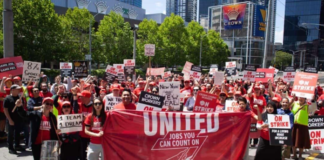

DP World’s threat to cut 200 jobs was, “corporate bullying and intimidation using the livelihoods of wharfies in an attempt to intimidate the workforce into accepting anything the company wants,” according to Warren Smith, Maritime Union of Australia Assistant National Secretary.
In July workers staged two weeks of industrial action across the country, striking for 48 hours from 8 July in Brisbane, Sydney and Fremantle and for four days in Melbourne. The following week workers in Sydney held another 48 hour strike, another 24 hour strike in Fremantle and a series of one-hour stoppages in Brisbane.
Enterprise bargaining talks have dragged on for over ten months, with the company demanding major cuts to workers’ conditions as the price of a new agreement. The port operator employs 1800 workers across its operations in Melbourne, Sydney, Brisbane and Fremantle.
DP World claimed that job cuts and more “flexibility” were necessary due to loss of market share and competition from other port operators. Yet it is part of a highly profitable global giant that made a profit last year of $1.3 billion, an increase of 10 per cent. The multinational has admitted that it paid no tax in Australia last year.
Its plan for job cuts would have allowed it to replace permanent jobs with casual staff. It also flagged outsourcing cargo care (the monitoring of refrigerated containers) as well as maintenance and refuelling, to allow cut-price non-union operators in these areas.
Such outsourcing is a risk to safety standards, as DP World’s use of an outsourcing company during one of the strikes shows. Wire ropes on a crane used to unload shipping containers “catastrophically slipped”, according to the union, most likely as a result of the company, which had never worked on the cranes before, incorrectly replacing the ropes.
DP World has also raised the prospect of automation, telling the Financial Review “we have that option” if the union refuses to agree to cost cutting. The MUA is asking either for job security clauses in their new agreement that would protect workers in the event of automation, or an undertaking from DP World that it will not take place during the life of the agreement. “We won’t stand by while outsourcing and automation are used to axe quality jobs from the Australian waterfront,” Smith responded.
For now, there is a stalemate. Strike action has forced DP World to lift the threat of job cuts in return for the union ending all industrial action. Enterprise bargaining discussions are back at square one.
But there is no need to wait for months’ more negotiations. Bans and strike action have shown how to stand up to the company’s attacks and win workers’ demands for conditions, safety and job security.
By James Supple