
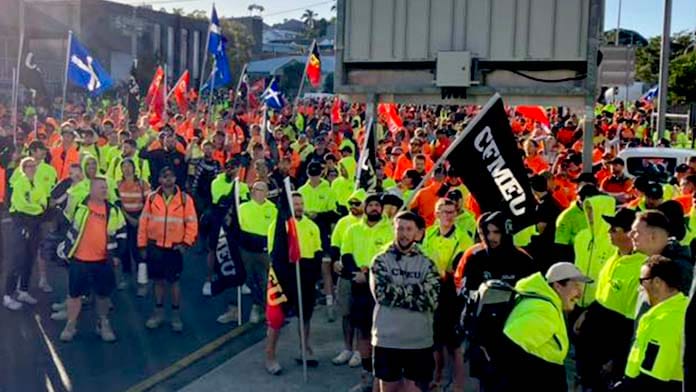
One year on the Administration regime has secured a tight grip on the CFMEU.
Administrator Mark Irving reported to parliament that “a large number of organisers in NSW and Queensland have exited the union” and been “removed in South Australia”, in his second six-monthly report tabled at the end of August.
In total 75 per cent of the organisers in NSW and about half of those in SA and Queensland have been replaced, it said.
The Administration is ridding those state branches of organisers, employed by the former democratically-elected officials, who were committed to industrial militancy.
Irving wants organisers who won’t challenge the anti-union laws of the Fair Work Commission (FWC) that restrict the right to strike and a union that collaborates with the bosses.
Many activists within the union have given up on resisting the Administration.
But organising within the union independently of the Administration, based on delegates and activists across building sites, is urgently needed to push back against this tame cat agenda and keep alive the militant traditions of the CFMEU.
Irving’s report sings the praises of the National Construction Industry Forum (NCIF), a class-collaboration body set up by the federal government involving the union and employer groups.
CFMEU staff including National Secretary and Victorian Executive Officer, Zach Smith, and National Legal Director of the CFMEU, Lucy Weber, sit on the body.
They do so alongside bosses’ groups like the Master Builders Association and the Civil Contractors Federation.
Irving’s report talks about the NCIF’s Blueprint for the Future, which involves increased productivity and the goal that “adversarial relationships give way to a culture of collaboration and shared interests”.
But the union and bosses do not have shared interests in higher wages for workers or guaranteeing safety on sites.
These can only be won through a fighting union that is prepared to defy to anti-union laws.
Queensland
Since the High Court rejected the legal challenge to Administration in June, the Queensland branch has been particularly targeted.
It was the only branch to respond with industrial action against Administration, with a two-day strike to protest against the court ruling.
Another result of Administration is that the CFMEU in Queensland is now facing a frontal assault on the union’s hard-won wages and conditions from a rampant Liberal National Party state government.
The LNP sees further attacks on the union as a way to address a combination of a housing shortage and the massive infrastructure projects required for the 2032 Brisbane Olympics.
A state-run Productivity Commission into the construction industry, set up by LNP Premier David Crisafulli, has been used to justify scrapping union rights under the Best Practice Industry Conditions (BPICs).
The commission has also called for a “broader reset” of already-negotiated EBAs in order to meet “productivity targets” for Olympics construction.
Crisafulli and the LNP government want to take full advantage of the climate created by the media campaign against the CFMEU and the union’s neutering by Administration to further the LNP’s anti-union agenda.
Crisafulli has publicly stated, “There’s no place in modern Queensland for the CFMEU.” This implies tame-cat unions like the Australian Workers Union are more than likely to be favoured on state government contracts for construction work, at the expense of the CFMEU.
Queensland CFMEU organisers close to the former elected branch leaders have capitulated to these demands for “productivity”, supposedly as a way to “get out of Administration”.
There is no prospect of this happening soon. Administrator Irving told Queensland CFMEU staff in September 2024 that no state or territory branch of the union will exit Administration for at least three years.
And it means accepting attacks on wages and conditions that the CFMEU has won over many years.
Building companies and property developers are queuing up to argue that rostered days off and pay rises are impacting “productivity” in Queensland.
Don O’Rourke, CEO of Consolidated Properties, has blamed “union rules that restrict working days” for “worsening the state’s housing crisis”.
In reality there are simply not enough construction workers for the work in the pipeline, including the Olympic stadium and other venues, new hospitals and a major rail tunnel.
The CFMEU has won the support of construction workers for its relentless campaigns to maintain safety at work. Greater productivity too often comes at the expense of more dangerous conditions.
There is a real danger that the CFMEU’s ability to defend workers and maintain safety standards built up over decades will wither as the Administration rolls out its plans. This can’t be allowed to happen without a fight.
By Tom Orsag