
The first contested election for Australia’s biggest blue-collar union, the United Workers Union (the ballot opens 30 April), has become the focus of an intense debate about the way forward for the union.
The outcome of the election will have implications for working class struggle and Labor Party politics over the next few years.
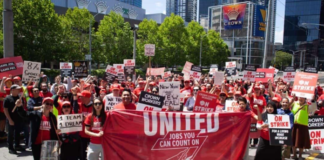
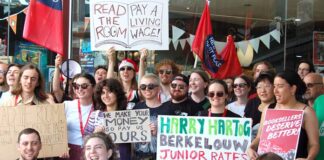
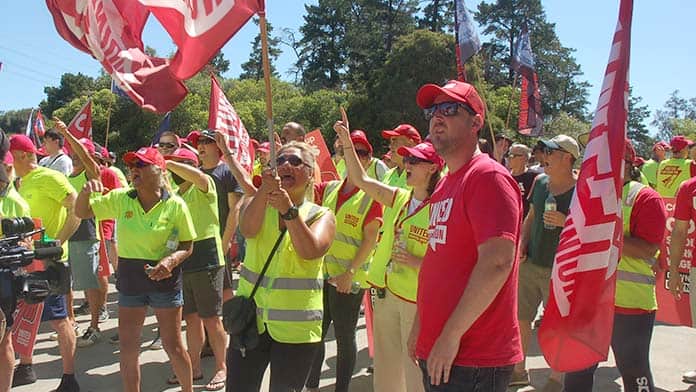
The UWU was formed in 2019 from the amalgamation of United Voice and the National Union of Workers. The union, with around 150,000 members in 45 industries, covers warehouses, casinos, call centres, aged care, early childhood education and more.
Two tickets are contesting the election, Members First headed by current national secretary, Tim Kennedy (previously national secretary of the NUW) and United for You headed by Jo Schofield, the current UWU national president and previously national secretary of United Voice.
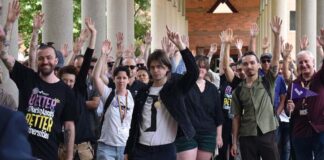
Hundreds of union members have attended enthusiastic Members First launches in Sydney and Melbourne.
Although the tickets are headed by the previous national secretaries of the amalgamated unions, what’s at stake is not just a bureaucratic power struggle.
Kennedy says, “Members First is committed to rebuilding rank-and-file industrial capacity by investing in delegates, strengthening workplace organisation and putting decision-making powers back with members …
“Without industrial power, political gains are fragile and short-lived. The history of labour movements internationally has shown that power in the workplace is not gifted by sympathetic governments but sustained through constant collective struggle.”
Schofield stresses the value of political campaigning, pointing to school cleaners who the NSW Labor government agreed to directly employ and the $3.6 billion in federal funding from Labor for a 15 per cent pay rise for childcare workers.
But militancy is a real question. Schofield told the Financial Review, “If you’re a disability worker you aren’t easily able to walk off the job because there are people you are caring for.”
United for You stresses lobbying Labor in its election material. Treasurer Jim Chalmers, Queensland Senator Murray Watt, responsible for imposing government Administration onto the CFMEU, and Health Minister Mark Butler are among the Labor MPs backed by UWU.
But there is considerable disquiet that the emphasis on lobbying Labor comes at the expense of organising industrially.
Nicki Toupin, a Victorian early childhood education worker and UWU delegate, told Solidarity, “I was growing the membership in 2024 before our planned walkout on International Women’s Day for our multi employer bargaining claim.
“Then the union cancelled it and people drew the conclusion, why bother being in the union.
“They settled the MEB for 10 per cent less that what we were asking for—15 rather than 25 per cent. There was no suggestion that we could have walked out and got more.”
Now Labor’s much–vaunted 15 per cent pay increase for early childhood workers is set to expire in November. Unless federal Labor includes the pay increase in the May budget, childcare workers are facing a pay cut of up to 6 per cent.
Nicki is supporting Members First. “This election defines what unions should be in the 21st century. The United for You ticket stands for the service model that we’ve seen for the past two or three decades, that’s still pushed largely by the ALP.
“The Members First ticket is linked to the rank-and-file model which goes back to what actually works—building power on the ground and pushing from below. I’ve some confidence that Members First mean what they say. It’s a bureaucracy so there are always limitations.”
Parsa Zaher, a UWU casino delegate in Sydney told Solidarity, “The dynamic is really grassroots.
“It’s delegates and rank and filers versus a top leadership who’ve been in that position for about 20, 25 years.
“The cost of living is still going up; we have to make sure we are on top of that. The union is the only way wages are going to be pushed up. If the union’s not strong enough to win, wages will keep falling further behind inflation.”
Hunter, a UWU delegate at a call centre in Melbourne and a hospitality worker, is hoping a Members First win means more organisers to back up rank-and-file organising.
“If they win they will need to follow through with their promises. They are a bit like politicians and we need to see them act,” they warned.
Solidarity would welcome a Members First victory. But no matter who wins, it will be workplace organising that will be crucial for UWU members to fight, independently of the leadership, if necessary, to take the struggle up to the bosses and the Labor government, to win real wages, staff ratios and permanency, in the struggles ahead.
By Ian Rintoul