
Workers at Harry Hartog and Berkelouw Books have walked out on strike again from Saturday 20 December for five days until Christmas Eve, after another insulting wage offer from management.
The weekend before, over 100 workers across 19 stores and four states and territories, organised by the Retail and Fast Food Workers Union (RAFFWU), staged their first ever strike from 11am on Saturday and all of Sunday.
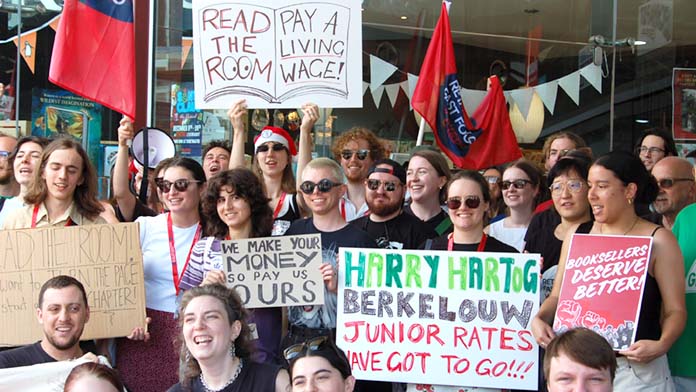
On Saturday 13 December, around 150 workers and supporters gathered outside Berkelouw Books in Leichhardt to kick off the nationwide strike action.
The workers are currently under a 13-year-old deal that was negotiated between six café workers at the Leichhardt store in 2012, with no union involved. This agreement was then imposed on retail workers at every Berkelouw and Harry Hartog store in Australia.
This deal includes the disgraceful casualisation of part time work, low wages, junior rates, and the denial of penalty rates for work on weeknights and Saturdays.
Booksellers are also often expected to purchase books with their own money and do unpaid labour off-the-clock to read them and write reviews for the store to display.
Jessica Sant, a RAFFWU delegate at the Penrith store, told the crowd of her experience of the “abysmal” Enterprise Bargaining Agreement (EBA). Jessica was given no notice for the financial shock of having her weekly shifts reduced from 30 hours a week to as little as four hours when her store’s hours were suddenly cut.
The company has tried to justify the lack of penalty rates by pointing to the marginally above-Award pay rate in the 2012 agreement.
“Yet if I were working under the current retail award,” Jessica said, “I would be earning an extra $198 a month. That’s over $2000 a year I’m missing out on due to a rotten zombie agreement. In a rapidly worsening cost of living crisis where every dollar counts, how is this acceptable?
“We did not want to strike today. We would rather be in our bookstores recommending stories to our customers and brightening their day as they brighten our own, but we can no longer sit around and pretend that this zombie agreement values proper and fair working conditions for booksellers over the profit of the business.”
RAFFWU Secretary Loukas Kakogiannis explained that, “[These workers] want a living wage. They want secure part-time work … Their hours and days change week to week. It’s shameful. It’s casual work without a casual loading.”
The union is demanding penalty rates, the abolition of junior rates for workers under 21 years (currently starting at only $19 an hour), an end to casualised conditions, protections against unfair and discriminatory treatment, leave time and an increase to the base rate for all staff to $31. They are also fighting the current review system, demanding that workers be given adequate time on-the-job to write reviews and are reimbursed for the books they are directed to read by management.
Solidarity spoke to two unionists, Harry and Rohan (delegate).
We are only using their first names due to concerns about management singling out members to harass and persecute them as union members, as experienced by other members attempting to organise.
Strike!
Rohan, a delegate who spoke at the rally, told Solidarity that after two months of bargaining, the union “[had] not been met with offers … that came anywhere close to what we’ve been asking for”. This included offers that did not increase wages or fully implement penalty rates until the third year of the agreement.
After months of insulting offers from Berkelouw, the membership voted unanimously to strike and impose work bans.
Workers are not receiving, transferring, delivering, shelving or replenishing stock. They are halting all training of staff except for safety training.
The day before their first strike, Berkelouw offered crumbs in an attempt to stop the workers taking action. This included a mere $0.34 base pay increase, minimum wage for casuals, and a bold-faced reduction in what meagre penalty rates are currently in place for Sundays.
“Offers like this are almost insulting to the demands we’ve asked for,” Rohan said.
This insulting offer was driven by the strategic timing of the strike–December is a precious time for Berkelouw’s profits, with workers usually flat-out recommending, curating and moving huge amounts of stock for the Christmas period. As Rohan explained, “Bargaining is about power and by using industrial action [workers] are taking the power back.”
“Staff members are also handing out leaflets and flyers and talking to customers about our action and why we are taking it … [we are] ramping up community awareness until the employers meet our demands,” Harry said.
With over half the staff on strike, the pressure is mounting in the run up to Christmas. Berkelouw has made several disgraceful attempts to break the confidence and impact of the industrial action.
They have encouraged scab labour by giving a temporary $2.50 pay rise to any workers who work during the strike.
They have simultaneously docked the pay of unionised workers by 37.77 per cent for participating in the work bans.
Members across stores have voted to no longer meet with management in any form, after disgraceful attempts by management to intimidate and coerce individual staff members out of participating in industrial action.
“Senior management at Harry Hartog and Berkelouw books spent the past two weeks calling our members on the phone, crying to them and begging them not to strike,” Loukas said.
The strike-breaking tactics have been unsuccessful and the Berkelouw family itself has been forced to personally staff the stores.
Members have been strengthened by the solidarity and respect from customers and comrades. The RAFFWU strike fund has been a significant buoy in supporting workers who have had their pay withheld and shifts cancelled by Berkelouw management.
“RAFFWU members are not going to be sold on a dud agreement,” Loukas said. “They know that we don’t win anything in the bargaining room with our charm and wit and intelligence. We win it through industrial power when we go on strike.”
Community members can donate to the strike fund here https://chuffed.org/project/hhbb
Building union membership
Solidarity spoke to unionists at the rally about the experiences building the union. Union membership at the company has been built up from nothing over the last few years.
Harry, a rank-and-file member, explained to Solidarity that he had to confront a lifetime of experiencing anti-union propaganda but his conviction to support his fellow workers pushed him to unionise for a fairer wage. His workplace has experienced high turnover rates of managers and staff, a challenge to building union membership. But the union has retained around 50 per cent membership there and members continue to have conversations to raise their coworkers’ confidence.
“Those who are in the union are staff who have been with the company for years,” Harry said. ”We are not naive idealists. We are people who have borne witness to the issues that have weighed down the company for years.
“At the same time, we are staff who love books and love each other. We love our jobs and that is why we are fighting to make it better for everyone. Having spent years surrounded by books written by some of the greatest thinkers in history, full of social and political wisdom, it was inevitable we were going to realise the deal we were getting wasn’t right.”
Rohan became a member of RAFFWU this year after hearing about the far higher wages his roommates were earning at other retail companies. As a delegate, Rohan acknowledged the hesitancy of workers to join the union, saying booksellers are passionate about their jobs and fear jeapordising their employment in a field that is difficult to get into.
Organising over long distances has also been a challenge, with Sydney organisers initiating contact with workers in Queensland, South Australia and the ACT to speak about nationwide action.
“It all came through conversations,” Rohan explained. “Initially we had almost one person from every store interested in unionising … those people went out and spoke to their co-workers and, in a way, ‘rallied the troops’.”
Despite these challenges, trust and confidence is growing in the Berkelouw ranks as more workers walk off the job and join their comrades in demanding fairer wages and conditions.
Members and delegates alike emphasised the importance of democratic decision-making for every step of the process. Bargaining representatives cannot make any agreements without a vote of the membership. Rohan, a delegate who is often in the bargaining room, also said that the union’s turn to action has encouraged more members to become directly involved in decision-making.
The willingness to call strikes must continue if the members want to remain on the front-foot of negotiations and reject compromises that would endanger the fair wages and conditions as well as confidence in the union itself as a mechanism for change.
Militancy and democratic trade union organising has been eroded in Australia by industrial bargaining laws and decades of union leaders selling out the rank-and-file in order to appease employers. These strikes by mostly young retail workers are an example of how to rebuild a union movement that fights for real gains for workers.
By Bri Akins