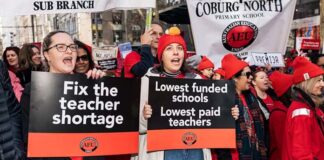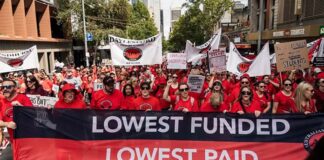

Thousands of Brisbane CFMEU construction workers took another day of illegal strike action on 23 May, marching off the job to Parliament House to demonstrate against the Labor state government delaying industrial manslaughter legislation.
The union movement has been raising the need for industrial manslaughter laws for years; the Beattie Labor government canvassed them in 2000. It was raised again at the state Labor conference in 2005. Industrial Relations and Racing Minister, and former secretary of the Queensland Council of Unions, Grace Grace, promised at the state Labor conference in 2016 that laws would be introduced, but nothing has happened.
Under existing laws workers lives are cheap. Under Queensland Workplace Health and Safety laws a breach, causing death, carries a maximum fine of just $60,000.
Grocon was fined $250,000 for safety breaches that resulted in the deaths of three people when a brick wall collapsed on passing pedestrians in Melbourne in 2013. Yet, in 2015, the CFMEU was fined $545,000 for “unlawful, intimidating and coercive conduct” during an enterprise bargaining dispute with Grocon.
One construction worker dies every week across the country. In October 2016, two construction workers in Brisbane were horrifically crushed to death between two concrete panels that had been incorrectly braced. Only a few days before, a rigger had walked off the job because of safety fears, saying that someone was going to get killed on the site.
Queensland, Tasmania and the Northern Territory are the only states that do not have industrial manslaughter laws of some kind. The CFMEU will picket the next Queensland state Labor conference in July. Unless legislation is introduced, another strike and demonstration is planned for 9 August.
Meanwhile CFMEU members are preparing for another day of strike action on 20 June, over the federal government’s efforts to re-introduce the ABCC and to take away union rights and safety conditions by demanding EBAs are “code-compliant” with their anti-union laws.
CFMEU members are showing the way; bad laws do have to be broken. Determined action can break the anti-union laws and stop the fines.
By Ian Rintoul