
Efforts across Asia to reimpose colonial rule at the end of the Second World War show that it was a struggle over the imperialist division of the world, argues Luke Ottavi
Eighty years after the end of the Second World War imperialist tensions are again rising in the Pacific, with Australia boosting its military spending by hundreds of billions of dollars to acquire nuclear submarines for a US-led war on China.
The Second World War was a calamity that left 85 million dead across Europe and Asia. The myth that Australia and the Allies fought the war in defence of democracy and freedom is still widespread.
The war in the Pacific was an imperialist struggle over economic interests and colonies that were threatened by Japan’s advance.
The Second World War, just like the first, was the result of the competition among the most powerful capitalist states—principally Britain, France, Russia, Germany, Japan and the US—to re-divide the world, its resources, and trading routes.
The Pacific war is often seen simply as the result of Japanese imperialist expansion. But US trade sanctions and competition for control of markets also triggered Japanese militarism.
The US responded to the Great Depression in the 1930s by enacting import controls that decreased Japanese exports by a quarter.
Japan invaded China’s Manchuria region in 1931 to help save its economy. But this brought it into direct competition with the US, which wanted China’s market for itself.
Japan lacked natural resources like tin, rubber, and crucially oil it needed to sustain its economy. But these could be found further south in European colonies like Malaya and Brunei.
In 1941, the US imposed a crippling embargo on Japan, cutting off all trade including supplies of oil, after Japan extended its invasion into China and then sent troops into French Indochina.
This was designed to force Japan to either capitulate to the US or declare war. As US Secretary of War Henry Stimson wrote, “The question was how we should manoeuvre them into the position of firing the first shot without allowing too much danger to ourselves.”
So the Japanese surprise attack on Pearl Harbour was not entirely a surprise to the US government. The attack brought the US formally into the war to determine whether who would control the Asia-Pacific.
There were strong hopes that the former European colonies in Asia would be granted national independence following Japan’s defeat.
Such hopes were encouraged by the Atlantic Charter authored by US and Britain.
The charter said Britain and the US would “respect the right of all peoples to choose the form of government under which they will live” and expressed their “wish to see sovereign rights and self-government restored to those who have been forcibly deprived of them”.
But at the end of the war the Allied powers, including Australia, sought to re-impose colonial rule on countries like Indonesia, Malaysia and Vietnam, suppressing national liberation movements and killing millions more.
Vietnam
Japanese troops entered Vietnam from 1941. The Vietnamese Communist Party, led by Ho Chi Minh, established the Vietminh, the League for the Independence of Vietnam, to fight Japanese forces.
By September 1945 in the wake of Japan’s surrender the Vietminh gained effective control of the country.
Ho Chi Minh and the Vietminh, following Stalin’s instructions to the Vietnamese Communists, welcomed British troops when they sailed into Saigon. Wrongly, they hoped that the Allies would open negotiations to deliver independence.
Instead the British released French troops from the prisons, unleashing a reign of terror and re-imposing French colonial rule by December 1946.
The Vietminh retreated to the countryside and launched a guerrilla war lasting another ten years. Full independence did not come until 30 years later in 1975 after the final defeat of France’s imperialist successors, the US.
Indonesia
After Japan surrendered, British troops were also the first to arrive in Indonesia, preparing the way for the Dutch to reoccupy it.
Australia was an ardent supporter of re-establishing colonial rule. The Dutch colonial government in exile was hosted in Queensland and weapons were shipped from Australian ports to British and Dutch troops fighting Indonesian nationalists who had declared independence on 17 August 1945. Australian troops were directly responsible for restoring Dutch control on the Indonesian island of Sulawesi.
Trade unions in Australia, however, prevented arms shipments for the Dutch for almost four years, with a ban on Dutch shipping supported by local seafarers as well as Chinese, Malay, and Indian sailors.
Japan had encouraged Indonesian nationalists, which meant the British were met with fierce resistance when they arrived to re-impose Dutch rule.
The British brutally bombed Surabaya to crush nationalist resistance, killing thousands to take the city after three days. So much for the promises of the Atlantic Charter.
By November 1946, the British handed over control to the Dutch. The US helped equip 55,000 Dutch troops as they attempted to re-establish colonial rule.
Indonesia finally defeated the Dutch, winning full independence after four years of fighting on 27 December 1949. About 100,000 Indonesians had been killed and seven million internally displaced.
Malaysia
Malaysia and Singapore were part of the British colony of Malaya before the war and Britain was anxious to re-impose control. It went about brutally crushing the democratic aspirations of the people of Malaysia.
Malaysians had fought the Japanese fiercely during the war-time occupation, organised through the Malayan People’s Anti-Japanese Army led by the Communist Party.
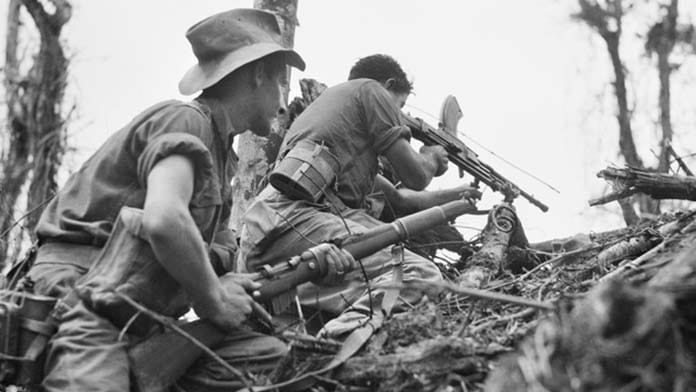
As Britain moved to re-assert control, communists in Malaysia went to the hills, conducting guerrilla warfare against the British occupation. The Australian government sent thousands of troops to assist British re-colonisation, while Australian fighter pilots dropped 500-kilogram bombs to crush resistance.
Britain forcibly moved peasants to try to cut off support and supplies to the guerrilla fighters. Some 500,000 peasants were moved into concentration camps with “barbed-wire fences, heavily-armed police guards, curfews, and other prohibitive regulations”. Australian troops patrolled the camps.
Malaya gained formal independence in 1957 but in essence continued as a British economic colony.
As in Indonesia, the aspirations of ordinary people to manage their own affairs did not figure in the calculations of the rulers of the crumbling British Empire or Australia’s ruling class.
Australian colonies
Australia itself wanted to take control of a series of Pacific territories at the end of the war. In 1943 the US ambassador reported to Washington that Australia wanted sovereignty over Fiji, the Solomon Islands and Vanuatu.
Australia proposed to Britain that it be given responsibility for running the island nations of East Timor, West Papua as well as Papua New Guinea, the Solomon Islands and share the “policing” of Vanuatu. It was rebuffed by Britain and the US who regarded Australia as too small an imperial player.
But Australia was already a brutal colonial power in the Asia-Pacific, administering the territory of Papua since 1906 and then annexing German New Guinea during the First World War along with Nauru.
Australian companies established plantations in PNG that exploited local villagers through virtual slave labour. The Australian administration jailed strikers on isolated coral islands if they dared to fight back.
The island of Nauru was destroyed by Australian business when its phosphate deposits were torn out of the ground, making four-fifths of the island uninhabitable.
Why US dropped the bomb
The atomic bombing of Japan brutally brought the war in the Pacific to an end. Official history says that the nuclear attack was necessary to force a Japanese surrender and avoid an invasion of Japan.
US President Harry Truman claimed in 1945, “We have used the bomb in order to shorten the agony of war, in order to save thousands and thousands of young Americans.”
This is a lie designed to justify one of US imperialism’s most horrific crimes.
Japan’s surrender was imminent and the US knew it. It had cracked Japanese communication codes and knew it had asked Russia to start negotiating an end to the war.
Japan’s navy and airforce had already been practically eliminated, with the US having nearly complete control over the skies and seas, bombing whatever targets it liked and enforcing a blockade of the Japanese home islands.
Japan’s capacity for war production had been shattered with the destruction of 600 of its major factories.
The US and Russia fought as allies in the war, with the US relying on Russia to defeat what was left of Japan’s armies in China. But the US, Russia and Britain had met in Yalta in February 1945 to divide up the world between them. After the war, imperialist rivalries would re-assert themselves and Russia would become the US’s key rival.
The atomic massacre of over 200,000 Japanese in Hiroshima and Nagasaki was designed to show Russia that the US possessed a power that it could not match.
Sixty per cent of Hiroshima was wiped out instantly. Those who survived the initial blast were baked by radioactive material. For months afterwards, survivors continued to die of radiation sickness. They suffered bleeding, hair loss, purple spots on the skin and extreme pain.
The nuclear weapons dropped on Japan were the opening shots of the Cold War between the West and Russia that would lead to bloody wars in Korea, Vietnam and Afghanistan that saw millions more killed.
The US emerged after the war as the dominant power in the Pacific region. In the aftermath the US displaced Britain as Australia’s key imperialist ally in the region.
For the first time since the Second World War, US domination is being challenged by China’s rise as an economic and military power. The US and Australia are again claiming to stand for democracy and freedom against autocracy as they prepare for war on China.
This clash is driven by the same imperialist competition that produced the Second World War. US military bases are expanding in the Pacific. Asian nations like Japan and South Korea are re-arming.
In Australia, we need to oppose the billions being spent on missiles and nuclear submarines and the imperialist system that is once again risking millions of lives as it fuels the drive to war.