
Paddy Gibson looks at how unions and socialists provided support for one of the major struggles for Aboriginal rights and against the racist Protection system
On 4 February 1939, Aboriginal people living on the Cummeragunja reserve on the Murray River walked off the reserve, crossed into Victoria and set up a strike camp at Barmah.
Many were Yorta-Yorta people with traditional connections to the region.
It was an iconic moment in the fight for Aboriginal rights, a creative and courageous action that is still commemorated every year.
The role the working-class movement in Melbourne played supporting this struggle, particularly the Communist Party of Australia (CPA) and socialists in the Labor Party, is less well known, but contains important lessons for continuing struggles today.
Cummeragunja was one of many reserves in NSW controlled by the Aborigines Protection Board (APB), a dictatorship with power over all aspects of Aboriginal life.
In 1937, a campaign by the Aborigines Progressive Association (APA), involving mass public meetings and media exposure of injustice, forced the NSW government to hold a parliamentary inquiry into the APB.
As part of this campaign, APA leader Bill Ferguson addressed the NSW Trades and Labour Council, winning support for a union wide position to abolish the Protection Board, grant full citizens’ rights to Aboriginal people and return “large tracts of fertile land” to Aboriginal ownership.
Despite this, the parliamentary inquiry petered out with no results.
This was particularly disappointing for Cummeragunja residents, who lived under the brutal rule of reserve manager A.J. McQuiggan and faced horrific conditions causing illness and malnutrition.
McQuiggan had been transferred to Cummeragunja from the notorious Kinchela Boys Home in 1937, after police investigations into his sadistic treatment of Aboriginal children, who he chained up and whipped.
Petitions from Cummeragunja residents throughout 1938 to remove McQuiggan were met with punishment.
Jack Patten, one of the most prominent APA members, had family ties to Cummeragunja and returned late in 1938 to lead the fightback.
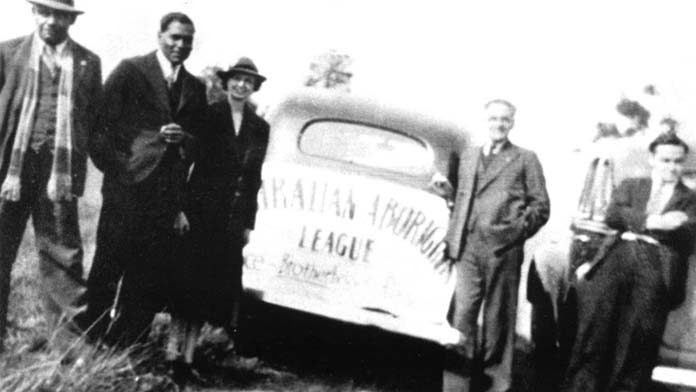
Along with his brother George, who had been active with the Australian Aborigines League (AAL) in Melbourne, Patten agitated for action.
After the walk-off, Patten was immediately jailed under the Aborigines Protection Act, which prohibited incitement of Aboriginal people to leave any reserve.
Working-class movement
The so-called “Protection” system worked to segregate Aboriginal people and enforce a racist division from “White Australia”.
Anti-Aboriginal racism was deeply embedded in Australian society.
But the joint experience that both Aboriginal and non-Indigenous workers had struggling against the hardships of capitalism laid the basis for relationships that could challenge this.
Many Cummeragunja residents were active in the trade union movement during times working away from the reserve, particularly in fruit picking and canning operations across Yorta-Yorta country.
Shadrick James, from a prominent Cummeragunja family, had been President of the Goulburn Valley Food Preservers Association and Vice-President of the District Labour Council in the 1930s.
Cummeragunja exiles also formed the core of a small but highly politicised Aboriginal community in inner-city Melbourne slums like Fitzroy.
William Cooper, an important Cummeragunja leader, moved to Melbourne in the early 1930s. He had been denied the Aged Pension living on the reserve under the NSW Act, but could claim it in Victoria.
Cooper and others formed the Melbourne-based AAL in 1934. At least one AAL activist, Ebenezer Lovett, was a member of the Communist Party of Australia (CPA) and all were staunch trade unionists.
The CPA, and like-minded socialists in the Labor Party, argued that racism was a tool used by capitalists to divide the working class and supported self-determination for colonised people across the world, including Aboriginal people in Australia.
AAL leader Anna Morgan, who had been expelled from Cummeragunja in 1908 for protest activity, consistently appeared on left-wing platforms.
Morgan addressed the 1935 International Women’s Day rally, condemning the APB for attempting to “wipe out the black race by taking girls away from the men as soon as they were fourteen years of age, and using them for domestic work that was the equivalent of slavery”.
The AAL affiliated to the CPA-led Movement Against War and Fascism, organised Aboriginal contingents every May Day and addressed working-class meetings on the Yarra bank throughout the 1930s.
In 1937, Melbourne socialists raised funds to support AAL members attending the NSW parliamentary inquiry, with the CPA paper Workers’ Voice declaring, “it is the responsibility of the labour movement to see that the aborigine witnesses get there”.
Cooper often made appeals for support for his people “as brother unionists” in the working-class press. One letter in The Australian Worker cited his long experience as a unionist in the shearing industry, stretching back to “picket duty” in the great 1890 strike, to make the case that Aboriginal rights was a union issue.
Strike support
When the Cummeragunja strike camp was established, the networks of solidarity built by the AAL swung into action. On Sunday 12 February, the AAL convened the first of many mass meetings on the Yarra Bank to build support and raise funds.
An Aborigines Assistance Committee (AAC) formed to organise donations and delegations to visit the strike camp. This included AAL members, Labor parliamentarians and representatives from the unions and the CPA.
The fact that Cummeragunja residents were forced to work for rations on the reserve was a point consistently emphasised in appeals to unionists.
Don Thomas, Secretary of the Building Trades Federation, was one of the first union officials to visit Barmah. He told the Workers’ Voice:
“These men and women are good unionists on the job. They are fighting now against the scab conditions forced on them at the mission and also against the threatened seizure of their children by the NSW State authorities”.
“The trade union movement should give them every assistance in the inspiring fight they are putting up”.
Prominent CPA leader Percy Laidler also visited the camp, reporting:
“The Aborigines at Barmah are standing together as solidly as any body of working-class strikers have ever stood… they told us of starvation rations and of a complete lack of respect for them as human beings”.
The strike committee at Barmah wrote to the Australian Council of Trade Unions (ACTU) annual congress, held in March, asking for “the support of our fellow unionists in our struggle for better conditions”.
Congress unanimously passed a resolution of solidarity, leading to a wide ranging discussion where delegates raised issues of injustice towards Aboriginal people in their own regions.
The ACTU sent demands to the Victorian government to provide sustenance payments to the Cummeragunja strikers. This was reiterated by a resolution carried by the Victorian Trades Hall Council in early April.
These payments were eventually won and proved vital for sustaining the strike camp. So too did donations from trade union members, with the Australian Railways Union and the Waterside Workers’ Federation branch in Melbourne making significant contributions.
At different points throughout the year, some families returned to Cummeragunja. There were also renewed pushes to rally support at the strike camp and make a drive for publicity.
The AAL had a major contingent at the 1939 Melbourne May Day rally, which carried a resolution “viewing with indignation the injustice inflicted on the aborigines of Cummeragunja” and pressing the demands of the camp.
Consistent agitation at working-class meetings across Melbourne, particularly by George Patten, peaked on 17 August with a mass meeting in Hawthorn Town Hall.
Hosted by the CPA-led Left Book Club, a huge crowd of 1200 people, many of them union delegates, packed into the hall to hear speakers from the AAL and AAC and raised 55 pounds.
Divisions
Despite these efforts, in October 1939, the NSW government convinced Victoria to cut off sustenance payments, forcing a dispersal of the strike camp at Barmah.
The entry of Australia into the Second World War in September overwhelmed many other political issues and campaigns.
McQuiggan was dismissed by the Protection Board in February 1940.
The NSW government also announced it would rebrand the Protection Board the “Aborigines Welfare Board” and include two elected Aboriginal representatives.
But the racist powers of NSW Protection Act remained in force.
While support from the workers movement in Melbourne had been crucial for sustaining the walk-off, the movement in Sydney, where opposition to the NSW Protection Board was most needed, failed to act.
This was due to weaknesses and divisions within both the Aboriginal rights and socialist movements at the time.
In the year prior to the walk-off, there had been an acrimonious split between APA leaders Bill Ferguson and Jack Patten.
Ferguson refused to back the strike, accusing Patten of being a Nazi agent, claims printed in the Labor Daily newspaper in Sydney. Patten sued for libel, but there were no prominent Aboriginal leaders in Sydney willing to take up the cause of Cummeragunja.
Meanwhile, influential Sydney-based CPA leader Tom Wright, head of the Sheet Metal Workers’ Union, had begun to promote a flawed and racist theoretical approach to Aboriginal struggle, heavily influenced by anthropologists working in the Northern Territory.
The CPA had previously championed rights to self-determination and the practice of distinct Aboriginal cultures right across Australia.
Wright however, now insisted this should only apply to “full bloods” in northern Australia, and that “part-Aboriginal” workers in southern states should embrace assimilation and reject the label “Aboriginal” entirely. This led Wright to openly criticise the demands of “the so-called Aborigines League” in Melbourne, that were backed by the Melbourne party.
By the early 1950s, the CPA had rejected Wright’s perspective and once again began to advocate self-determination Australia wide, helping to reinvigorate struggles that eventually defeated the Protection system.
Despite these limitations, the Cummeragunja walk-off had shown that tyrannical managers could be fought and beaten. And in a lesson that remains as relevant as ever, defiant Aboriginal leadership and principled socialist organisation could mobilise working-class support against the racist divisions imposed by the system that exploits us all.