
The Statewide Treaty Bill passed the Victorian parliament on 30 October. The Labor state government and the First Peoples’ Assembly, an elected Aboriginal body established in 2019, have emphasised the historic nature of the treaty, the first in Australia.
But Senator Lidia Thorpe has criticised the weakness of the treaty, calling it a “service agreement”.
The only real change being legislated is an expanded role for the First Peoples’ Assembly, which will direct a new institution, Gellung Warl.
Gellung Warl will be empowered to make submissions, question ministers and departments and consult on policy change. This is essentially implementation in Victoria of the “Voice to Parliament” proposal defeated in the 2023 Federal referendum.
Gellung Warl will also nominate appointees to statutory boards and committees, and play a role developing school curricula and the naming of places and landmarks—but the final say on such matters remains with the government.
Generations of Aboriginal activists have campaigned for a Treaty seeking recognition of sovereignty and restitution for genocidal dispossession.
But this treaty returns no land, pays no compensation for dispossession and creates no rights that can be enforced against the state.
And while the Labor government celebrates its “new partnership” with Aboriginal people, it is inflicting ever greater racist violence and trauma.
The rate of Aboriginal incarceration in Victoria jumped 15 per cent in the year to June 2025, now at an historic high of 14 times the non-Indigenous rate.
Rates of child removal in Victoria are the highest in Australia by a significant margin and continue to rise, with more than 10 per cent of all Indigenous children in care, 24 times the rate of non-Indigenous children.
Racist attacks
The Liberals in Victoria have launched a racist attack on the Treaty bill, decrying supposed “special privileges” for Aboriginal people and vowing to repeal the legislation if elected in 2026.
This echoes Dutton’s attacks on the Voice to Parliament.
During the referendum, rather than actually legislate for Aboriginal rights, Albanese consistently pointed to the powerless nature of the Voice in an attempt to appease the racists. All this did was embolden the hard right and guarantee defeat.
Victorian Premier Jacinta Allan is repeating this failed approach. Speaking in support of the Treaty bill, she emphasised that “Treaty doesn’t take anything away from anyone” and that “Gellung Warl will not have coercive powers or powers to veto policy and legislation”.
But real justice for Aboriginal people does require taking back land and wealth from the state and the ruling class who profit from a system built on dispossession. It requires powers not just to consult on, but to control Aboriginal affairs.
The First Peoples’ Assembly says that issues of land and compensation will be dealt with in future treaties with Traditional Owners.
But the attitude of the current Labor government makes it clear that forcing any serious concessions with the state will require a fight.
Truth but no justice
The Yoorrook Justice Commission conducted three years of “truth-telling” to prepare for this treaty from 2021.
Yoorrook heard comprehensive Aboriginal testimony about the horrors of colonisation and continuing oppression. It returned formal findings that genocide was committed in Victoria and that Aboriginal people still face deeply entrenched institutional racism, leaving many in extreme poverty.
Yoorrook made hundreds of recommendations, calling for urgent and comprehensive policy reform to address these injustices. Most of these recommendations have gone unanswered by the state—or have been explicitly denied.
Among the litany of government betrayals, Yoorrook reported that, of the 1.3 million hectares the state has previously committed to return to Aboriginal title, only 59,000 hectares has been returned to date.
Speaking at Yoorrook, the Labor government initially promised to raise the age of criminal responsibility to 14 and reform bail laws that contribute to the mass incarceration of Aboriginal people.
Two years later, Labor reneged on both promises. Victoria now has some of the toughest bail laws in Australia and the brutal Malmsbury youth detention is being reopened due to “a significant increase in young people in custody”, according to Minister Erdogan.
In its final report, Yoorrook made a strong point that Victoria’s Aboriginal people have never enjoyed greater levels of “consultation” by government. Despite this, “‘outcomes flatline—or worse, go backwards” and “governments have failed to shift the material conditions of Aboriginal lives”.
Shifting material conditions requires mass struggle against a capitalist system premised on dispossession.
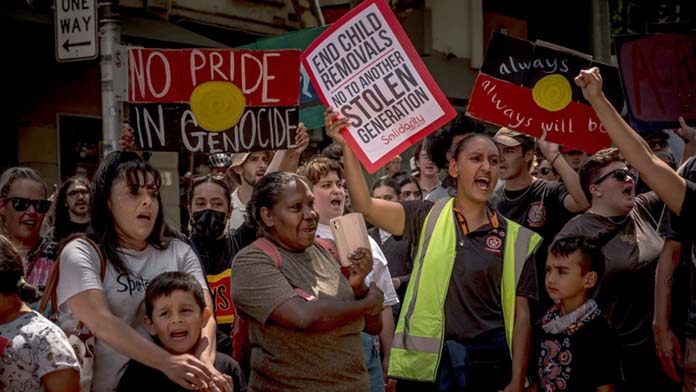
Over the past decade, Victoria has seen some of the biggest Aboriginal rights demonstrations in history. This could provide fertile ground for the struggle that is needed—mass mobilisation of popular power behind demands for land, justice and self-determination.
By Paddy Gibson