
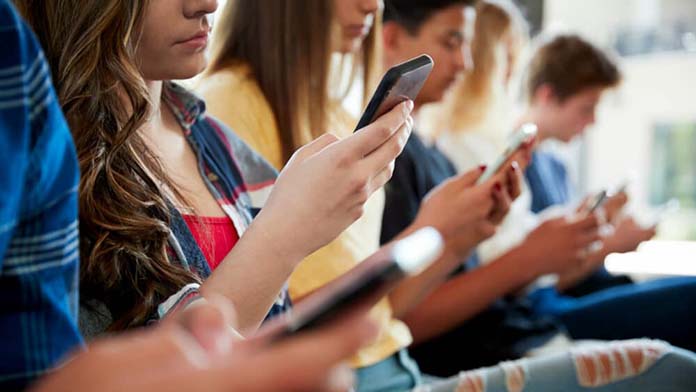
Anthony Albanese’s social media ban for under 16-year-olds was a stunt designed to give a do-nothing government the appearance of taking action to protect kids.
But it has not ended the tech oligarchs’ control of the social spaces of childhood. With absolute predictability, it has led to work arounds, with young people easily creating new accounts or moving to other platforms, from streaming services to online games and other social media apps also controlled by tech billionaires.
Social media companies perpetuate and capitalise on the desperate lack of opportunity to socialise and access culture outside of the control of family, work and school. Like pubs, cafes, gyms, clubs and cinemas, social media platforms graft an opportunity for a modicum of free human association onto their profoundly anti-social goal of profit making.
But social media can dominate our social world with unprecedented power.
As the fifth and sixth wealthiest companies in the world, Alphabet (owner of YouTube), and Meta Platforms (owner of Facebook and Instagram), alongside X (owned by the world’s richest person Elon Musk), the social media oligarchs openly use their enormous influence to assert the most backward ideas.
Social media has been toxic from its inception. The commodification of social interactions to sell to advertisers objectifies the lives of the users who actively post, while passive scrollers are recruited to the process of superficial, competitive comparisons.
Whistleblowers have revealed that Meta has long known about the obvious social cost of its product: “We make body image issues worse for one in three teen girls,” said a slide from one internal presentation in 2019. “Thirty-two per cent of teen girls said that when they felt bad about their bodies, Instagram made them feel worse,” a subsequent presentation reported in March 2020.
Workers at Facebook have raised dissent against the company’s cozy relationship with the powerful, which, through various mechanisms like XCheck, exempted “VIPs” from having posts removed which violate Facebook policies.
As a result of this special treatment for the world’s rich and powerful, and exclusive focus on profits, Facebook has admitted to playing a role in inciting violence in Myanmar during the military’s genocidal campaign against the Rohingya.
It promotes false and Islamophobic content in India, fuelling racist violence, and has facilitated mass censorship in Vietnam.
In its quest for advertising dollars, tax exemptions and global social media market dominance, Mark Zuckerberg, CEO of Meta, gifted the re-elected Donald Trump an end to fact-checking, turned off many of its already compromised content moderation systems, and created more widespread exceptions to its hate speech policy to allow for dehumanizing speech about immigrants, transgender people and other groups.
Deeper problems
Albanese’s social media ban has the false depth of an Instagram post. The legislation masquerades as regulation of the social media barons. But it does nothing to address the deeper problems that make social media a rotten place.
The loopholes and exemptions for different social media, messaging and gaming sites where children are just as likely to be subject to bullying and predatory behaviour reveal the unseriousness of the intention to protect children.
And in this context as Senior Lecturer in Wellbeing Science, Dr Catherine Smith points out, the messaging about “backing parents” shows that the real burden of the ban, “lands squarely on Australian families—manage yourselves better, because we can’t manage the tech giants…
“When predictable crises arise—body image issues, online misogyny, algorithmic radicalisation, sleep disruption—the regulatory instinct focuses downward, not upward.”
Despite their extraordinary power, and Albanese’s pathetic ducking from the fight, social media companies don’t have total social control.
According to a January 2025 Ipsos poll in the US, 64 per cent of teens said major tech companies like Google, Apple, and Meta don’t care about their mental health or well-being, and 62 per cent don’t believe they will protect their safety at the expense of profit.
There is every reason to believe Australian teens are just as critical. Last year, according to the 2025 Ethics Index published by the Governance Institute of Australia, social media platforms were the lowest scoring sector on “ethical behaviour”—far lower than AI, large corporations, media and mining companies.
Credit for the increasingly critical attitude to social media goes in large part to the Meta workers around the world, from Silicon Valley to Kenya and Ghana, who have exposed the cynical policies and lies of their bosses through whistleblower exposes, legal action, petitions and more.
These workers have the collective power to impose real bans that would paralyse the social media machines and their profit driven harm. Reforms that empower working people to communicate and organise freely, outside of the control of our bosses, our repressive government, and restrictive anti-strike laws would strengthen their fight—not Albanese’s soggy paternalism.
By Lucy Honan