
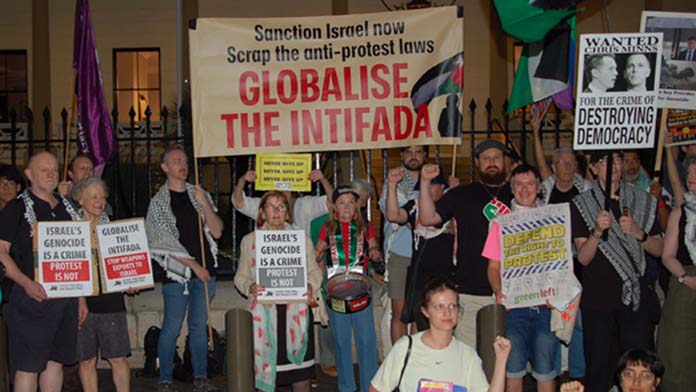
The Minns government in NSW is attempting to ban the phrase “Globalise the Intifada”, with Victorian Premier Jacinta Allan also saying she hopes to prosecute people using it.
In the aftermath of the Bondi terror attack Chris Minns declared the phrase amounted to “hateful, violent rhetoric”. This was a cynical attempt to smear the Palestine solidarity movement and blame it for the Bondi attack.
The slogan bans must be strongly resisted. Queensland has already banned the phrase, alongside “From the River to the Sea”.
Intifada is an Arabic word that means “uprising” or “throwing off oppression”. The word is used to both describe major Palestinian uprisings and celebrate the history of Palestinian resistance to ongoing oppression.
The First Intifada in 1987 broke out after 20 years of Israeli military occupation in Gaza and the West Bank and saw mass protests, strikes and boycotts.
A Minns government inquiry recommended the ban by saying the “Second Intifada … was characterised by violence” so that, “The slogan ‘Globalise the Intifada’ may therefore be perceived to incite violence against Jewish people.”
In fact it was a response to Israel’s brutal occupation, apartheid and genocide—not something targeted at Jewish people in general.
The Palestine solidarity movement has been staunchly anti-racist. Anti-Zionist Jewish groups have been a consistent part of the fight against Israel’s crimes.
The call for Intifada is a call for mass resistance. The defining image of the Second Intifada is a young Palestinian boy, Faris Odeh, throwing a stone at an Israeli tank. Ten days after the photo was taken he was shot in the neck by an Israeli soldier. Tens of thousands of Palestinians were involved in such acts of defiance.
The main feature of the Intifada was not Palestinian violence but Israeli violence. During the Second Intifada at least 4973 Palestinians were killed by Israel, outnumbering Israeli deaths by around 5:1.
Push back the attacks
Some sections of the campaign—like the Palestine Action Group in Sydney—have so far been reluctant to defend the slogan “Globalise the Intifada” because they say it has not been widely used. But the chant has indeed been raised—and other chants celebrating “intifada” are common at rallies.
Failing to defend the slogan only concedes to the idea that there is a problem with it and means the movement will fail to challenge a direct attack against it. The ban will intimidate people and help silence expressions of support for Palestine.
It is also the thin edge of a dangerous wedge. If the bans succeed, governments will try to push them further.
Israel’s Foreign Minister Gideon Sa’ar has already praised the Queensland slogan ban and called for other states to follow suit.
In the UK there has been a crackdown on the slogan “Globalise the Intifada” as well as the designation of Palestine Action as a terrorist group. There have been similar crackdowns in Germany where pro-Palestine conferences have been banned and protests restricted.
Globalise the Intifada
The call to Globalise the Intifada is a call for a global movement of solidarity with Palestine to end the complicity of governments worldwide in Israel’s genocide. This means striking, protesting and boycotting, action directed against our own government, with the spirit of defiance shown by the Palestinians.
Australia is complicit in the genocide in Palestine and is directly involved in Trump and Israel’s war on Iran. It will require real rebellion to stop the shipments of F-35 parts to Israel, Bisalloy armoured steel going to IDF vehicles, the intelligence sharing with Israel and to cut the campus ties to genocide.
The laws restricting protests, code of conducts restricting free speech and anti-strike laws will have to be broken.
We saw a glimpse of the defiance we need when Israeli President Isaac Herzog visited Sydney. Minns told people not to protest at Sydney Town Hall and banned a march, but up to 20,000 turned out.
Grace Tame defiantly chanted “Globalise the Intifada” from the stage. The crowd chanted, “We will march.” And despite brutal police attacks, the next week protest restrictions were lifted.
As we went to press the law was still yet to be introduced into the NSW Parliament. On 17 March as a new sitting period began around 200 people rallied outside parliament against the ban, defying Minns to chant “Globalise the Intifada”.
NSW Greens MP Jenny Leong reminded the crowd that “Bad laws need to be broken”, while NTEU NSW Secretary Vince Caughley pledged to “without apology always protect the right to speak, the right to protest and to dissent.”
This must be the start of a much bigger fight against Minns’ attacks, for free speech and a free Palestine.
By Adam Adelpour