
Finnian Colwell looks at the armed struggle against colonial rule in Algeria and why elements of the French left were right to support the resistance
In 1962, Algeria won independence from France after eight years of armed struggle led by the National Liberation Front.
Elements of the French left were willing to give material support to the Algerian resistance in opposition to their own government’s imperialist war.
France took control of Algeria in 1830. One million European settlers controlled some 2.3 million hectares in Algeria by 1930, or around 40 per cent of the land. Native Algerians were forced onto less fertile land, into humiliating agricultural work on their former properties or into segregated urban ghettos.
Whereas in 1834 “nearly all the Arabs can read or write” according to a French general, by 1954 literacy rates had declined to 10 per cent.
The French also forced nomadic tribes in Algeria to adopt sedentary lives. Muslims in Algeria, practically the entire local population, were subject to punitive apartheid-style laws with fewer rights than French citizens.
During the First World War, the European powers including France mobilised the populations of their colonies to send into the slaughter. Algerian soldiers who survived were given the right to vote and encountered new ideas in France alongside middle-class Algerians studying there. These groups started to articulate their nation’s demands for independence.
FLN
The “Young Algerians”, led by Ferhat Abbas, thought France might allow reforms giving Algerians equal rights and placed hope in the Popular Front government of 1936 which brought together Communists and Socialists. But the Popular Front abandoned a proposal to extend the democratic franchise in Algeria.
It also outlawed the “North-African Star”, a more radical group set up by Messali Hadj which advocated national independence.
At the end of the Second World War in 1945, Algerians in Sétif demonstrated for independence. When a number of settlers were killed the French army responded by massacring up to 40,000 Algerians.
The French also inaugurated elections to an Algerian Assembly in an attempt to dampen discontent. Both Messali and Abbas reconstituted parties to run but the French rigged the votes to ensure they gained only a handful of seats.
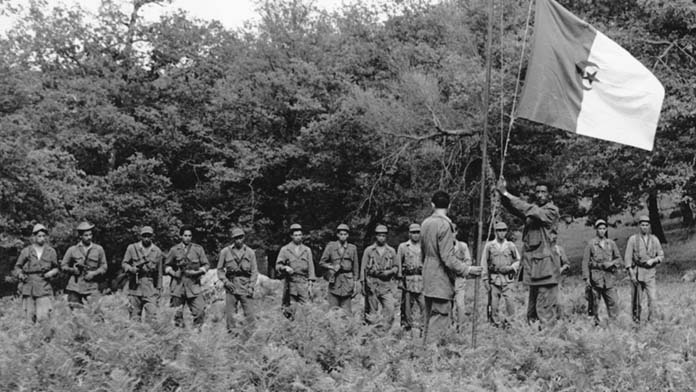
A new generation of activists, radicalised by the massacre at Sétif and seeing that elections would not bring independence, joined the OS (Special Organisation). Soon reconstituted as the FLN (National Liberation Front), these new militants launched an armed insurrection in November 1954, in which 70 targets, military and civilian, were attacked.
During the ensuing eight-year war, the FLN organised guerilla attacks on French troops and government buildings from the mountains. But as the war escalated, they also bombed targets in Algiers, including cafés and cinemas. These actions would be condemned as terrorism today.
The FLN’s decision to launch an armed struggle was a response to brutal colonial violence. As French philosopher Jean-Paul Sartre put it, “It is not their violence, but ours, turned back.”
The FLN’s struggle for independence gained mass support among Algerians. The famous film The Battle of Algiers depicts its call for a one-week general strike in 1957, which brought the ghettos of Algiers to a halt.
The French army imposed martial law in response and brutally destroyed the clandestine FLN networks until the organisation was relegated to the countryside. In 1958, when a new French prime minister took power who was in favour of negotiations with the FLN, there was a coup that saw European settlers seize control of Algeria to try to prevent independence.
General Charles de Gaulle was given control of the French government in June 1958 in an effort to resolve the crisis.
But opposition to continued French rule made it clear that it was impossible to keep control of Algeria. De Gaulle signalled from 1959 that he would negotiate with the FLN. In December 1960, there were mass demonstrations in Algerian cities against de Gaulle’s visit. The FLN created a political crisis which contributed to the French granting Algeria independence in 1962.
The Left in France
Appallingly, most of the French left supported ongoing colonial rule in the years leading up to independence. In response, a radical, anti-colonial left formed in France, opposed to parliamentarism and the Stalinism of the French Communist Party.
In 1956, a left-wing coalition government came to power, led by the SFIO (the Socialist Party, the equivalent of the Australian Labor Party). It refused to allow independence and set out to crush the rebellion by giving the French military “special powers”, allowing it to detain and interrogate suspected FLN members. The same year, France called up reservists to double its military presence in Algeria from 200,000 soldiers in January to 400,000 in July.
The PCF (French Communist Party) had hundreds of thousands of members at the time and control of a militant trade union federation. But to gain parliamentary influence it abandoned its anti-colonial principles and voted for special powers with the SFIO. The PCF’s hypocrisy, given the role it had played in organising armed resistance during the German occupation of France, angered many of its younger members.
By 1956, reports of the army torturing Algerians were reaching the French population and there was increased opposition to the war within France.
The “Young Resistance” was an illegal organisation of draft resisters and anti-war activists. They stopped trains transporting troops to Algeria and distributed leaflets at demonstrations encouraging desertion. They even assisted jail-breaks of FLN members.
Alain Krivine, a member of the Young Resistance, explained that its activity “was a matter of ‘practical’ internationalism, and not one of discourse”. The PCF, despite its talk of internationalism, was completely opposed to draft resistance and expelled members found to materially support the FLN.
Philosopher Francis Jeanson set up an illegal network of “suitcase carriers” transporting money raised among migrant Algerians in France to the FLN. White French supporters were less likely than Algerians to be stopped by police.
In September 1960, members of the Jeanson network were put on trial and eventually sent to prison. Sartre, Simone de Beauvoir and other famous intellectuals and artists signed a “Manifesto of the 121”, defending the right to refuse conscription and to support Algerian resistance. The SFIO and PCF condemned the manifesto but 20,000 students demonstrated in support of the accused.
In October 1961, the FLN called on supporters to demonstrate in Paris after a racist curfew was imposed on the 150,000 Algerians living there. About 30,000 broke the curfew to demonstrate and more than 200 were killed by police. The office of the Communist Party newspaper L’Humanité, along the march route, kept its iron shutter down, refusing shelter for bleeding, wounded Algerians.
The “practical” internationalism of draft refusal and transporting NLF funds were connected to the dissemination of propaganda encouraging opposition to the war. This put pressure on the SFIO and the PCF.
In 1958 the left-wing of the SFIO split off and became part of the anti-colonial PSU (United Socialist Party).
Dissidents in the PCF student wing were expelled in 1965, forming a Trotskyist group that played a key role in the May 1968 student demonstrations.
Right to resist
Socialists support the right for nationalities oppressed by imperialism to demand self-determination through whatever means they choose.
The brutal colonial violence of the French occupation of Algeria, and France’s determination to hold onto its colonial possession, were responsible for the violent struggle that developed. The blame for all the violence lies with the occupying power.
Algerians found out through bitter experience that France would never give them equal rights or allow independence until they were forced to.
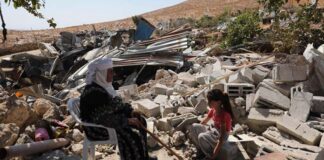
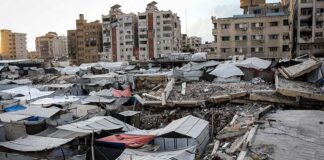
Israel today is a settler-colonial state backed by Western imperialism that was established through the dispossession and ethnic cleansing of Palestinians from their lands, illegally occupying the West Bank, East Jerusalem and Gaza and enforcing apartheid within its own borders.
It has shown no interest in serious negotiations or concessions towards the Palestinians. Israel expanded settlements and continued to dispossess Palestinians even while supposedly negotiating to create a Palestinian state during the Oslo Accords in the 1990s.
Israel has murdered non-violent Palestinian protesters, such as during the Great March of Return in 2018, and armed resistance fighters alike. The Palestinians have a right to national liberation—but this is impossible while Israel remains as a Zionist state that denies them equal rights and continues to dominate and dispossess them.
Those in France who aided the FLN recognised the Algerians’ right to resist French colonial occupation, including through the use of armed struggle. They resolutely opposed the imperialist policy of their own government.
Not recognising that all the blame for violence rests with the occupying colonial power led to racist explanations of violence, such as that Algerians are inherently backward and violent.
All oppressed nations under military occupation have the same right to choose the means by which they resist. This applies to the Palestinians just as it did to the Algerians.
But unconditional support for struggles against colonialism and occupation, and making it clear we side with them against imperialism, must not mean that support is uncritical.
While the FLN talked of socialism, once in power it imposed an authoritarian regime and repressed working class opposition while a new ruling class grew rich. This was a consequence of its mistaken focus on armed struggle led by a small elite, instead of a mass democratic movement.
Small organisations like the “Young Resistance” in France helped turn the French population against continued war in Algeria and played a key role in the new radical left that emerged through the 1960s.
Similarly, socialists in Australia need to defend the right of the Palestinians to resist and campaign to break Australia’s material support for Israel and US imperialism, playing our part in working to end the West’s support for the Israeli terror state.