

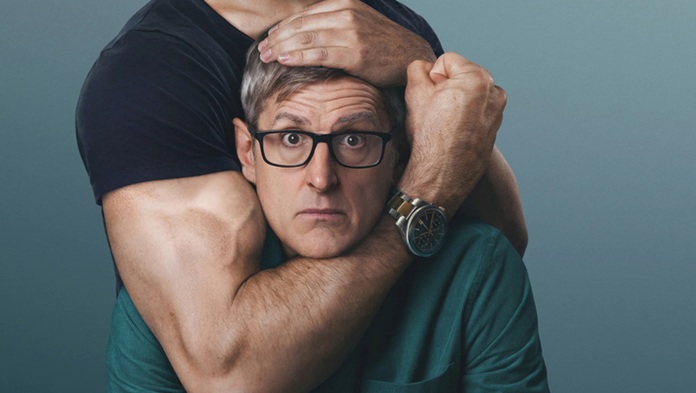
Louis Theroux’s new Netflix documentary Inside the Manosphere follows some of the world’s most popular misogynist online influencers.
Influencers who are part of the manosphere offer misogynist solutions to problems facing young/isolated men. It’s largely about reinforcing the archaic, sexist idea that men need to be assertive/dominant and even aggressive for women to like you.
Women are supposedly submissive and do not deserve, nor apparently want, ownership over their lives or bodies and should be controlled by men.
But the manosphere also comes with many other reactionary ideas and conspiracy theories that can all have very dangerous consequences.
Rather than offer any solution, Louis is famous for his unassuming tone when interviewing potentially controversial figures and, in theory, this is meant to expose their problematic ways to the world as a way of raising awareness.
This is achieved to a certain extent in Inside the Manosphere but the problem is that the documentary doesn’t provide any explanation as to why misogyny has become such a problem or what we should do about it.
The result is that it just becomes another way for these influencers to get a wider reach rather than challenging the absolute torrent of sexist/racist/homophobic and transphobic ideas that they are spreading—and it doesn’t help the audience understand what can be done about it.
Regardless, it is quite eye-opening and alarming and it seems to be having an impact on many people who have watched it, sparking interesting discussions among friends and colleagues about why these ideas are becoming so popular, particularly among young boys.
What the documentary does make clear to viewers is that these influencers have millions of viewers and are not only encouraging men to oppress women, they are also encouraging antisemitic conspiracy theories that stem from fascist ideology.
What was most alarming to me was their ability to openly say things like “the Rothschilds control everything” and “Jewish people are trying to wipe us all out” and then walk down the streets with groups of young teenage boys running up to them, giving them high fives and telling them how amazing they are.
The question that arises here is how is this happening? Why now? A popular theory is that there’s just too much technology, young boys are too attached to their phones and too removed from the real world and so vulnerable that they are just drinking this stuff in.
However, while banning devices or banning young kids from social media might seem like some kind of solution, that unfortunately just doesn’t cut it. This won’t get Trump out of the White House, it won’t stop people coming out on the streets against migrants, it won’t stop the growing threat of fascism around the world.
This is because these ideas are not just coming from reactionary individuals on the internet. These ideas have long been pushed on us as part of maintaining the interests of capitalism. Sexist ideas divide workers and help bosses get away with raking in profits while we struggle to afford housing and the day-to-day cost of living.
Extreme version
The reactionary gender roles promoted in the manosphere are only a more extreme version of those already encouraged in the mainstream of society through unequal pay, the concentration of women in “caring” professions such as childcare, teaching and nursing and the fact that women continue to carry the bulk of the work caring for children inside the nuclear family.
From Kyle Sandilands’ sexist tirades on radio to Anthony Albanese’s labelling Grace Tame as “difficult” for her support for Palestine, sexism is all around us.
But the growth of the far-right and fascism is showing the situation is becoming incredibly urgent; there is no room for complacency.
We need to understand this is not just a few idiots running their mouth off—this is part of a long history of attempts by the far right to gain traction.
The Nazis used the slogan Kinder, Küche, Kirche (children, kitchen, church) to justify the oppression of women. Hungary’s far-right prime minister, Viktor Orban, is paying women to have more children in the name of cancelling out the Muslim population.
This is why it’s so important we challenge these ideas. Part of that is pushing back on any attempts to equate criticism of Israel with antisemitism. This not only impedes our ability to build the movement against genocide but also makes it more difficult to challenge the kind of real antisemitism seen in this documentary.
History shows us that when ordinary working class people unite in struggle against oppression, war and the interests of profit, that can play a role in pulling people away from dangerous, reactionary ideas.
Building the movement for Palestine is not just about standing against genocide, it’s about pointing the finger at the role our leaders are playing in this and a system that needs war and genocide to survive. Global solidarity shows that there is an alternative way of organising that puts people before profit and can liberate us all.
Louis Theroux has turned a spotlight on the manosphere and highlighted a serious problem but it’s ordinary people organising in their workplaces, universities and communities who have the ability to really push back this threat.
By Jasmine Fischer