

David Glanz reviews a new book that helps explain why the high hopes of the Bolivarian revolution ended in a squalid deal with US imperialism
The kidnapping by US forces of Venezuelan President Nicolás Maduro and his wife, Cilia Flores, on 3 January was a blatant act of gangster imperialism.
It was a shocking reminder of the exercise of power by the US in Latin America—a sordid history that includes 41 instances of overthrowing progressive governments since 1898.
It’s a warning that when Trump threatens the regime in Cuba, he may not be bluffing.
The kidnapping was a surprising tactic but not a total shock—the US had been threatening Venezuela for weeks, building up forces off the coast and destroying small Venezuelan boats in international waters.
But what was maybe unexpected, not least for those on the international left who have looked to the Bolivarian revolution in Venezuela as a shining example of “21st century socialism”, was the response among Venezuelans. There were few rallies for the regime and those that did take place seemed to be government-sponsored. The end of Maduro’s leadership was barely mourned.
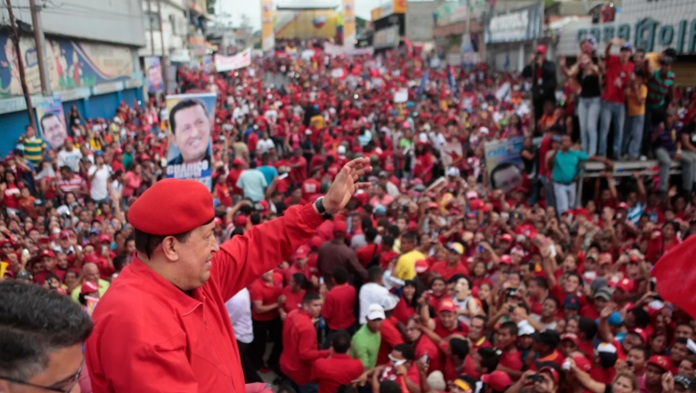
When the right, backed by the US, had tried to overthrow Maduro’s predecessor, Hugo Chávez, in 2002 there was a massive outpouring of anger on the streets from workers and the poor that saw Chávez back in office within 47 hours. Now, even among those fearful of US intervention, there was scant effort to challenge or even protest Maduro’s seizure.
Among the Venezuelan diaspora, there were celebrations at what people initially thought was the fall of the regime—but Vice-President Delcy Rodríguez was sworn in as Acting President within two days and her government appears stable for now. The rabidly pro-US official opposition remains marginalised.
The BBC reported that in her first speech to the National Assembly on 16 January, Rodríguez criticised “imperialist expansion by the United States” but met CIA Director John Ratcliffe the same day.
Since then, Venezuela and the US have restored full diplomatic relations and the US embassy has re-opened in the capital Caracas. Rodríguez’s government passed a law opening the way for US oil companies. The US even carried out a military exercise in Caracas on 23 May, announced in advance by the Venezuelan Foreign Minister.
By removing Maduro, the US has dramatically increased its influence within Venezuela, marginalising the influence of China, Russia, Turkey and Iran. Despite the occasional fiery anti-imperialist rhetoric and official calls for the return of Maduro and Flores, Rodríguez is prepared to work with Washington.
How did a revolutionary process that began in 1999 with such hope come to a spluttering end like this?
A book published shortly before the kidnapping of Maduro helps answer that question. Venezuela in Crisis: Socialist Perspectives is an excoriating critique of the decline of the Bolivarian revolution, a process that began under Chávez but that accelerated under Maduro.
This is not a pro-US, pro-imperialist book. As its sub-title suggests, the authors are all Venezuelan socialists, many of them who participated in the Bolivarian movement or government. Their criticisms are bitter and forensic precisely because they wanted the revolution to succeed.
Economic crisis
To begin to understand the lack of popular support for Maduro, we need to appreciate the crisis of the Venezuelan economy and society. Roberto López Sánchez, a former guerrilla and the founder of the National Union of Workers-Zulia, writes, “The reality of the Venezuelan economy more than eight years into Maduro’s rule ranks as the worst performance in the world, and of the five worst performances in the history of capitalism over the past seventy years.”
The book’s editor and translator, Anderson M Bean, lists a range of horrific statistics, “From 2013 to 2021, Venezuela’s gross domestic product declined by more than 75 per cent. Inflation has been a persistent problem, reaching 130,000 per cent in 2018, the highest in the world. The percentage of households classified as poor increased from 48.4 per cent in 2014 to 81.5 per cent in 2022. The monthly minimum wage is the equivalent of $US2.23, the lowest in all of Latin America. After adding the government food bonus, the monthly minimum salary is roughly $US4.47 or $US0.15 a day … four dollars is about what two pounds (a kilo) of meat costs.”
The minimum wage is so low that many workers spend more on commuting to work than they earn—they are effectively working for free. One result of this disaster is that some seven million Venezuelans have fled the country; today almost a quarter of Venezuelan households rely on transfers of hard currency from family members overseas to survive.
Workers’ misery is compounded by the way their bosses, both private and state, are gorging themselves through rampant corruption. Gonzalo Gómez, a leading Venezuelan Trotskyist and a founder of Marea Socialista (Socialist Tide), writes that the level of misappropriation and criminal capital flight between 1998 and 2013 may have been more than $US259 billion. “Another investigation found a ‘missing without record’ of over $US216 billion in PDVSA (the state-owned oil company) accounts.”
Poverty and looting by the rich led to anger and some resistance. The Maduro government responded with massive repression. The ruling PSUV (the United Socialist Party of Venezuela) lost the National Assembly elections in 2015—Maduro’s reaction was to rule by decree and then engineer the election of a National Constituent Assembly as an alternative source of authority. The main focus of Maduro’s crackdown, however, was on the workers’ movement and the left.
The late Carlos Carcione, a Trotskyist journalist, writes, “The initial step, or impetus, for the transformations in the political regime comes from the new bolibourgeoisie (Bolivarian bourgeoisie), the military caste, and related sectors needing to establish a new management scheme for the country … This involves eliminating pressures from the left, which aimed to deepen the Bolivarian process, and countering the newly formed bourgeois right, which is more directly aligned with the United States and eager to gain prominence. The first blows in this transformation were directed against the left.”
Marea Socialista was hounded and eventually banned. The Communist Party of Venezuela was barred from contesting elections and by the 2024 election, all left parties were blocked from standing. Dissident views within the pro-government party, the PSUV, were crushed. In unions where elections might have seen the defeat of the pro-government bureaucracy, the results were fixed by the courts, union struggles were criminalised, the right to strike abolished, all collective bargaining agreements were cancelled and union activists tortured and jailed. Firms where workers had developed some independent power were taken over by the military.
Carcione notes, “The bureaucratic consolidation of the PSUV, the persecution and silencing of critical sectors, and the dismantling of grassroots union and popular leadership—replaced by state bureaucracy and army agents—left the right as the only visible opposition when dissatisfaction with the Maduro government and its counter-reforms escalated to mobilisation.”
Broken dreams
It wasn’t meant to be this way. The Venezuelan working class and the global left had great hopes in the society that began to emerge from 1998. As Bean writes, “Venezuela’s Bolivarian process—the shorthand used for the revolutionary struggle and newly formed state institutions created following the election of Hugo Chávez in 1998—improved Venezuelans’ material well-being, brought greater social equality, and empowered sectors of society that were traditionally excluded.”
There were three major problems from the start. The first was the overwhelming reliance on oil exports. At first, that wasn’t an issue. The world price of oil began to rise after 1998, enabling the new government to make serious inroads into poverty as the economy grew. But around the time that Chávez died in 2013 and Maduro took office the oil price slid and Venezuela entered recession. The government was trapped—by 2015, oil exports accounted for 95 per cent of the country’s exports and oil revenues more than 90 per cent of the government budget.
The second was the imposition of increasingly tough sanctions by the United States. President George W Bush banned weapons sales to Venezuela in 2006 before imposing sanctions on senior officials in 2008. In 2011, the Obama administration added more personal sanctions before the first Trump administration imposed economic sanctions in 2017 and 2018. There is no doubt that the 2017 sanctions played a role in damaging the economy—there was a loss of revenue of $US6 billion in 2018 alone. But as researcher Omar Vázquez Heredia notes about rising inequality and malnutrition between 2010 and 2016, “This decline in living standards occurred prior to the imposition of US economic sanctions” and began under Chávez.
The sanctions also gave Maduro cover for his neoliberal and authoritarian agenda. Gustavo Márquez Marín, a minister and ambassador under Chávez, writes that Maduro introduced an Anti-Blockade Law “which essentially allows Maduro to govern outside constitutional bounds, without constraints, and without accountability”.
The third problem was the most fundamental. The rise of Chávez signalled a progressive, nationalist drive to create a wealthier and fairer Venezuela. But his Bolivarian government did not try to dispossess the existing ruling class despite a formal policy of workers’ control, communal councils and communes. The 1999 constitution gave significant protection to private property. It took a full five years after coming to office before Chávez declared that the Bolivarian project represented “socialism of the 21st century”.
But he later clarified, “Who would think to say that Venezuela is a socialist country? No, that would be to deceive ourselves. We are in a country that still lives in capitalism, we have only initiated a path; we are taking steps against the world current, including towards a socialist project; but this is for the medium or long term.”
Lopez Sánchez notes that, “Chávez never outlined a truly socialist economic program. The measures he implemented fit perfectly with a Keynesian model of state intervention.”
The failure of the Chávez government to fundamentally challenge capitalism meant that as Maduro reversed earlier gains, the Venezuelan bosses made hay. In 2021, for example, the government established special economic zones (backed by the Venezuelan Federation of Chambers of Commerce and Production, one of the main organisers of the 2002 coup that tried to overthrow Chávez). Maduro gave himself the power to scrap labour, environmental and other laws within the zones, along with offering corporations big tax breaks and easier access to natural resources.
Chávez good, Maduro bad?
A simplistic reading of the trajectory of the Bolivarian process would be this: Chávez forged a progressive path from 1999 until his death in 2013 while Maduro has dismantled virtually all gains since coming to office, not least because of the crash in oil prices and the impact of US sanctions.
There’s no doubt the imposition of neoliberal policies and repression accelerated sharply under Maduro. His declaration, for example, of the Orinoco Mining Arc in 2016 over the protests of Indigenous people and environmentalists opened up huge swathes of the Amazon rainforest to mining predation. Maduro refused to publish the results of the 2024 elections. When mass protests erupted with, as Bean writes, “mass participation from the working class and residents of popular barrios—many of whom had historically supported Chávez”, more than 2000 people were arrested and at least 25 killed.
But the authors of this book are honest enough to record that the seeds of disaster were present under Chávez. Márquez Marín writes that as early as 1999, Chávez tried to solve economic challenges by using the armed forces to circumvent inefficient state bureaucracies. “It came at the expense of introducing a form of ‘military management’ into public administration … The frequent practice of bypassing administrative regulations under the pretext of an “emergency” facilitated the misallocation of public resources … there were numerous allegations of corruption … with many directed at the newly established revolutionary government.”
Lopez Sánchez writes that although Chávez oversaw some real improvements in workers’ social wage—health programs, school meals, expansion of the pension system to homemakers, and so on—real wages began to decline, falling 20 per cent between 1999 and 2010.
He adds, “As early as 2009, during an event where forty intellectuals debated the most visible problems of the Bolivarian Revolution, warnings were raised about the formation of a new ‘Bolivarian’ bourgeoisie. This group emerged through the influence of the ruling party and numerous leaders of the revolution … who used their positions to seize numerous private companies, which simply changed hands due to the extortive power of those controlling the state.”
Corruption was also unwittingly facilitated by Chávez’s focus on boosting imports to raise living standards. Vázquez Heredia notes that this “fostered opportunities for fraudulent activities, such as overinvoicing of foreign purchases”. In addition, “The Venezuelan state apparatus continued to privatize and channel oil income toward financing the accumulation and external hoarding endeavors of both established and emerging dominant classes. For instance, according to the BCV (Central Bank of Venezuela), the amount deposited by private individuals abroad stood at $US24.4 billion in 1998, before Chávez assumed power, but by 2012, during his final year in office, it had surged to $US151.3 billion … In summary, significant capital flight occurred during Chávez’s tenure.”
Chávez had taken a strong stand over environmental issues, declaring that he would stop plans made under the previous administration to open up more than 1 million hectares of the Imataca Forest Reserve (part of the Orinoco region). “If obtaining gold requires destroying the forest, then I will preserve the forest.” However, in 2004 his government legalised mining there. Earlier, his government forced through the installation of a power line to Brazil on the land of the Pemón Indigenous people, despite their active opposition. The government vilified its opponents and mobilised the military to help quell dissent.
Was there an alternative?
Chávez’s election in December 1998 gave an enormous boost to a workers’ movement that had declined under previous conservative governments. The politically bankrupt Confederation of Venezuelan Workers (CTV), which had supported a coup attempt against Chavez in 2002, dramatically declined as workers deserted to build more militant alternatives.
Lopez Sánchez writes that, “Between 2003 and 2004 alone, the number of unions officially recognised by the Ministry of Labor grew from 2974 to approximately 4000. By 2012, the CTV had lost a staggering 90 per cent of the workers who had been affiliated with it in 1998,” dwindling to a “hollow shell”.
Encouraged by the Bolivarian Constitution of 1999, which cut the working week and guaranteed union democracy and the right to strike, there was a rise in working class combativity. In response to the reactionary oil industry strike of 2002 to 2003, which aimed to bring down Chávez, workers adopted slogans like “factory stopped, factory occupied” and “control of productive activity by workers”, occupying a number of workplaces. At SIDOR, the steel corporation, workers mobilised against its earlier privatisation, winning renationalisation in 2008. Workers’ control became official government policy in 2004, endorsing the earlier, spontaneous formation of workers’ councils that aimed to unite workers within workplaces across sectional divisions.
Alongside this activity was the rise of a lively and militant left. The founding of the PSUV in 2007 initially saw the involvement of four or five million militants who participated in community assemblies of hundreds of people and provided a space for the far left to intervene.
But as the economy shrank first under Chávez and then under Maduro, and repression grew, these initiatives were snuffed out. The millions who looked to the Bolivarian revolution had put their faith in a charismatic leader, Chávez, who in turn hoped to reform Venezuelan society and its economy without a full break with capitalism.
As Carcione ends his contribution to the book, “It’s imperative to recognize a crucial lesson for future revolutionary and socialist endeavors in Venezuela, Latin America, and beyond: even the most advanced and progressive processes are prone to regression and transformation into their antithesis if they fail to transcend the confines of a historically exhausted system—imperialist capitalism. To achieve this goal, deeply democratic organizations rooted in mass movements are essential, with a steadfast belief that the struggle extends beyond the boundaries of capital.”
Venezuela in Crisis: Socialist Perspectives, ed. Anderson M Bean, Haymarket Books 2026, $US27.95.