
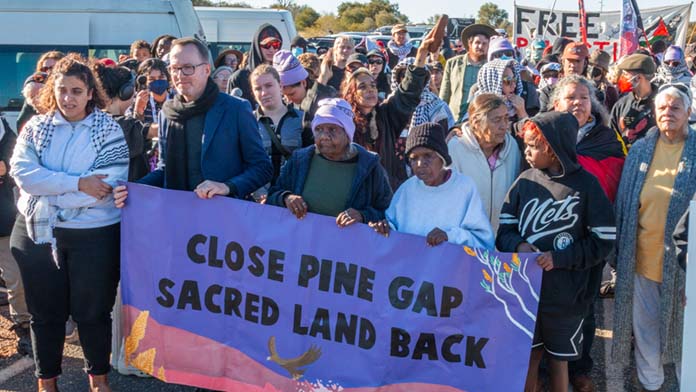
Around 400 activists protested outside the Pine Gap spy base on Monday, as part of the Close Pine Gap Sacred Land Back convergence between 18 and 20 July.
The three-day convergence, the largest against Pine Gap since 1987, saw people travel from across the continent to Arrernte Country in Mparntwe (Alice Springs).
The convergence was dynamic and militant, throwing a spotlight on the active complicity of Australia in the continuing genocide in Gaza.
Activists successfully disrupted the operations of Pine Gap. They are now planning for a nationwide escalation of efforts to confront the imperialist war machine being expanded by the Albanese government as part of its commitment to the AUKUS alliance.
Protesters organised a convoy from town of more than 100 vehicles before marching up to the gate of the facility and chanting “Always was, always will be, Aboriginal land” and “From Arrernte to Gaza, Globalise the Intifada”.
The march was led by the Hayes family, the Traditional Owners of Kuyunba, the sacred land on which Pine Gap was built without their consent.
At the gate, the family delivered a letter demanding the return of Kuyunba and the closure of Pine Gap, compensation for the decades of occupation without consent and compensation for families in Gaza.
The letter reads, in part: “Since the base was built, we’ve been locked out of our own sacred land … We’re suffering because we can’t take our next generation to that place. We feel homeless on our own Country.
“We feel sorry for the families around the world whose lives have been taken away by that base … We’re not the ones controlling that facility, but we feel guilty that it’s coming from our land.”
The base is widely considered to be the most important US signals intelligence facility outside the US itself, feeding information to the US military that is used for identifying targets for military strikes.
Intelligence collected at Pine Gap is also shared with Israel for use in its genocide in Gaza and its wars across the region—showing the deep complicity of the Albanese government which allows this.
Convergence organiser and activist with Mparntwe For Falastin, Jorgen Doyle, told Solidarity that the organisers had not expected to get so close to the base.
Doyle said, “It felt good to be right in front of the base and to be able to see the American and the Australian flags and have our flags in confrontation with those flags.”
Messages of solidarity with the Hayes’ family’s struggle were delivered from other First Nations activists and Palestinian activists, as well as Greens Senator David Shoebridge, who was part of the delegation to the gate with the family.
A statement of support from the Maritime Union of Australia Sydney branch, which donated to help send a bus from Sydney to the convergence, was also read out.
The statement reaffirmed the union’s opposition to AUKUS and support for boycotts and sanctions on Israel, concluding, “Unions have a critical role to play and we stand with you.”
The action followed the example of similar convergences in the 1980s.
Doyle told Solidarity that these previous protests, which had linked the fight against militarism with the fight for land back and solidarity with independence and anti-nuclear struggles in the Pacific, served as an inspiration for this gathering.
He said these earlier protests “built this coalition of 100 or so groups called the Australian Anti Bases Campaign Coalition” arguing “that’s what we need to recreate” now.
US bases
There is a rapid expansion of US bases happening across the country as preparation for a potential war on China.
Over the two days before the protest, participants heard from First Nations activists fighting against the impacts of the military build-up on their land.
An important plenary that linked these struggles to the need to oppose the AUKUS nuclear submarine program was addressed by Karina Lester, a Yangkuntjara woman and second-generation nuclear test survivor, and Aunty Sue Haseldine, a Googatha Elder fighting against Southern Launch missile testing on her Country near Koonibba in South Australia.
A busload of activists also travelled to Irrkerlantye (Whitegate) Town Camp where many of the Traditional Owners of the land where Pine Gap was built live. The community has been denied running water and electricity for decades while billions have been poured into the spy base that occupies their land and the imperialist slaughter that it’s used for.
A session on union activism for Palestine was packed out, with about 60 participants filling the room to hear from activists fighting for sanctions on Israel and a nurse involved in union organising against the IHRA definition of antisemitism being enforced in their workplaces.
Another of the convergence organisers, Anti Militarism Action Network (AMAN) activist Nat Farah, told Solidarity that the convergence was a “real step up”.
At least 80 activists joined car convoys to the convergence from Melbourne organised by AMAN and other groups, and more than 30 more through a bus and car convoy from Sydney organised by Stop the War on Palestine.
“We are building a stronger anti-war movement that brings the strength of the pro-Palestine movement together with the fight against militarism happening here,” Farah said.
Doyle said that the task now was to “find ways to take the work that we’ve done here together to wherever it is that we’re going back to”.
One outcome of the convergence was a call to back a national day of action against AUKUS on 20 September.
As Farah told Solidarity, “The US is on a path of destruction. There is real fear about what that aggression would mean in the Pacific. It seems like they are not slowing down when we look at what is happening in Iran.
“But that fear can turn into action. We need everyone there on 20 September and for whatever comes after.”
By Angus Dermody