

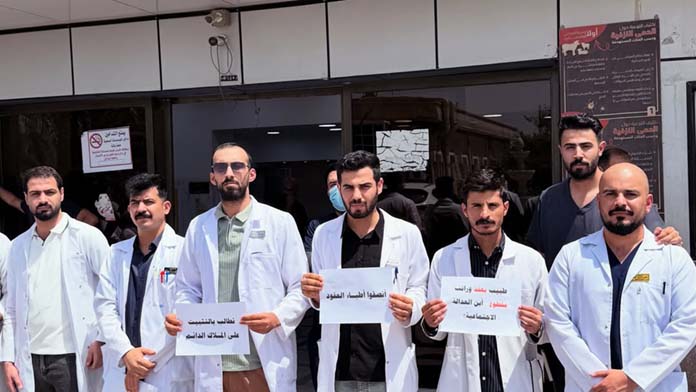
Five thousand Iraqi medical graduates from the class of 2024, now working in the public health sector, staged a national strike from 1 June to 15 June, vowing to continue to fight until their demands are met.
The medical graduates have three core demands: permanent contracts for career advancement, payment for all unpaid working hours and for salary parity with previous graduates.
The 2024 medical graduates had spent two years struggling to secure employment before finally receiving placements at the start of 2026. But from the start, they have been subjected to exploitative conditions and an unsafe work environment—a situation worsened by Iraq’s broader economic crisis. That crisis stems from decades of corruption and mismanagement, compounded more recently by the war on Iran.
As a result, the Ministry of Health has failed to pay any of the 5000 graduates for four to five months of work.
In the months leading up to the strike, the graduates negotiated with the Ministry of Health, held large demonstrations, and staged smaller walkouts to protest their exploitative placements.
The graduates have been working a minimum of 12-hour shifts, five days a week, with on-call duties that can stretch their work shifts to 24 hours—and in some cases as long as 30 hours.
The dramatic cut in pay compared to previous graduates has added to the doctors’ grievances. While previous graduates were employed on permanent contracts with a monthly salary of around AUD$1090, the 2024 graduates are paid just AUD$455 a month on insecure, four-month casual placements that must be repeatedly renewed—on top of going unpaid for four to five months.
Under Iraq’s medical training system, graduates must complete six years of university before progressing toward being a specialist or general practitioner. Advancement requires supervision from doctors at the level above, and senior residents cannot move up until they have trained junior doctors capable of replacing them—creating a hierarchy in which each doctor’s progress depends on the one below them.
Previously, medical graduates were guaranteed permanent placements after finishing their studies. But the 2024 cohort has been placed on casual contracts with no secure career pathway. Chaos in the health system is the result of unregulated numbers of medical graduates, driven by profit-seeking from the over-enrolment of students in the 36 medical colleges, combined with the Ministry of Finance’s failure to budget for 2024 graduates.
Iraq’s education and health systems that were destroyed by the American occupation have been replaced by US-style, neoliberal, profit-driven restructuring made even worse by the Covid-19 pandemic.
Footage circulating online shows hospitals standing empty as a result of the strike. While some patients have expressed anger at the disruption, the striking graduates argue that their ability to provide adequate health care depends on the government providing adequate pay, staffing, and working conditions.
Actions
The graduates began their strike on 1 June. On 8 June, thousands marched from the Ministry of Finance building to the Ministry of Health building in Baghdad.
The Ministry of Health threatened to tear up the casual contract of any graduate who continued striking. But the 2024 graduates did not back down. The government then tried to get the 2025 graduates to scab by offering them casual contracts on $AUD650. But the 2025 graduates rejected the government’s offer, declaring their solidarity with the striking 2024 graduates.
The doctors’ strike was suspended on 15 June, with the start of public holidays and the beginning of Islamic month of Muharram.
But the fight is not over. Other health workers are taking action. The pharmacists union and the dentists union have called a joint strike for 18 June in support of the unemployed dental and pharmacy graduates of 2023, 2024 and 2025.
The struggles of the health workers have rocked Iraq. They have shown how to win a real alternative to the corrupt, neoliberal capitalism that has left Iraq without adequate health services while health workers are left unemployed.
By Ali Al-lami