
Workers in Spain rose up to stop a fascist coup 90 years ago, sparking the civil war. This put revolution on the agenda—but holding it back led to defeat, argues Peter Robinson
The Spanish Civil War still resonates through the decades. It provides an inspirational example of the heroism, creativity and self-organisation of workers. Everything was possible.
When the English writer George Orwell arrived in Barcelona in December 1936 he wrote, “It was the first time that I had been in a town where the working class was in the saddle. Practically every building of any size had been seized by the workers and was draped with red flags or with the red and black flags of the anarchists; every wall was scrawled with the hammer and sickle and with the initials of the revolutionary parties.”
The Spanish Civil War is usually portrayed as a battle between fascism on one side and democracy on the other. But this was a workers’ revolution whose crushing led directly to defeat for the republic and decades of fascist rule in the Spanish state. The questions it posed are still fundamental to our movement: how best to fight fascism; our attitude to the state and how to fight for socialism.
The anti-fascist forces combined liberal republicans, social democrats, communists, revolutionary socialists and anarchists, and they all battled to increase their own political, ideological and military influence.
The global depression following the 1929 Wall Street Crash produced political polarisation. Many workers moved to the left, galvanised by the example of the Russian Revolution. Ruling classes, desperate to defend their own interests, often resorted to brutal repression.
Fascism’s rise seemed unstoppable. In Germany Europe’s best organised labour movement had failed to stop Hitler. Instead of calling for working class unity against fascism, the German Communist Party accused social democrats of being “social fascists” for propping up capitalism. The labour movement was split with catastrophic consequences.
Alliances
By the mid-1930s, with the Second World War on the horizon, Communist Parties, directed by Moscow, backflipped. Now they sought to make broad alliances in order to create a bulwark against the threat of German invasion. Russian leader Stalin was desperate to ally with capitalist imperial powers, especially Britain and France. Communist Parties were encouraged to enter alliances with not just social democrats but also capitalist parties that opposed fascism. This appealed to many, but in practice maintaining unity meant the interests of the working class became secondary.
In 1936 democracy in Spain was only five years old. Spain was backward economically—industrial capitalism had developed mainly in just a few cities. Big business, the church, army and landowners looked with fear at the rights and social reforms workers were demanding.
The popular front government was elected in February. Alongside the Communists the reformist Socialist Party was a key component. Their power base came from the moderate trade union, the General Union of Workers (UGT) which claimed up to 1.5 million members.
But the popular front was dominated by middle class republican parties. Previous republican governments had instituted some moderate land reforms and made concessions to the regional aspirations of Catalonia, although not the Basque Country. Ultimately, however, their aim was to strengthen Spanish capitalism.
Nevertheless, workers celebrated the popular front victory, immediately raising demands for reforms and organising strikes. Within months, sections of the ruling class acted decisively. The army rose up and tried to overthrow the republican government.
The man who came to lead the fascists was General Francisco Franco who was head of the Spanish Army of Africa based in Morocco.
What Franco had not anticipated was a spontaneous revolutionary anti-fascist uprising. When the government refused to distribute weapons, the trade unions called a general strike and workers stormed military barracks in order to arm themselves. They managed to repel the army, and in the process took control of several major cities.
The hastily organised volunteer militia units commandeered trucks and left the cities to prevent the rebel advance.
In the political vacuum, neighbourhood workers’ committees organised healthcare, food, transportation and public safety. In the areas they controlled, workers took over the factories and much of the land. In Barcelona, for example, 80 per cent of industry was collectivised and in eastern Aragon up to 400 agricultural collectives were established.
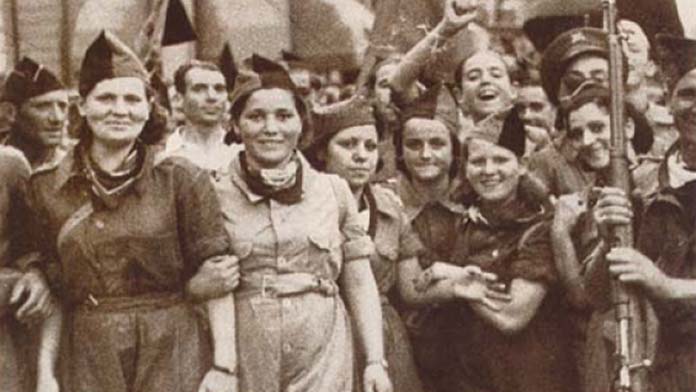
In a state previously dominated by the repressive Catholic church, women gained new freedoms. Women now participated actively in politics by joining workplace cooperatives, anti-fascist committees and armed militias. They fought alongside their male comrades at the front. Other gains included information on birth control and limited legalisation of abortion.
The main organisation pushing the revolution forward was the National Confederation of Labour (CNT). The anarcho-syndicalist trade union was deeply rooted in the working class, especially in Barcelona, with about one million members.
The anarchists steadfastly rejected political parties and standing for elections. For them, revolution meant controlling the streets, factories and land, not political institutions. Nevertheless it supported the popular front government and an anarchist was even appointed minister for health and welfare the following November. This disoriented their rank and file—were they for revolution or stability?
In Barcelona, Lluis Companys, head of the Catalan regional government, met CNT leaders less than a week after the attempted military coup. He told them, “Today you are masters of the city and of Catalonia… You have conquered and everything is in your power; if you do not need or want me as president of Catalonia, tell me now.”
Debated
The CNT regional committee then debated whether to take power. They voted against. It would mean substituting one form of dictatorship for another, they argued, and they were not prepared to take on dictatorial powers. The Russian revolutionary Leon Trotsky’s verdict was damning:
“To renounce the conquest of power is voluntarily to leave the power with those who wield it, the exploiters. The essence of every revolution consisted and consists in putting a new class in power, thus enabling it to realise its own program in life. It is impossible to wage war and to reject victory.”
The other important group was the Workers Party of Marxist Unification (Poum), a small, recently formed revolutionary socialist party. It was led by Andreu Nin, a former member of the Communist Party (CP), who had been expelled from Russia as a member of the Left Opposition to Stalin.
Nin had links with Trotsky, but Trotsky criticised the Poum heavily from his exile in Mexico, particularly for signing the popular front pact in early 1936 and entering the Catalan government the following September. The Poum argued to build an alternative revolutionary power based on workers’, peasants’ and fighters’ committees and the construction of a red army modelled on the one Trotsky led in defending the Russian Revolution.
But with about 3000 to 5000 militants, it was small and, fearing isolation, ended up tailing the CNT, propping up the crumbling republican state instead of fighting for a revolutionary alternative.
The CP had 20,000 to 30,000 members at the outbreak of the war. Now it was arguing that the revolution was a distraction and radical actions would only alienate moderates, the middle class, and business who they were desperate to stop going over to the fascist side. One CP official wrote that socialisation and collectivisation were “not only not desirable but absolutely impermissible”.
Britain, France, Germany, Italy, Portugal and Russia all signed a Non-Intervention Agreement, supported by the US. They agreed not to supply arms or personnel to either side. Nevertheless, Germany and Italy immediately flouted the agreement by shipping weapons, aircraft and thousands of troops to bolster the fascists.
Russia was the only country to provide arms to the republic. Controlling the distribution of these weapons greatly increased the Communist Party’s influence in Spain.
War and revolution
The outcome depended on the type of warfare they used. Was it to be an orthodox or revolutionary war?
Trotsky wrote at the time, “A civil war is waged, as everyone knows, not only with military but also with political weapons… To accomplish this it is only necessary to advance the program of the revolution.”
Franco controlled about 50 per cent of the land. A revolutionary war could have included a program of land redistribution to win the peasants over. Commitments to regional independence for Catalonia and the Basque Country could have ensured the adherence of wavering supporters there.
Another option was to grant independence to Morocco, which Franco was using as a base of operations. This was discounted for fear of alarming the imperial powers, particularly France, which controlled neighbouring Algeria.
Instead the Communist Party insisted on centralising the army and repressing the revolutionary struggle in order to keep the capitalist republican forces onside. In May 1937 in Barcelona they sought to disarm the militias in order to decapitate the revolution and consolidate their own power. At this time perhaps four fifths of Barcelona was in the hands of anarchist and Poum militias.
After six days of street fighting the CNT, fearing undermining anti-fascist unity, convinced their members to disarm. The Poum was outlawed and Nin, along with scores of his comrades, was tortured and then murdered. Hundreds more filled republican jails. Many of the gains of the revolution were reversed. Collectivised estates and factories under workers’ control were returned to individual owners or taken over by the state and churches reopened.
Three years of war brought carnage with around 100,000 executions by the fascists and post-war repression that claimed the lives of tens of thousands more. Around half a million refugees fled to France and were interned in terrible conditions. There followed 36 years of fascist rule. The church regained its former power and women were thrown back into the home with their freedoms ripped from them.
The republican government’s refusal to wage revolutionary war led to a terrible defeat for the working class. This was ensured by the counter-revolutionary actions of the CP and the ideological shortcomings of the anarchists.
Far right and fascist parties are on the rise again, with France’s National Rally, the AfD in Germany and Reform UK all leading in the polls and now One Nation’s surge here. We all owe it to the heroes of the Spanish Revolution to learn from their struggle.