
A coronial inquest into the police killing of Muluridji man Aubrey Donahue has heard disturbing evidence about the moments leading up to the shooting.
While official findings are months away, what came out at the hearings in Cairns last month paints a damning picture of police violence and the racism of the system.
Muluridji man Aubrey Donahue was shot dead by police on 25 March 2023 in Mareeba in Far North Queensland.
He had locked himself in a bathroom with his partner and was threatening self-harm when officers attached to Queensland’s Special Emergency Response Team (SERT) stormed in with assault rifles and shot him in the head.
The police officer who fatally shot Aubrey initially refused to appear and had to be issued with a warrant for his arrest to finally do so.
Indigenous activist Lizzie Jarrett, who travelled to the inquest from Sydney, explained, “This officer was also involved in the Lindt cafe siege in Sydney. So he’d had lots of experience dealing with hostages. This was a trained officer.”
The officer claimed that before he fatally shot Aubrey a flashbang device was deployed and another officer breached the door, and that he saw Aubrey turn towards him with a knife and, allegedly fearing for his own life, told Aubrey twice to “drop the knife” before shooting him. Absurdly, he said that all this took place in just one second.
“Aubrey’s partner’s evidence from day one was that she never heard a police officer say anything. She said they’d had domestic violence problems in the past. But on that day, she felt no fear for her life, only that Aubrey was going to take his own life,” Lizzie said.
None of the other officers who were there recalled hearing the words “drop the knife”; only that something was shouted into the bathroom before Aubrey was shot. Even the killer cop admitted that, having used a flashbang device, he would expect that “no one would be able to hear basically anything”.
Nor can the words be heard on the only audio recording of the shooting, taken from the bodycam of the negotiator outside the building. There was no bodycam footage from any of the officers inside, as SERT officers did not wear them at the time.
Despite all of this, evidence from the inquest suggested that police concluded that there was insufficient evidence to pursue criminal charges against officers before they had interviewed any of the officers involved. They “made the decision from witnessing only one body worn camera recording”, Lizzie said.
Just two days after the shooting, the President of Queensland’s police union claimed in a statement that, “All police involved in this matter performed professionally, responsibly and with great restraint.”
“The main thing the family were asking repeatedly to every officer that was there that day,” on the day of the shooting “was why no family member was called. They could have had his mother on a phone,” Lizzie said.
On a previous occasion where Aubrey had taken his partner and hid in a ceiling cavity, “The police got in contact with his mother, and she helped de-escalate the situation and helped her son come down and be able to deal with whatever consequences would come from his actions.”
The inquest also heard that a number of reports regarding Aubrey’s mental health were effectively ignored.
Aubrey was on parole at the time of his death and had told a case manager that he was struggling with his mental health and agreed to attend counselling. But no referral was made for him.
Aubrey’s mother contacted corrective services the month before his death to raise concerns about his wellbeing and again just two days before. During the inquest, the regional manager for Queensland Corrective Services said that families did not often raise such concerns, and that it should be taken “quite seriously”. But corrective services made just two attempts to call Aubrey, and despite those attempts failing, never tried to visit him at home.
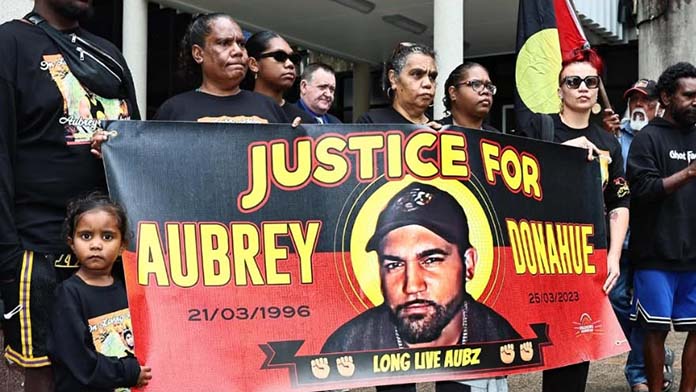
Aubrey’s family and friends attended the court each day of the hearings and held a rally the day after it ended.
Lizzie said, “The family’s hoping, once the transcripts [of evidence] come and you can see the failures that ended up costing a young man’s life, that there is a push for a re-investigation,” and charges against police.
In May, police announced there would be no charges over the killing of Kumanjayi White by an off-duty police prosecutor in an Alice Springs supermarket in 2025. A coronial inquest will begin in April next year.
In a statement, Kumanjayi White’s grandfather and Warlpiri elder Ned Hargraves said that, “Our family has gone through too much—just too much trauma. And now you’re making us go through another coronial inquest. The whole system needs to change.”