

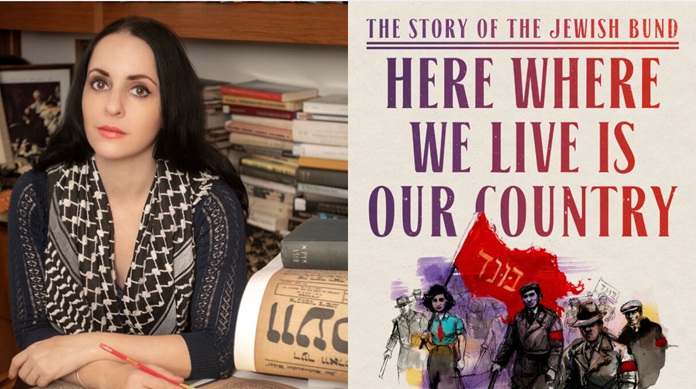
US author Molly Crabapple is speaking to sold-out audiences in Melbourne and Sydney on a speaking tour this month hosted by the Jewish Council of Australia.
It’s a fascinating opportunity to hear about her book, Here Where We Live is Our Country, and its impact on the debate about Zionism.
Crabapple relates the story of the Bund, the mass Jewish socialist organisation that led major struggles in the Russian Czarist empire and in what later became independent, pre-war Poland.
She told the Melbourne audience that her research and writing had been driven by her anger over the Israeli genocide in Gaza.
While the Bund had stood firm and fought the antisemites, capitalism and the Holocaust, the Zionists had urged Jews to flee to Palestine and become colonisers at the Palestinians’ expense.
The Bund played a major role in the Warsaw Ghetto uprising against the Nazis in 1943. Meanwhile, the Zionists had spent the past three years trying to liquidate the Gaza ghetto, using the Holocaust as justification.
I recommend the book. It’s a stinging rebuttal of Zionist claims to represent the mass of Jews, now and in the past.
Doikayt
The Bund, founded in 1897 as the General Jewish Labour Bund in Lithuania, Poland and Russia, was made up of thousands of working-class Jews.
Critically, they rejected the Zionist argument that antisemitism was eternal and that Jews had no choice but to move to Palestine and establish a colony at the expense of the Palestinians.
Their watchword was Doikayt (“hereness”), a word in the Yiddish language of the Eastern European working class that summed up the fierce determination to fight the antisemites and the capitalists and to refuse to be driven from where generations of ancestors had lived.
The Bundists organised unions, strikes and campaigns, often with Polish (non-Jewish) socialists. They also created a vibrant culture of writing, theatre and the arts in Yiddish.
Mostly young, they were enormously courageous fighters. Crabapple, whose great-grandfather was a Bundist leatherworker and artist, introduces us to a cast of revolutionary characters otherwise lost to history.
There was Itka, memorialised in a painting by Crabapple’s great-grandfather throwing a rock through a window. Virgil Kahan, a 22-year-old who led the building of street barricades in Lodz. Bernard Goldstein, who organised Warsaw workers into a self-defence militia. And many more.
Crabapple made the point in Melbourne that while Zionists often portray themselves as strong and powerful and the Jews of Eastern Europe as weak and ineffectual, the Bundists showed exemplary courage and commitment.
The chapters on the Bund in Poland between the two world wars are some of the most useful and compelling in the book.
There is much here to admire.
Outflanked
However, in forging an exclusively Jewish organisation, those brave young women and men cut themselves off from the task of a united working class revolution against Czarism and capitalism.
In 1903, their delegates walked out of the congress of the Russian Social Democratic Labour Party, which at that point united all Marxists in the Russian empire.
The Bund insisted on its exclusive right to organise Jewish workers. This ran counter to the argument put forward by Lenin the previous year in his pamphlet What is to be Done that it was the responsibility of all revolutionaries to challenge all forms of oppression—whether of women, of oppressed nationalities or of Jews.
The Bund was comprehensively outflanked by Lenin’s Bolsheviks, who went on to lead the October 1917 workers’ revolution and in doing so to win the allegiance of large sections of the Jewish working class.
Crabapple’s book is weakest in dealing with this conundrum. At the Melbourne meeting, she criticised the Bund for, in her words, flouncing out of meetings and refusing to risk taking power. She cited the 1903 congress but also the Bund’s refusal to fight for influence in the soviets (workers’ and soldiers’ councils) after the October revolution.
However, she cannot account for major flaws in Bundist politics: counterposing a constituent assembly to the soviets and arguing for revolutionary Russia to continue fighting the war with Germany and Austria.
It’s an issue I addressed earlier this year in a talk given at a seminar put on by Anti-Zionism Australia, the video of which is embedded below.
Schmaltzy
Crabapple’s book has contributed to a revival of interest in the Bund—for its rejection of Zionism and its commitment to socialist internationalism.
But the Bund today effectively does not exist. Its mass base was persecuted by Stalin and then all but wiped out by the Nazi Holocaust. Its remnant in Melbourne is no more than a schmaltzy Yiddish sentimentalist society that has not once spoken out against the genocide in Gaza.
The historic Bund’s fighting spirit and refusal to endorse the ethno-nationalist Zionist colonial settler state in Palestine is inspiring nonetheless.
With Crabapple, let us celebrate the Bund’s radical anti-Zionist history. But we should recognise, too, Bundism’s limitations. The struggle to bring down capitalism and destroy antisemitism, along with all forms of racism, still needs the Bolshevik tradition.
By David Glanz
Here Where We Live is Our Country: The Story of the Jewish Bund, by Molly Crabapple. Bloomsbury (2026).
Solidarity also recommends The Radical Jewish Tradition: Revolutionaries, Resistance Fighters and Firebrands, by Donny Gluckstein and Janey Stone. Bookmarks (2023). Buy it here.