
One Nation’s Victorian campaign launch opened not with promises to address the cost-of-living crisis, but with an AI-generated video depicting a Sudanese man with a machete, a Middle Eastern man with a bomb strapped to him and an Aboriginal person describing how they are paid on the basis of identity rather than merit.
Racism is at the centre of One Nation’s rise and in Victoria hysteria about crime is fuelling it.
Victorian Labor is in crisis. Anger over the cost of living has seen it plunge in the polls. New Premier Ben Carroll has done everything possible to distance himself from his hated predecessors, driving around Victoria in a big red truck emblazoned with “new premier, new direction”.
But this “new” direction is the same one Labor was already heading in: to the right. Carroll has called a royal commission into the CFMEU and promised to slash government spending, responding to a ruling-class campaign blaming the decline of public services and the cost-of-living crisis on overspending and debt.
Labor shifting working-class anger to the right has relied on a racist media onslaught about crime, particularly targeting Sudanese youth.
Under Jacinta Allan, Labor responded by ripping up its own 2023 bail law reforms to look “tough”, introducing new laws that remove the requirement to consider remand as a last resort for children.
This has made racism a central political issue. A recent poll found that 33 per cent of respondents nominated the state’s economy and finances as their highest voting priority, while 24 per cent picked crime and policing.
Carroll’s attempts to further tighten bail laws and expand police powers have not convinced anyone that Labor has the answers on crime. Instead, they have fed the racism of the Liberals and One Nation, who are positioning themselves as the answer to Sudanese youth, Indigenous people and Palestine supporters.
Meanwhile, Labor is emboldening the Liberals’ racist plan to scrap Treaty by destroying Djab Wurrung sacred trees and defying the Treaty body’s intervention against Labor’s bill denying prisoners their legal entitlement to at least one hour in the open air each day.
Unions and anti-racism
Sections of the union movement, including Victorian Trades Hall, have campaigned against One Nation’s anti-worker credentials but avoided confronting their racism.
Combined with an unwillingness to organise strikes against Labor to win better wages and conditions, this has given One Nation space to grow.
The firefighters are a stark example. They are furious at Labor over ageing, faulty firetrucks, a six-year wage freeze and attacks on safety. The United Firefighters Union is campaigning to “put Labor last”.
While it has not formally endorsed One Nation, it has indicated support, claiming that “[One Nation’s Victorian leader] Warren Pickering has made some significant statements about firefighter safety—and we support those who support us.” Among members, racism and support for One Nation are at fever pitch.
But anger at Labor does not have to go to the right. Anti-racist campaigning and workplace organising can shift it to the left.
Anger at the growing crisis in schools enabled Fight the Crisis, a rank-and-file teachers and school staff group, to push their union into strikes against Labor over pay and conditions this year. The group has also demanded that the school funding shortfall be addressed by abandoning the $1.6 billion committed to locking children up under Labor’s bail laws.
Teachers are legally required to remain politically neutral at work. But Fight the Crisis has used Department policy opposing racism to organise a week of action teaching against racism.
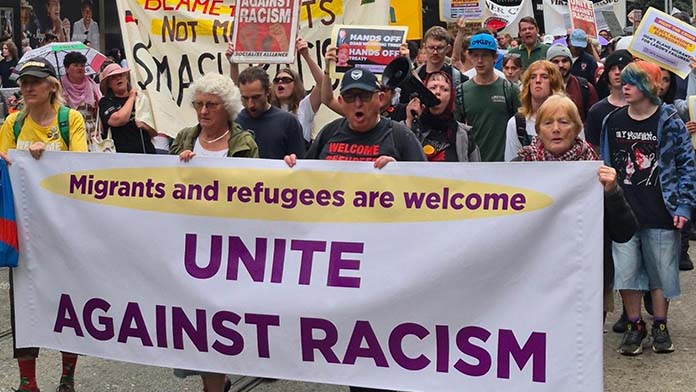
This campaigning has been reinforced by Unite Against Racism, a new coalition that organised two rallies in October: against One Nation on 24 October, and against the racist Australia Marches on 1 November.
The rally against One Nation mobilised up to 350 people and received endorsements from the state branches of the AEU, NTEU, MUA, AMWU and ASU, as well as Bendigo Trades Hall Council.
Building on the AEU’s endorsement, Fight the Crisis mobilised four school sub-branch banners, alongside flags from the AMWU and ASU.
The following week, 250 people counter-protested against Australia Marches, a racist group calling to “end mass immigration”.
These marches help build the confidence to oppose racism directly, at a time when many accept the idea that how-to-vote cards and conversations on the cost of living are the only way to turn workers away from One Nation.
Taking the momentum of anti-racist campaigning into unions and building stronger fightbacks against whichever party is in power after November remains key to stopping the far right’s growth.
By Casey Forsyth