

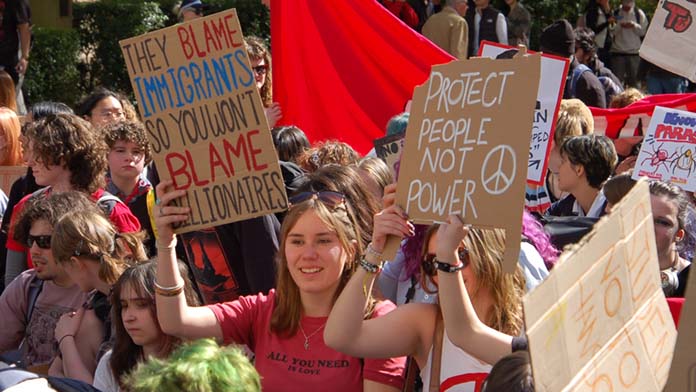
Immigration Minister Tony Burke has announced measures designed to cut immigration, pandering to the idea that migration is responsible for the housing crisis and letting One Nation’s racism set the political agenda.
The government will launch increased efforts to track down and deport visa overstayers, with 100 extra compliance officers and the opening of at least one new detention centre in Melbourne.
This will mean targeting asylum-seekers denied protection visas who have become unlawful as well as those on expired tourist or student visas.
But the government’s main targets are international students and backpackers on working holiday visas.
Labor is demonising international students as “visa hopping” to try to stay in the country. But studying here, after paying huge student fees, is a recognised pathway to staying permanently. It helps provide skilled workers that bosses want.
International students will now be able to extend their visa only if switching to a course at a higher level. And moving to a different education provider will require a new visa.
Those studying here will also be barred from bringing partners and children with them, apart from PhD students and those from the Pacific and ASEAN countries.
In July and August the government also slowed and then quietly stopped processing working holiday visa applications from 24 countries.
It will now introduce a ballot for those who want to stay on for a second and third year, with only 5000 places for the third year compared to 31,000 who qualified last year. It plans to reduce the number of backpackers by almost 40,000.
Labor is desperate to ensure it meets its target for net overseas migration, the overall increase in population each year from immigration. It wants to reduce this over two years to 225,000 from around 292,000 currently.
But its plans will do nothing to solve the housing crisis. Most backpackers stay in hostels and share houses. They are required to spend time working in regional areas, meaning they are often in temporary accommodation.
Many international students live in student accommodation and some are forced into overcrowded apartments with shared bedrooms. A study by academics at the University of South Australia last year found that increased numbers of international students between 2017 and 2024 had no impact on rent prices.
Anthony Albanese was forced to rule out plans to reduce the refugee intake following an outcry from refugee organisations and his own backbench MPs.
But Labor still hopes to cut immigration further. It reportedly wants to remove the right to work for asylum-seekers appealing the rejection of their claims and reduce their appeal rights.
But this would require legislation, which has stalled after the Coalition made demands including a ban on refugee claims from countries deemed safe, the deportation of all unlawful non-citizens and criminalising assistance to return to Australia of people like the wives and children of former Islamic State fighters.
Response to One Nation
Burke presented Labor’s approach as a middle course opposed to One Nation’s demands, cutting immigration while also defending it as important for business.
He said he was opposed to “drastic cuts” because this would only “hurt the economy”, and defended immigration as necessary to bring in the construction workers needed to build more houses.
Labor is trying to appease opposition to immigration and support for One Nation. It has constantly repeated that it is getting the numbers of migrants down.
This is a capitulation to claims that immigration has driven up the price of housing and rents, fuelling the racist idea that migrants are some sort of threat. In September, Newspoll found that 66 per cent wanted less immigration.
But even Burke admitted that the number of houses built in the past 20 years has outpaced population growth. He pointed to fewer people living in each home, especially after COVID, as a bigger problem.
The unaffordable price of housing is not due to immigration. Policies benefiting wealthy investors and the failure to build public housing are to blame. The surge in house prices began in the early 2000s after the Liberals introduced incentives for investors through capital gains tax and negative gearing.
Labor’s modest effort to unwind this will only slow the growth in housing prices. But they need to come down dramatically to make them affordable. House prices compared to average annual incomes have doubled from four times income in the early 2000s to eight times today.
Nor is Labor doing anything to reverse the decline in public housing and the retreat of governments from building houses themselves.
Acting on this is what’s needed to undermine One Nation’s racism and put an end to unaffordable housing and rents.
By James Supple