

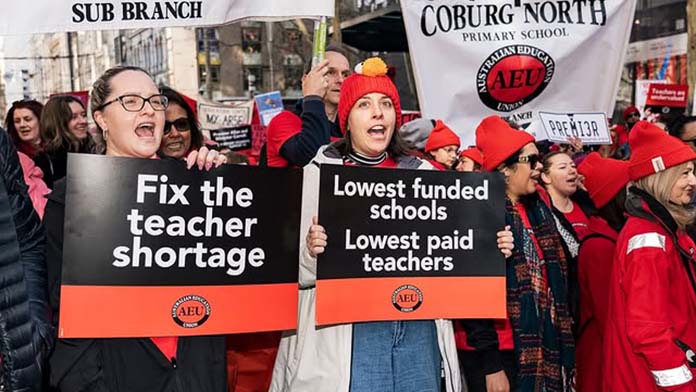
Victorian teachers and education support staff took strike action again on 23 July, with schools across the state severely affected. About 20,000 marched in a display of raw anger at conditions in schools.
When they saw the turnout as photos went around on apps, many teachers who hadn’t planned to attend rushed to join the lively and militant march.
The pressure to restart strikes and fight for more is a product of relentless rank-and-file organising, pushing the AEU leadership.
After teachers decisively rejected a deal that the leadership argued for in June, the leadership refused to call further action and instead surveyed members about next steps. But rank-and-file group Fight The Crisis immediately began pushing for another strike on 4 August.
Members registered 90 per cent support for another 24-hour strike and 75 per cent support for multiple strikes in the survey.
Shocked, the leadership responded by calling the strike in July. This went ahead after union members rejected a new offer by 51.18 to 48.82 per cent, with about 90 per cent of the membership in Victorian government schools taking part in an electronic vote.
The Department of Education sent the offer to each staff member individually, at the same time as it notified the union. This was a clear attempt to undermine the union’s authority and pressure the AEU leadership to accept it.
It was a marginal improvement on the previous offer, rolling in Education Support “annual allowances” into base salaries—something the Department said could not be done.
The AEU leadership put the offer to members without recommending a vote one way or the other at short notice. Many members cited the lack of proper process in deciding to vote No, while for others the deal did not go far enough, still offering the same pay over four years, and no movement on class sizes, support staff job descriptions or face-to-face teaching time.
Strike three
But after the strike, the AEU leadership missed an opportunity to set a deadline for the government to respond by announcing a new strike date.
Fight The Crisis continued to campaign for a strike on 4 August, as a third strike day. More than 40 individual AEU sub-branches passed a motion committing to this, as well as Maribyrnong Region.
The AEU had already authorised stop-work action to conduct publicity, leaflet parents and walk off the job if a Labor MP visited the school. Fight The Crisis used this to provide legal cover and contacted sub-branches to organise a walk-off, independently of the AEU leadership.
AEU Victoria branch secretary Erin Aulich came down hard. She sent a letter to every sub-branch that had passed the 4 August motion to strike for a third time, calling the action “unprotected” and “illegal” and telling members they would be subject to $20,000 fines. The Department of Education also sent letters to Principals threatening that the 4 August strike was unlawful.
This had the intended effect of leaving sub-branches feeling fearful or concluding that now was not the time to confront the anti-union Fair Work Act. The debate came to a head at the Inner City Regional meeting on 29 July where a large number of delegates and members mobilised to decide whether to strike on 4 August.
At that meeting, Aulich announced that AEU leadership would call for a third strike at the branch council that Friday. This gave cover to Socialists In Schools to support the leadership by amending the motion to remove a commitment to strike on 4 August, with members confident that leadership would call another strike.
With the AEU leadership under pressure from sub-branches and no negotiations since the July strike, it has called a strike for 19 August, four weeks after the last strike. The idea is to give the Victorian Government plenty of time to make a new offer and time for members to consider it before moving to strike again.
But this lifts the pressure from the Victorian government, which can now dictate the pace of negotiations. Ben Carroll, the Education Minister, now also Premier, has made his contempt for school staff absolutely clear throughout this campaign with multiple unacceptable offers to school staff who are burning out and looking for solutions.
Rank-and-file activists are determined to keep up the pressure. Fight The Crisis is campaigning for local, disruptive actions that use the local stop-works authorised by the AEU. This can keep members mobilised at a local level and keep the issue in the media.
Teachers’ rank-and-file organising shows how to get the union fightback needed to deal with the crisis over cost of living and conditions at work—and to show there is an alternative to both Labor’s failures and One Nation.
By Jonathan Sherlock, AEU member and Fight The Crisis activist
Keep in touch through the Fight the Crisis Instagram here