

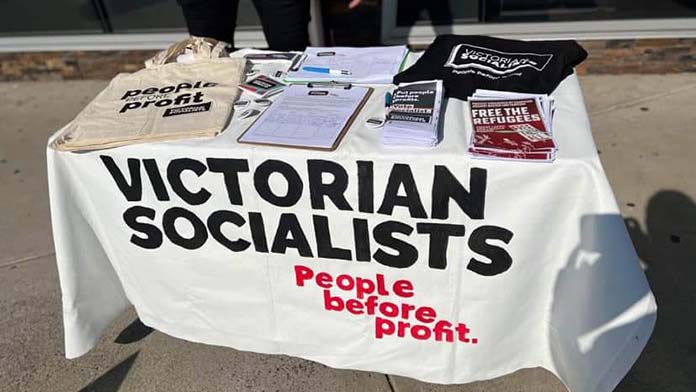
Ian Rintoul argues that the Victorian Socialists’ Manifesto and election campaign relies on reformist politics instead of making any attempt to argue for or connect with struggles
The prospect of One Nation winning a significant number of seats in the Victorian election in November is frightening. Some polls are predicting they could take up to 15 seats.
This is the context for the Victorian Socialists’ considerable electoral campaign, running candidates in all 88 lower house seats. Hundreds of members have been mobilised to doorknock electorates. In August, Corey Oakley, secretary of the Victorian Socialists, was even suggesting that “we have a serious chance of getting our Northern Metro and Western Metro candidates into parliament.”
The Victorian Socialists recognise the threat of One Nation. Their Socialist Manifesto for real change opens with the threat of One Nation’s advances leading to a “greater normalisation of far right politics.”
So you might think that the fight against One Nation would be a big part of their manifesto. But you would be wrong. There is nothing in the manifesto about actually fighting One Nation.
According to the Manifesto, “Victorian Socialists is the alternative.” Everything in the Manifesto is about voting, “In November, we are putting forward a vision of hope, solidarity and working-class unity.”
“Putting a socialist in parliament” is a legitimate tactic for revolutionary socialists. But just electing a socialist is not going to beat Pauline Hanson. A socialist electoral strategy needs to be one part, a subordinate part, of an overall strategy for social change that looks to the power of the working class in the streets and workplaces.
Parliament is the high-point of capitalist democracy, but it hides the reality of capitalist class rule. We might get a vote every three or four years for parliamentary representatives but there is no economic democracy; no vote on who runs the factories or the call centres; no vote on the police or the judges. As the old saying has it, “Whoever we elect, the bosses rule.”
The separation of politics and economics underpins capitalist parliamentary democracy. The economic struggle is confined to trade union activity while the political realm is confined to parliament.
Overcoming this division and arguing for the working class to use its industrial power for political ends is an essential element of socialists’ argument to challenge capitalism. But the Manifesto does nothing to disturb the idea that parliament is the fundamental arena of change.
The Manifesto says, “We hope we can play a role in limiting [One Nation’s] gains, but more importantly we hope that there’s also a surge in the socialist vote that’s impossible to ignore.” There is nothing about how the vote is going to turned into action.
Every socialist has to answer the questions: Is activity in parliament directed towards encouraging and strengthening mass struggles outside of parliament? Or are those movements subordinated to a supporting role for the socialists elected to parliament?
The Victorian Socialists answer is the entirely reformist one, “building more powerful movements for change outside parliament is the only way change can be won inside parliament”! And, “Our solution isn’t merely to elect socialist parliamentarians … it’s to have those parliamentarians do everything they can to build the socialist movement outside parliament to back up their efforts within it.”
When the Manifesto does talk about “being active” (struggle doesn’t get a mention), they talk about themselves (ie Victorian Socialists) being active, not building and supporting wider struggles.
One example of activity they use, the recent Victorian teachers’ industrial campaign and the role of Socialists in Schools, is particularly telling. The sectarianism of Socialist Alternative that controls Victorian Socialists unfortunately is manifested in the exclusive membership of Socialists in Schools (SIS). Membership is limited to members or supporters of Victorian Socialists; so no non-aligned members, no Labor supporters, no other socialists.
It is an approach that cuts SIS off from other left-wing activists in the union and places a singular importance on Victorian Socialists’ membership, not on building the struggle of rank-and-file workers.
It also puts the lie to the Victorian Socialists’ claim that they are “putting forward a vision of working class unity”.
The drastic political failure of SIS during the recent teachers dispute in Victoria has been dealt with elsewhere—suffice to say here that SIS failed the most elementary test of solidarity when they mobilised to oppose fellow union members from calling stopwork action and then scabbed on local sub-branch stopwork actions.
At a key moment in the campaign where the union leadership was close to wearing down members into accepting a deal, their priority focus was on elections.
On the Victorian Socialists’ website this is spelled out: “Socialists think that the teachers and education support staff … should run the school system. That’s why teachers who have helped lead the recent rank-and-file rebellions against the Department of Education and the leadership of the AEU are setting their sights on parliament.” (my emphasis).
No connection with struggles
The overarching political methodology of the Victorian Socialists is also thoroughly reformist. The demands are typical politicians’ “promises”, a grab-bag list of policies that the Victorian Socialists think might get them votes, but have no possibility of delivering. Among the list: A state bank and a publicly-owned energy operator; free publicly-owned child care, free school lunches, free public transport, free to air sports coverage including all AFL games. None of these policies are remotely able to be delivered by electing even two or three Victorian Socialists to parliament.
Their policies are not concerned with connecting to, or mobilising, actual local or working class struggles. So there is no demand to cut ties with Israel to connect with the pro-Palestine movement, or to connect with the wave of strikes against the Labor government by raising the need for a fight to break Victoria from the shackles of the federal industrial relations system that restricts the right to strike.
In the fine print they say that they will introduce “an immediate 2.5 percent above inflation pay increase for nurses”, which of course they can never deliver; but there is nothing about organising the industrial campaign needed to break the government’s wage cutting pay cap.
As the left-wing Queensland Greens member and former local councillor Jonathan Sri noted comparing The Greens and the Victorian Socialists, “In the 2025 federal election, you could’ve swapped the names and branding on the two parties’ flyers and few people would’ve been able to tell the difference.”
But perhaps Sri is too generous. The Victorian Socialists’ core flutes say “Vote for Real Change” while The Greens at least have some concrete demands like “Tax the Big Emitters.” The Victorian Socialists are touting a “vision” for socialism, but it’s a top-down vision. They have nothing to say about the political ideas or the struggle needed to fight for real change.
The Manifesto is more evangelical than political. A vision does not create an audience for revolutionary socialist politics. Ideas need to be connected to everyday aspirations and the real demands of ordinary people. People have no reason to listen to us unless we are prepared to show that we can fight around the issues that matter.
Socialists have to wage concrete struggles over wages, opposing cuts, racism and over Palestine to show that there is an alternative to Labor’s management of capitalism and to One Nation’s racist scapegoating of migrants.
In Brunswick, the Victorian Socialists candidate says she hopes the election produces a few more confident socialists. But she had nothing to say about ASU members fighting for months for an EBA at Merri-bek Council, which covers the area.
The door-knocking priorities of the Victorian Socialists were starkly on display in early October when the Victorian Socialists were conspicuous by their absence from the anti-racist rally at One Nation’s election launch.
The Manifesto says “there are glimmers of hope. Millions of people in recent years have voted for parties like the Victorian Socialists.”
The real glimmers of hope in terms of struggle—the hundreds of thousands who marched for Palestine across Sydney Harbour, the struggle to drive ICE out of Minneapolis, the port workers’ strikes in Europe to stop arms to Israel—don’t get a mention.
There are no shortcuts. Lenin argued in Left Wing Communism, which was in part an argument for socialists participating in elections, that “for the working class to be won to revolution propaganda and agitation are not enough … for the working class to be won to revolution they must have their own political experience. Such is the fundamental law of all great revolutions.”
To do this a revolutionary party, he went on, must have the ability “to link up, maintain the closest contact, and—if you wish—merge, in certain measure, with the broadest masses of the working people”. Combined with this, correct political leadership, strategy and tactics can win workers to revolutionary politics “provided the broad masses have seen, from their own experience, that they are correct”. In short, leadership in struggle is crucial.
It is impossible to understand the Victorian Socialists’ approach without recognising it as an extension of the abstract propagandism long practised by Socialist Alternative, the group that controls the Victorian Socialists.
Instead of a focus on connecting socialist politics with workers in struggle and organising the rank-and-file, or building broad movements with a life of their own, their focus is on trying to win individuals to socialist ideas in the abstract.
The outcome of the Victorian elections will have national implications. But the outcome of the Victorian Socialists’ campaign, not so much. People will be horrified by One Nation winning seats. One Nation is already setting the national political agenda as both Labor and the Coalition make concessions to One Nation’s anti-migrant racism.
To the extent that the Victorian Socialists’ campaign helps to limit One Nation’s vote, it will be useful. But people are going to vote socialist, Greens and Labor to try to keep the Coalition and One Nation out of parliament.
The task for socialists is to tap that real anti-racist mood and build a movement that both fights racism and poses a real alternative to Labor and the cost of living crisis. The movement to defeat One Nation will need to unite revolutionaries and reformists of all stripes, together in struggle.