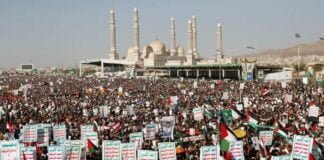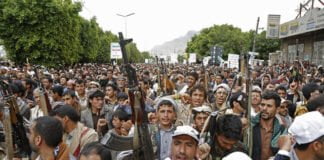

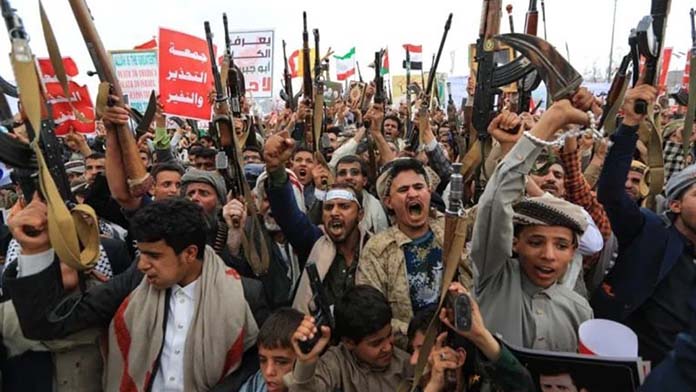
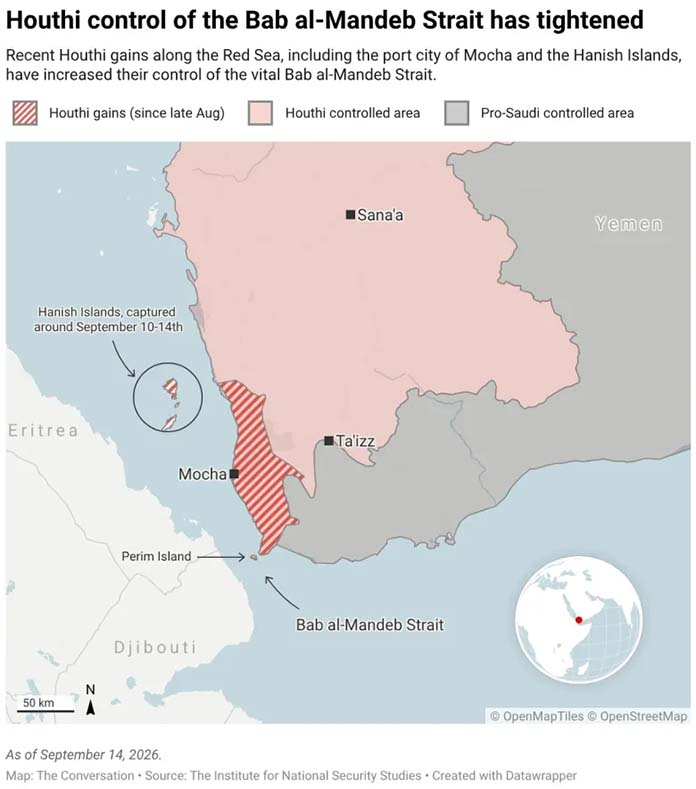
The crisis created by the US and Israel attacking Iran has spread from the Persian Gulf to the Red Sea, with Iran’s allies in Yemen seizing control of the Bab al-Mandab Strait.
The Ansar Allah (Partisans of God) movement, commonly referred to as the Houthis, has won control of the entire west coast of Yemen, allowing it to interdict tankers carrying oil produced by its enemy, Saudi Arabia.
The result has been another spike in world oil prices, even as the US has had some success in moving oil through the Strait of Hormuz.
Higher petrol prices are causing political pain in the US and Australia. The price of fertiliser, highly dependent on oil prices, is also higher than for most of the past three years, pushing up the cost of food.
The Ansar Allah forces, which hold the national capital Sanaa, made gains amid an upsurge in fierce fighting with the internationally recognised government, based in the southern city of Aden and backed by neighbouring Saudi Arabia.
The conflict is threatening to draw in Saudi Arabia’s allies, further destabilising global trade systems and raising the risk of a more general war.
Casualties
The human cost of the fighting in Yemen is rising, in a country where civil war between 2015 and the start of 2022 led to more than 377,000 deaths.
The World Health Organization has documented 838 deaths and another 3600 casualties since 6 August. The UNHCR reports that fighting has displaced more than 100,000 people, with some Yemenis fleeing across the Red Sea to Djibouti.
At the beginning of the month, Saudi-backed government forces said they carried out hundreds of attacks on Ansar Allah forces.
Meanwhile Ansar Allah missiles have hit both government forces and Saudi oil and military facilities.
There is a real risk of the conflict spreading. Turkey, Pakistan, Saudi Arabia have activated the Mecca defense pact, and will deploy forces to Gulf kingdom against Houthis.
France is sending troops and radar systems to protect the Saudi Red Sea oil export hub of Yanbu. Britain is sending an RAF Voyager aircraft to refuel Saudi jets in the air, allowing them to remain in action longer.
Foreign Ministers from the G7 nations—Britain, Canada, France, Germany, Italy, Japan and the United States—issued a statement on the sidelines of the UN’s General Assembly calling on Iran to end its arming and support of Ansar Allah.
Last month, Donald Trump rejected two requests in one day from Saudi Crown Prince Mohammed bin Salman that the US attack Ansar Allah.
He held off partly because Ansar Allah has promised not to harm US shipping in the Bab al-Mandab Strait. But it also reflects the way the war against Iran has weakened US imperialism.
However, the US is starting to show its ally more support. There are more than 100 US military advisers in Saudi Arabia providing intelligence, geospatial targeting support and battlefield technology for the campaign against Ansar Allah.
Axios reported that in the last two weeks of September, the US military provided the Saudis with more than 200 Ansar Allah targets to strike. And on 2 October, cabinet members met at Camp David to discuss next steps in the Iran war and the conflict in Yemen.
Saudi-UAE rivalry
The situation is further complicated by Saudi Arabia and the UAE backing different “official” government factions in the south.
Lebanese socialist Simon Assaf told Socialist Worker in Britain, “The thing we need to do is place this in a wider context—in terms of the retreats of United States’ imperialism, everything is up for grabs.
“The Saudis were always the bulwark of reaction in the Middle East but the UAE is now a competitor. They are both trying to spread their influence, trying to position themselves amid a weakening of US hegemony.
“The UAE has its fingers everywhere—Libya, Sudan—and in projecting this regional power they are treading on the Saudis’ toes, especially over who has control of Aden.”
Amid this rivalry, the hope for Yemeni workers and peasants rests on a revival of the revolutionary spirit of 2011. Rural communities had been hit by the collapse of agriculture, while urban professionals and workers suffered rising prices.
As part of the broader Arab Spring, rural and urban communities rose in a mass movement against an autocratic elite. Sadly, their rising was diverted into a new, pro-US government.
But for a short while, ordinary Yemenis showed the potential to take events into their own hands and bring real change.
By David Glanz