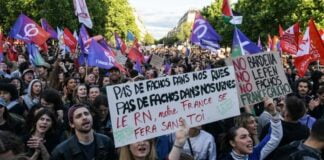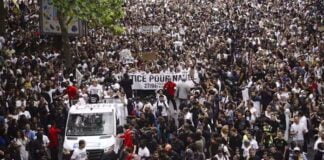

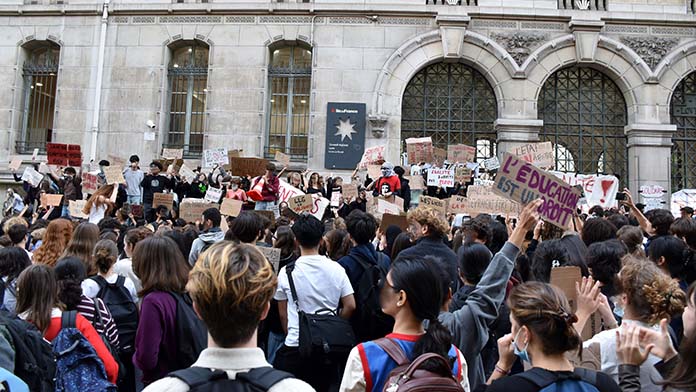
Since the beginning of October, a huge wave of struggle has erupted across France. Protests that began as a revolt against the terrible conditions in France’s public school system have become a broader movement, demanding more social spending, standing for Palestine and immigrants’ rights and against both police violence and the far right.
Similar mass protests and strikes have broken out across Europe, in Italy, Spain, Portugal, Germany and Albania.
The students have every right to be angry. School buildings have been severely neglected, with classroom temperatures as low as 5 degrees in winter and 40 degrees in summer, a lack of tables for students and cockroaches crawling from classroom walls.
The government has proven incapable of dealing with this situation. Prime Minister Sebastien Lecornu announced his intent to address government debt through $86 billion in cuts to pensions, education and other social spending while leaving military spending untouched.
Things came to a head on 28 September. Public sector workers resolved to strike against the budget cuts. Students joined them, blockading hundreds of schools to protest learning conditions. Student blockades spread to more than half of all French high schools and 90 per cent of universities. They were joined by groups of striking health, railway and education workers.
The students were met with incredible violence from the police, urged on by the government. One 14-year-old had his jaw blown off by a tear gas grenade and hundreds were arrested. Anger spread through the French working class because of this police brutality.
The largest marches on Saturday 17 October saw over 800,000 people join 1000 protests across France. Huge demonstrations have continued every weekend.
The movement has linked together the struggle for Palestine and opposition to the fascist RN with the fight against cuts and austerity. It has united workers and students.
Crucially, it has shown the power of a mass movement on the streets to shift politics. The protests are a break with the mainstream parties and the idea that elections are the only way to win change. They have boosted Jean-Luc Melenchon, leader of the radical left LFI in the polls. What’s more, the government has been forced to offer concessions—although they do not go far enough.
Le Pen and the fascists have also been exposed as siding with the authorities against the mass of the population on the streets, backing the police and calling for more law-and-order measures.
Police violence
The protests have also exposed the role of the police. Police have employed brutal violence to try to break the protests, using tear gas, “non-lethal” ordinance which has killed and maimed protesters, and water cannons. Cops have openly sided with fascists who have come through to wreck rallies on the streets.
The French state and media have attempted to undermine the movement by blaming rioting and property damage on a supposed radical faction of protesters (“breakers”), hell-bent on destroying buildings and businesses. But the smashed shop windows and looted stores are an outpouring of frustration against a system which denies basic needs and a future to young people.
And violence was the result of the disgusting conduct of police. At the 17 October march in Paris, police tried to prevent people accessing the protest meeting point through relentless use of tear gas before the protest had even begun.
The protests did not come from nowhere. In recent years, France has seen several waves of struggle, from the Gilets Jaunes (yellow vests) in 2018, to mass strikes over pensions in 2023. These movements won some concessions and showed how mass protests can weaken the government. However, these waves of revolt ended prematurely because the leaderships of the union federations failed to escalate the strikes and wound down the struggle.
The general strike set to be held on 5 November as we go to press is very encouraging. The possibilities of the current wave of struggle across France are immense—but the stakes are also high.
Marine Le Pen’s fascist National Rally (RN) continues to lead polls for the presidential election next April and racists have been emboldened by the government’s condemnation of the riots.
For the movement to go further it needs to trigger more serious and widespread workers’ action: including longer and more frequent strikes as well as workplace occupations.
To avoid a repeat of the past, workers must organise themselves from below, rather than allowing union leaders to direct the struggle.
As a member of the CGT union in Fos-Sur-Mer said, “Our rights are the fruit of our struggles. We must keep defending them collectively. That very much includes the general strike on 5 November. And afterwards? Let’s see, let’s see …”
By Maya MacNamara