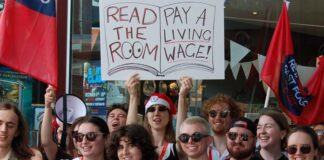

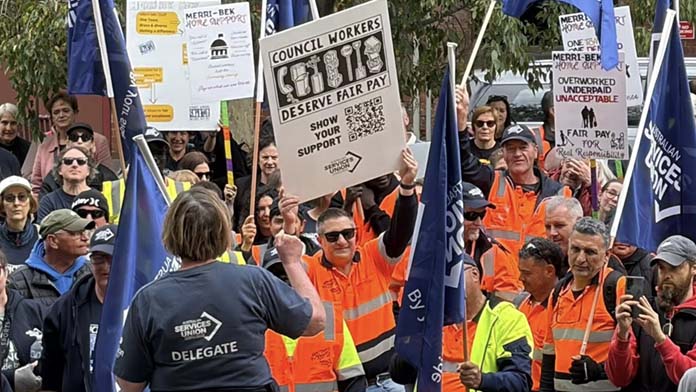
Wages are going backward as the cost of living keeps rising. Australia’s economy is also faltering. But all the answers being pushed by business and the mainstream media will mean workers are hit even harder.
Inflation rose to 4.3 per cent in September, delivering wage cuts in real terms for most workers.
Real wages have dropped by 7 per cent since March 2021 and the Reserve Bank estimates it will take another decade to reverse the losses. That means workers face 15 years with no real pay rise.
One third of households experienced food insecurity in the last year, an increase of 100,000 from the previous year to 3.6 million households, according to Foodbank.
Another survey found 12 per cent of the population are skipping meals to save money, while half are searching harder for discounts or cheaper meals.
The Reserve Bank’s answer to this is to force up interest rates and demand cuts in government spending.
But Trump and Albanese’s war on Iran is the main reason prices are rising. Higher interest rates do nothing to reopen the Strait of Hormuz, as many have noted. Petrol prices jump 9.4 per cent in the month from August to September.
So the Reserve Bank’s sledgehammer aimed at the economy is simply reckless. It means more workers lose their jobs as higher interest rates deliberately slow the economy.
Unemployment is up to 4.7 per cent and would have risen to 5 per cent in September if people had not given up looking for work altogether.
It also squeezes anyone paying off a home loan. The repayments on a median-sized home are at levels not seen since interest rates were at 15 per cent in the late 1980s, as a share of household budgets.
There are even fears it could drive the economy into outright recession.
The Reserve Bank claims there are “supply constraints”, meaning that too much demand for goods and not enough supply is driving up inflation. But increasing unemployment and weak economic growth point in the opposite direction.
Business groups are also blaming the economic slowdown on low productivity growth. They want more attacks on workers’ rights under industrial relations laws and even less restrictions on, for instance, the spread of AI data centres.
Stop Labor’s cuts
There is growing ruling class pressure on Labor to impose budget cuts, with claims that government spending is driving inflation.
The Business Council of Australia’s Bran Black called for cuts to public sector jobs and business regulations while the Liberals have demanded an end to climate and renewable energy programs.
But most government spending goes into vital services such as healthcare, aged care and schools. Cutting it makes life harder for workers—either forcing people to pay more to access services themselves or to go without. (One exception is surging military spending.)
Federal government spending has been rising as a percentage of the economy, to 26.9 per cent of GDP from 25.1 per cent in 2023. This comes even as Labor imposes major cuts to the NDIS and pushes below-inflation wage rises in the public service.
Former Reserve Bank Governor Philip Lowe has even said the government should be running a “sizeable” budget surplus instead of the current deficit, which would mean well over $30 billion in cuts.
Treasurer Jim Chalmers may be pushing back against the pressure to slash the budget by defending Labor’s spending. But he has also promised to deliver more cuts in the budget update in December.
Tax the rich
The real solution is to tax the rich. Australia is a low tax country even by international standards.
If the tax take grew to the average among the OECD club of developed nations government revenue would jump by $100 billion.
That is double the amount the government currently spending on the NDIS, schools and JobSeeker payments combined.
The money is there. A 2 per cent wealth tax on anyone with more than $5 million could raise $41 billion a year, reintroducing inheritance tax, $10 billion, and completely scrapping the capital gains tax discount, $19 billion a year, according to the Australia Institute.
A 25 per cent gas export tax, backed by The Greens, David Pocock and the ACTU, would raise $17 billion a year.
Reversing privatisation to bring more services back under government control would also bring down costs for workers and reduce inflation.
Childcare fees for instance have surged due to the free market model that’s opened it up to private profiteering. Yet government subsides make up most of childcare operators’ income. They should be nationalised.
Labor’s willingness to give in to the demands for cuts and appease the demands of big business must be resisted.
We need to fight for higher wages and measures to make sure workers don’t pay for the crisis.
By James Supple