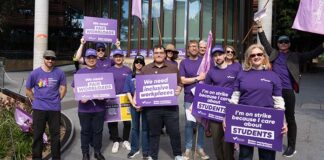

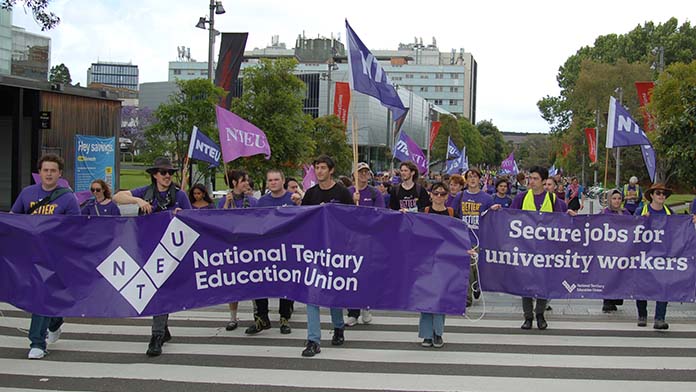
On 22 October, University of Sydney staff walked out on a 24-hour strike, their second this semester. Staff in the NTEU (National Tertiary Education Union) are fighting for a wage increase in line with inflation, greater job security, freedom of political expression, and guard-rails on the use of AI.
Hundreds of staff members attended pickets from 7am to 1pm, shutting the campus down, before gathering outside the quadrangle building for a rally.
“In September, over 500 of us came out to the picket lines with hundreds more supporting remotely”, NTEU member Caitlin Erbacher told the crowd at the closing rally. “And today, we have delivered another successful strike. We’ve shut down this campus, stopped delivery vehicles from entering.”
Incoming NTEU Branch President John Buchanan noted the depth of support for the campaign across campus. “In the last month alone, 100 people have signed up to the union.”
This growth is inseparable from the industrial action taken by the union over the past two months. Since the 2 September strike, USyd management has been forced to offer concessions to staff, especially around provisions for gender affirmation, disability, and Aboriginal and Torres Strait Islanders. There has also been some small progress on academic workloads, de-casualisation and reduction of fixed term employment. However, negotiations around wages, AI, and freedom of speech are at a standstill.
“We need to show management that we won’t be rushed into accepting a subpar agreement or any erosion of our rights”, said Erbacher. “If necessary, we might need to carry this campaign into next year.”
More industrial action will be necessary to force concessions from management. At a 600-strong stop-work meeting held in the week before the strike in October, the Branch President bypassed the Branch Committee to move a last-minute motion to try to call off the strike.
He argued that industrial action was a “finite resource”, and that the strike should be postponed indefinitely until we were stronger. In practice, this would have meant either postponing further strike action until the new year, or winding down the campaign and accepting whatever deal the university offers over the summer break.
Cancelling the strike would have sent a message to management that the branch was ready to fold. Thankfully, the majority of union members voted down the motion and the strike went ahead. It will take a much more fighting approach to rebuild momentum and take the further strike action needed to win fair pay and conditions for staff members.
By Jacob Starling