

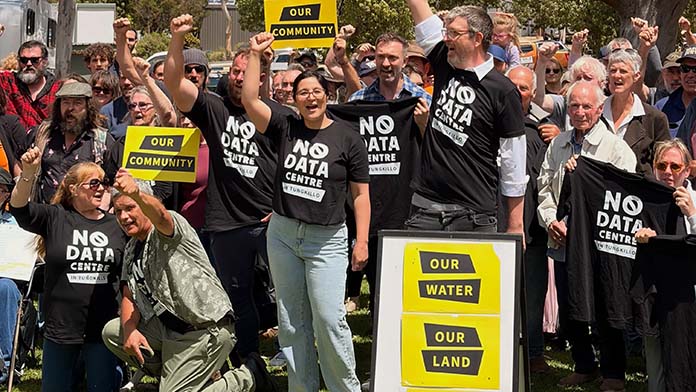
In August, residents of Sanderson Street in Yarraville in Melbourne used parked cars and wheelie bins to obstruct workers trying to install 15 metre power polls.
This work was part of an upgrade to the electricity supply for AI data centre developer NextDC.
The company operates a 60MW facility in nearby Footscray and has applied to increase its capacity to 225MW. This would see the data centre use the same amount of power as 428,000 households.
Locals fronted state and federal inquiries this year detailing the huge disruption of living next to the data centre—including a constant hum and irregular power supply.
The blockade produced delays to the company’s expansion plans. When NextDC announced this, its shares plummeted 41.7 per cent, wiping more than $3 billion from its market value.
Also in October, Australian data centre developer Firmus abandoned plans to float on the stock market. The company is backed by the giant US chip manufacturer NVIDIA, the most valuable company on Wall Street.
Firmus was expecting the float to raise $44 billion, which would been the second largest in Australian history after Telstra in 1997, despite annual revenue of only $50 million.
These episodes illustrate the huge resources going towards the data centre roll-out across Australia, but also the growing resistance to it.
Moratorium
In late September, the Goodman Group withdrew plans for a proposed $1.2 billion data centre at Lane Cove on Sydney’s north shore after a concerted community campaign.
Goodman also faces opposition in Guildford in Sydney’s west, where its “Project Pluto” data centre, approved in July, led to a protest meeting of over 200 people on 26 October. Residents spilled out of a Cumberland Council meeting later that week that resolved to campaign against the centre.
Data centres in NSW are considered State Significant Developments, transferring planning powers from councils to the NSW Government’s Independent Planning Commission (IPC).
With 19 data centres in the IPC pipeline and an additional 20 in early assessment stages, the Minns government has promised developers it can turn around approvals in just 75 days.Councils have also been cut out of decision making in Victoria and their peak body has called for a moratorium on all new data centre developments.
At Arncliffe in southern Sydney, Stop the Cooks River AI Project (SCRAP) has held protests against plans by developer Stockland to build a data centre.
This is part of an industrial park development that would destroy some of the last remaining green space on the much-loved local river.
SCRAP rallies have been addressed by representatives from the National Tertiary Education Union (NTEU), concerned about the impact of AI on education and workers’ rights.
The NTEU resolved at its National Council in October to support the call for a moratorium on new data centres, citing “the fundamental unsustainability of AI systems reliant on energy intensive data centres that are already driving a boom in fossil fuel use in a time of climate crisis”.
Out of sight
Albanese has announced that new regulations, to be tabled in parliament before the end of the year, will prohibit data centres in suburban areas.
In Victoria, however, similar commitments only led to a 150 metre buffer zone between housing and data centres.
The biggest data centres planned are already being proposed in industrial parks in working-class areas like Western Sydney, or in regional and remote areas the government hopes will be out of sight and out of mind.
NSW’s biggest proposal is in rural Wagga Wagga—an eye watering $15 billion, 1.4 GW project.
Zerra DC recently announced a 2.4GW project for Dalby in Queensland. Zerra has a partnership with Anthropic, who wants to make Australia its “second home”, and utilise these mega facilities to train its AI models.
Despite initially promising to mandate data centres use renewable energy, Albanese has already conceded that projects in Queensland will be able to draw power from coal-fired power stations.And at rural locations including Moss Vale in NSW, Weddell in the NT and the Kimberley in WA, developers are planning to power data centres with new gas-fired power stations.
Albanese is committed to the mass data centre roll-out, seen as an opportunity for Australian companies to profit and to tmore closely integrate Australia into the US military alliance.
Locating data centres in Australia to power major US AI models is only possible due to AUKUS and other security partnerships with the US, ensuring access to advanced chips and models denied to China and other rivals.
But the industry offers no benefits to ordinary people—and the growing anger about its rush to profit at our expense shows data centre developments can be stopped.
By Paddy Gibson and Caitlin Boyce