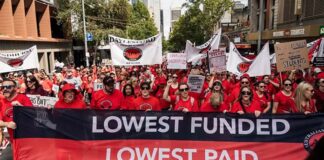

About 600 people, including many council workers, rallied at Martin Place on 18 November to protest the NSW government’s drive to merge local councils across the state. Shouting chants of “no forced amalgamations” and declaring that “local democracy is dead”, the diverse crowd heard speeches from union leaders, councillors, community groups, NSW upper house MPs and shock jock Alan Jones.
The Liberal government is using a mixture of carrot and stick to forcibly cut the 41 metropolitan councils down by half. On the basis of forced council submissions on financial sustainability and residential targets to the pricing regulator IPART, they declared that all but six councils in the metro area are “not fit for the future” and must amalgamate.
The NSW state government claims that “bigger is better” and there will be efficiency gains from larger councils. Yet four out of the five biggest are currently ranked worst in the category of financial sustainability.
Mergers in Queensland, Victoria and New Zealand have shown that the money offered to councils has not been enough to cover the upfront and ongoing costs associated with merging. The real reasons behind the push by the Liberals are to break up Labor hegemony in key council areas, privatise more council-run services and also relax regulation on new developments. Yet many Labor councillors have jumped into bed with the Liberals rather than fight it.
The Liberals are promising low interest loans and one-off payments to councils that agree to merge with their neighbours, whilst threatening to sack those that hold out and replace them with administrators.
Only a strong political and industrial campaign can force the government into a climb down. While a lot of the resident opposition has come from wealthy suburbs, working class areas like Holroyd and Liverpool have also marshalled opposition. There are genuine concerns about further dilution of local representation, deregulation of development and planning, and job losses from the reduction of services.
But the executive of United Services Union, the main union organising council workers, passed a motion declaring that it would only oppose forced mergers, and where there had been community consultation and the councillors voted to merge, it would not oppose it. It appears they may have done a deal on the issue.
So far the community campaign has consisted predominantly of small stunts and petitions. If the unions are going to stop more privatisation and protect jobs, they will need to prepare to mobilise workers in more demonstrations and through industrial action.